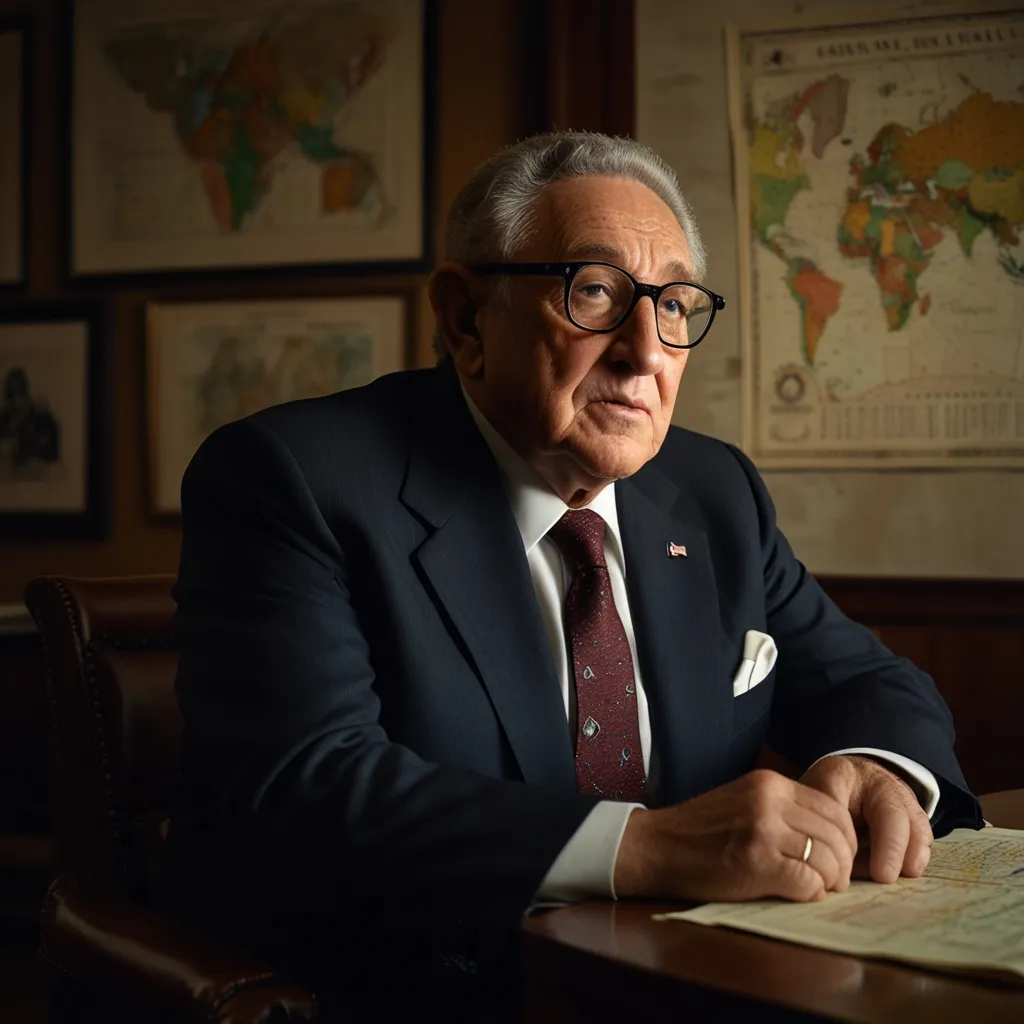
Picturing Henry Kissinger in the midst of a heated debate often tugs at mixed emotions. Some see him as a mastermind diplomat; others, a villain responsible for unimaginable atrocities. His story is a blend of brilliance and brutality that’s almost cinematic in its sweep and scope. We need to unpack his life and impact to get a clearer picture of who he was and what he stood for.
Born in Nazi Germany, Henry Kissinger witnessed firsthand the horrors of oppression as a Jewish boy during Hitler’s rise. Imagine growing up amidst that nightmare. It would mess with anyone’s worldview. His family managed to escape to the U.S. just before the outbreak of World War II, saving themselves by the skin of their teeth. A traumatic childhood like that leaves deep scars. For Kissinger, it birthed a philosophy centered around pragmatism over idealism, a style known as Realpolitik.
Kissinger’s realism was etched deeply into his policies as he climbed the political ladder, eventually becoming the U.S. Secretary of State and National Security Advisor under Presidents Nixon and Ford. His paramount focus was security. For Kissinger, the world was a dangerous place, and America’s safety had to be guarded at all costs.
His role in the Vietnam War hits this point hard. Before officially working for Nixon, Kissinger allegedly leaked confidential information that torpedoed peace talks, elongating the conflict by seven grueling years and adding massive financial and human costs. Then, as Secretary of State, he amped up military operations in Cambodia, a neutral country, leading to bombings that killed hundreds of thousands and wreaked economic havoc. The bombing campaign is even blamed for paving the way for the rise of Pol Pot, the brutal dictator responsible for the Cambodian genocide.
Kissinger’s controversial actions didn’t stop there. In South America, his support for Operation Condor, which aimed to eliminate left-wing leaders through CIA-backed coups, triggered a whirlpool of violence, torture, and authoritarianism across the continent. His willingness to back military regimes involved large-scale human rights abuses, a clear nod to his cold-blooded policy of safeguarding U.S. interests by any means.
He showed the same ruthless pragmatism in Pakistan by supporting military actions against Bengalis, which led to mass massacres. It’s even reported that he expressed satisfaction over these atrocities. Critics, like the diplomat Archer Kent Blood who exposed U.S. support for these genocidal actions, often found themselves silenced or removed from their positions.
More of Kissinger’s handiwork unraveled in Indonesia, where he tacitly supported Suharto’s invasion of East Timor, resulting in a staggering loss of life. This relentless pursuit of U.S. influence left trails of blood and horror across several continents.
However, not all of Kissinger’s maneuvers were draped in bloodshed. One significant instance where his über-pragmatic style had a positive impact was the Yom Kippur War in the Middle East. Acting with acute diplomatic finesse, Kissinger managed to play various sides to the advantage of U.S. interests and ultimately steered towards a somewhat favorable peacemaking effort. He delayed ceasefire negotiations to solidify Israel’s territorial gains and concurrently held off arms shipments to pressurize Israel into agreeing to a peace plan. This balancing act of promises and pressure also helped end the Oil Embargo, positively impacting the West’s economic scenario.
Kissinger’s Middle Eastern diplomacy wasn’t an altruistic move—it was a cold, calculated chess game. Yet, it did avert further devastation in that specific instance, showing a hint of his complex genius.
In the end, Henry Kissinger remains an enigmatic figure—a man of undeniable intellect and strategic acumen yet devoid of a moral compass. His legacy might be more of a cautionary tale, a reminder of the extreme lengths to which policy can be bent in the name of national security. For better or for worse, Kissinger played an outsized role in shaping modern geopolitics, leaving behind a legacy as complex and shadowed as the man himself.