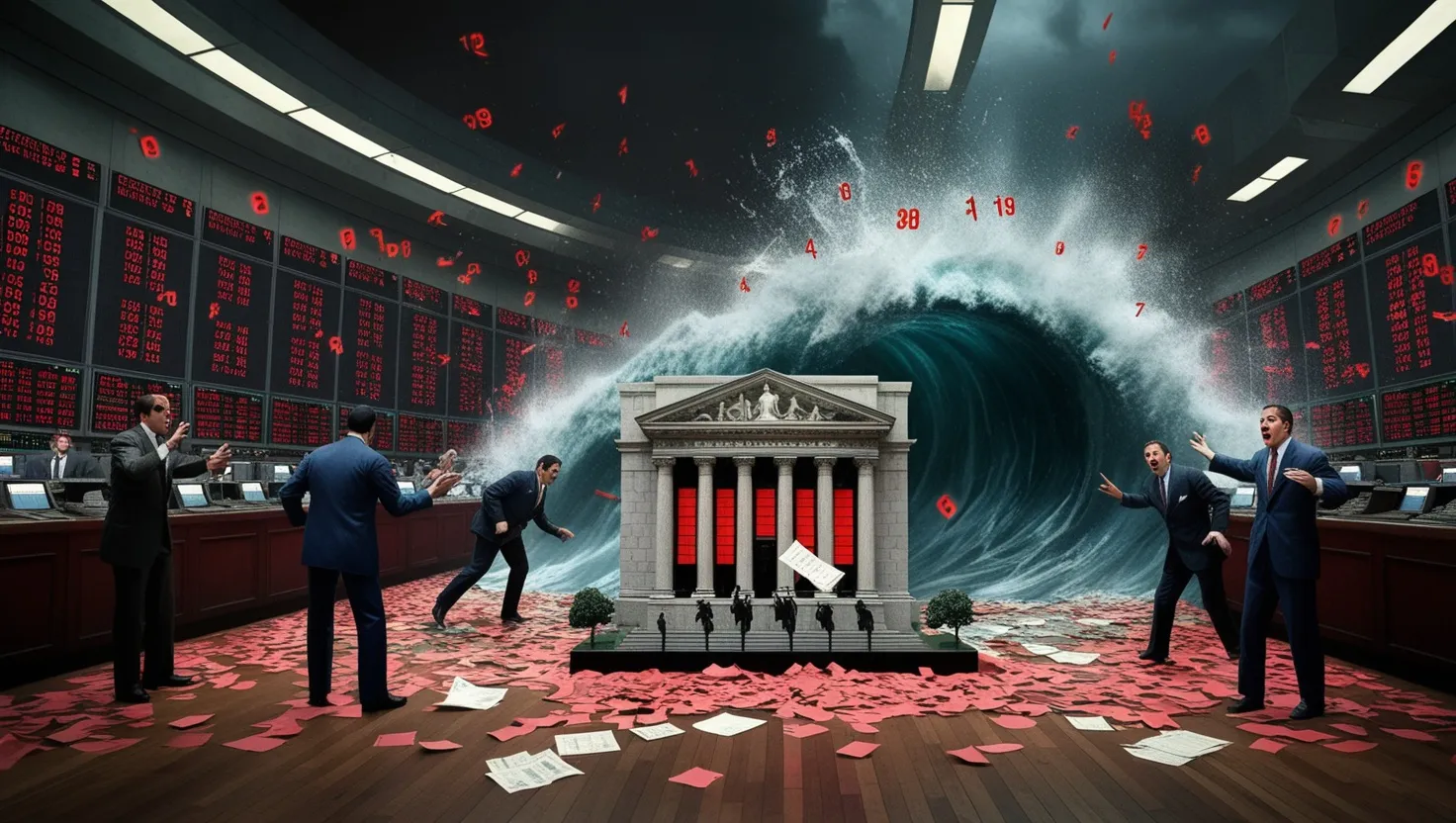
The 1987 Crash: When the Hedgers Became the Avalanche
On October 19, 1987, the Dow Jones Industrial Average fell 508 points. That was 22.6% of its value in a single session. No war had broken out. No major bank had failed. The trigger was a risk-management technique that was supposed to make markets safer. Strange, isn’t it, that the thing built to protect investors became the thing that hurt them most?
The technique was called portfolio insurance. Academic economists built it so pension funds could get the protection of a put option without actually buying one. The idea was simple enough for anyone to follow. As the stock market fell, a manager would sell futures contracts. As it rose, the manager would buy them back. In theory, this created a floor under losses.
But the mechanics rested on a shaky assumption. The strategy treated the market like a calm, endless river. It assumed a manager could always sell at the going price. It assumed stocks and futures moved together. It assumed other investors were not doing the exact same thing at the exact same time.
By 1987, portfolio insurance had become wildly popular. Estimates suggest it guided tens of billions of dollars. Pension funds liked it because it offered downside protection without the cost of buying options. Consultants liked it because it felt scientific and disciplined. The strategy had turned risk management into a formula anyone could follow blindly.
That formula had a loop built into it, and not a friendly one. When prices dipped, the model said sell. When prices fell further, the model said sell more. A small decline was manageable. A large decline demanded a flood of selling. Nobody built the model to handle a crash made worse by its own instructions.
As the famous investor Benjamin Graham once said, “The investor’s chief problem, and even his worst enemy, is likely to be himself.” Black Monday proved this true for entire institutions, not just individuals.
Black Monday delivered exactly that nightmare. Portfolio insurers sold S&P futures in waves. Futures fell faster than the underlying stocks. Arbitrageurs bought the cheaper futures and sold stocks to balance their books. That selling slammed into the New York Stock Exchange. Specialists, the people responsible for keeping trading orderly, were buried. Trades went unexecuted. The gap between futures and cash prices widened by the minute.
The models saw that gap and demanded even more selling. The more they sold, the more prices fell. The more prices fell, the more the models demanded. What began as a hedge had become the very disaster it was meant to prevent. Can a tool designed to protect you ever become the thing that destroys you? History says yes, repeatedly.
The crash forced regulators into action. The Brady Report studied the failure of portfolio insurance in detail. Exchanges introduced circuit breakers to pause trading during extreme moves. The NYSE adopted collars restricting index arbitrage during volatile stretches. Portfolio insurance, as a strategy, quietly disappeared.
But the flaw underneath it never disappeared. It shows up again whenever a risk strategy gets too popular. Three assumptions failed in 1987, and they fail in every panic since. The first is continuous liquidity. Liquidity is not guaranteed by nature. It is a service offered by traders who can walk away exactly when you need them most. The second is stable correlation. Assets that usually move independently can suddenly fall together when fear takes over. The third is independent action. A private hedge stops being private the moment thousands of people copy it.
John Kenneth Galbraith once wrote, “The herd instinct among forecasters makes sheep look like independent thinkers.” The same applies to hedgers who all reach for the same formula at the same time.
Some practical lessons follow from all this. A hedge is only as strong as the market it depends on. If the instrument you rely on can gap, halt, or trade at a steep discount, your protection is nothing but a theory on paper. Mechanical rules, when adopted widely, can turn into systemic threats. A stop-loss order that feels personal and safe becomes a public event when everyone sets the same trigger. Cash, oddly enough, is one of the most underrated hedges available. An investor holding cash is never forced to sell into weakness. That advantage grows larger during a panic, not smaller.
Have you ever wondered why cash feels boring during calm markets but priceless during a crash? That contrast tells you everything about how we misjudge safety when things are going well.
Modern markets carry new versions of the same old pattern. In 2018, inverse volatility products collapsed the moment volatility spiked. In March 2020, risk parity funds and trend-following funds sold aggressively into an already falling market. In cryptocurrency, automatic margin calls cascade across exchanges within minutes, sometimes seconds. Short-dated options concentrate hedging activity around specific days and strike prices. Each instrument looks different on the surface. The underlying structure is remarkably familiar.
Warren Buffett once remarked, “Only when the tide goes out do you discover who’s been swimming naked.” The 1987 crash was the tide going out for an entire industry built on a flawed formula.
The answer is not to avoid hedging altogether. The answer is to understand exactly what your hedge assumes about the world. Ask yourself who takes the other side of your trade. Ask what happens if that counterparty vanishes overnight. Ask what happens if thirty percent of the market starts using your exact rule. Test your portfolio against sudden gaps, not just slow, gentle declines. Favor hedges that do not force you to sell into a falling market. Cash, short-duration government bonds, and assets that are genuinely uncorrelated may feel unglamorous compared to a dynamic trading strategy. They are also far less likely to betray you at the worst possible moment.
Why do smart people keep building the same trap in different clothing? Maybe because confidence in a formula feels safer than admitting the market cannot be fully controlled.
The 1987 crash was not caused by stupidity or fraud. It was caused by a reasonable idea pushed to an unreasonable scale. The market punished the belief that risk could be engineered away through clever mathematics. That lesson still makes people uncomfortable because it offers no tidy solution. It only warns against trusting any illusion of total safety, no matter how elegant the formula behind it looks.