5 Sieges That Shaped Civilizations: From Constantinople to Stalingrad
Discover 5 history-defining sieges — from Constantinople to Leningrad — that reshaped civilizations. Explore the battles that changed the world. Read the full story now.
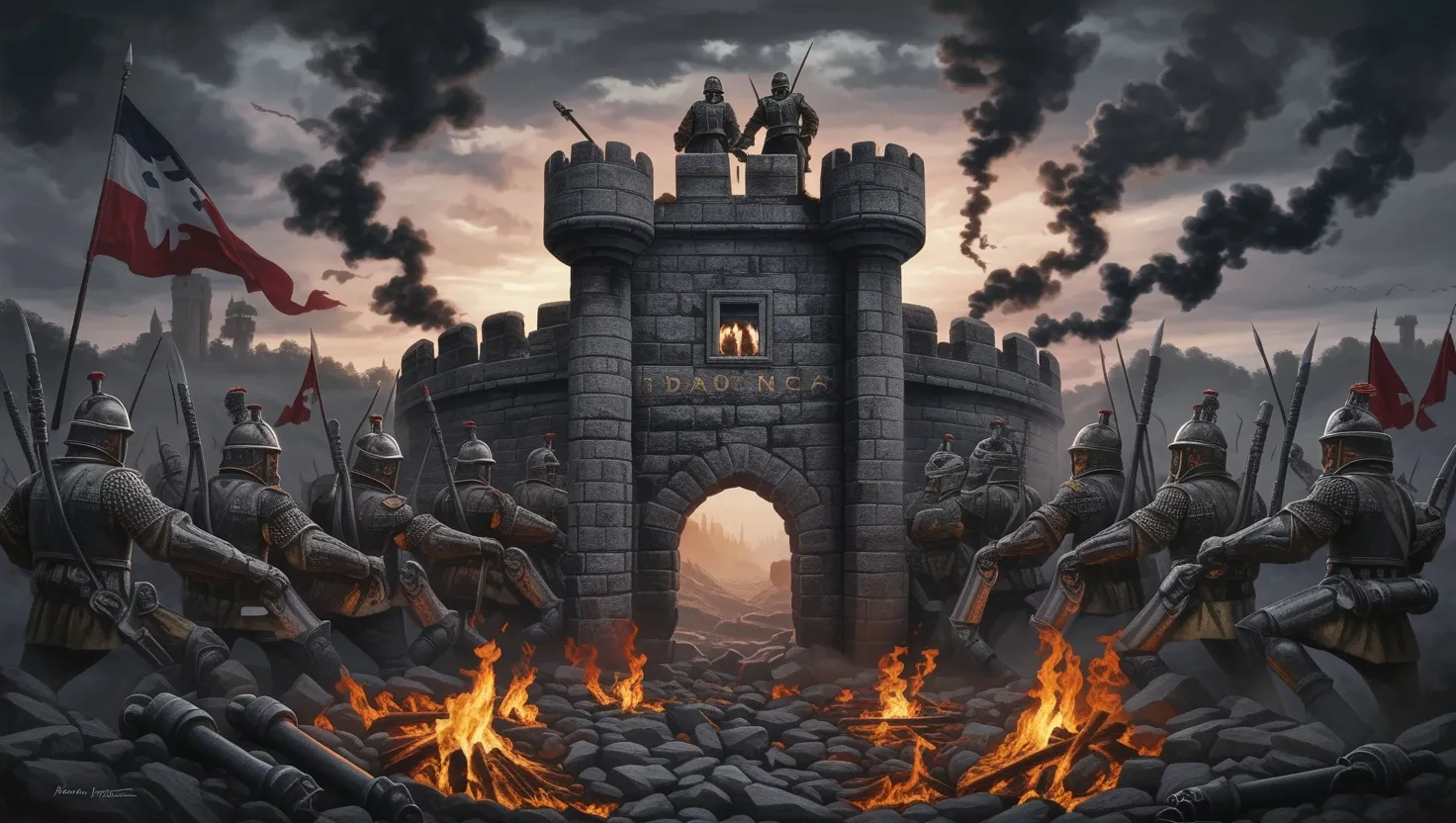
History has a way of compressing itself into single moments. Not battles fought in an afternoon, but sieges — those brutal, grinding contests where armies stare at each other across walls for weeks, months, sometimes years. A siege is history’s most honest stress test. Strip away the politics, the diplomacy, the grand speeches, and what you get is simple: a wall, the people behind it, and the question of whether they can hold.
These five sieges did not just decide wars. They decided what the world would look like for centuries afterward.
Constantinople, 1453 — When a Thousand Years Ended in Fifty-Three Days
Imagine a city that had survived for over a thousand years. Walls so thick and so well designed that every army that came against them eventually gave up and went home. The Theodosian Walls of Constantinople were not just stone — they were a psychological fact. They meant the city could not fall.
Then Mehmed II showed up with cannons.
Not ordinary cannons. The Hungarian engineer Urban built Mehmed a cannon so large it had to be transported by sixty oxen. When it fired, people heard it from miles away. The walls that had laughed off Hunnic and Arab armies were now facing something they were never designed to handle: artillery at close range, firing repeatedly, opening holes that could not be repaired fast enough.
“The fall of Constantinople is a turning point in history — not just an event, but a rupture.” — Steven Runciman
Here is what most people miss about 1453: the defenders actually held for seven weeks. Constantine XI had fewer than 10,000 soldiers against perhaps 80,000 Ottoman troops. He stretched them along miles of wall, patched breaches at night, and kept fighting. The city fell not because the defenders were weak, but because the cannon finally opened a gap at exactly the wrong moment.
The ripple effects were enormous. Byzantine scholars fled west, carrying Greek manuscripts that fed the Renaissance. Trade routes to Asia were now Ottoman-controlled, which pushed European powers to find alternatives. Thirty-nine years later, Columbus sailed west looking for one of those alternatives. You could draw a straight line from Mehmed’s cannon to the Americas.
Tenochtitlan, 1521 — The Siege Nobody Talks About Honestly
Ask yourself this: how does a few hundred Spanish soldiers conquer an empire of millions?
The short answer is that they did not do it alone. When Hernán Cortés besieged Tenochtitlan — the magnificent Aztec island city built in a lake — he had somewhere between 80,000 and 200,000 indigenous allies fighting alongside him. The Tlaxcalans, the Texcocans, and dozens of other peoples who deeply resented Aztec tribute and human sacrifice provided the real manpower.
The siege lasted 93 days. Cortés built small warships, called brigantines, to control the lake surrounding the city. He cut off the causeways. No food in, no reinforcements. The defenders, under the young emperor Cuauhtémoc, fought street by street. And then smallpox arrived.
The disease had preceded the siege, spreading through the population before the fighting even began. Cuauhtémoc himself may have been sick. Thousands died not from Spanish swords but from a pathogen against which the Aztecs had zero immunity.
“Epidemics are the true conquerors of civilizations.” — William H. McNeill
The fall of Tenochtitlan established Spanish colonial rule over Mesoamerica in a way that 300 years of policy, religion, and administration then reinforced. The city was deliberately buried — the Spanish literally built Mexico City on top of it. That act of erasure tells you everything about how the victors understood what they had won.
Malta, 1565 — The Siege That Saved a Continent and Got Forgotten
Here is a test: ask ten educated people what happened at Malta in 1565. Most will have no idea.
The Ottoman Empire in 1565 was the most powerful military force on earth. Suleiman the Magnificent had already taken Belgrade, Rhodes, and much of Hungary. His fleet, under the admiral Piyale Pasha and the corsair Dragut, carried roughly 30,000 to 40,000 soldiers to the tiny island of Malta, held by the Knights Hospitaller and perhaps 6,000 defenders.
The siege was extraordinarily violent. The Ottomans fired cannonballs the size of cartwheels. They attacked the fort of St. Elmo for weeks, suffering losses that shocked even experienced commanders. When the fort finally fell, the Ottoman commanders had the defenders’ bodies crucified and floated across the harbor. The Knights responded by beheading their Ottoman prisoners and firing the heads from cannons.
What kept the Knights going? Partly their fortifications, which were brilliantly designed. Partly their commander, Jean de Valette, who was 70 years old, had survived Ottoman captivity as a galley slave, and apparently had no fear of anything. When a cannonball landed near him during the fighting, he reportedly kicked it aside and kept walking.
“Courage is not the absence of fear, but the judgment that something else is more important than fear.” — Ambrose Redmoon
A Spanish relief force arrived in September. The Ottomans, exhausted and depleted, withdrew. The central Mediterranean remained open to Christian shipping. Italy was not invaded. And Jean de Valette built a new city on the island, naming it Valletta — the only European capital named after its military commander.
Stalingrad, 1942–43 — The City That Ate an Army
Do you know what the German Sixth Army expected when they entered Stalingrad? A quick fight. Their commander, Friedrich Paulus, thought the city would fall in days.
What they found instead was a concept Soviet commanders called Hugging — closing the distance between their own troops and the Germans so tightly that German air support and artillery became useless. You cannot bomb a position when your own men are twenty meters from the enemy. The Soviets literally grabbed the Germans by the belt.
The fighting went into buildings, then into floors within buildings, then into individual rooms. The Soviets held the western bank of the Volga with their backs literally to the water. Every night, reinforcements and ammunition crossed the river under fire. A famous Soviet sniper, Vasily Zaitsev, recorded over 200 kills during the siege. The psychological effect on German soldiers of fighting for a single house for a week, then losing it, then taking it back, was catastrophic.
Then in November 1942, the Soviet Operation Uranus encircled the entire German force. Nearly 300,000 men were trapped. Hitler refused to allow a breakout. Paulus surrendered in February 1943 — the first German Field Marshal ever to be captured alive.
“Not one step backward.” — Joseph Stalin, Order No. 227
The myth of German military invincibility died in Stalingrad. The Soviets lost more people in that one siege than the United States lost in the entire war. The numbers are almost impossible to process.
Leningrad, 1941–44 — 872 Days of the Unthinkable
What would you do if your daily food ration was 125 grams of bread? That is about four thin slices. For most of the Siege of Leningrad, that was what civilians received. And much of it was not really bread — it was cellulose, sawdust, whatever could be mixed with a tiny amount of flour.
The German Army surrounded Leningrad in September 1941 and did not leave until January 1944. Over a million civilians died, mostly from starvation and cold. People ate leather, boiled wallpaper paste, caught and ate every cat and dog in the city, and then kept going. The bodies of the dead were sometimes left in apartments by families too weak to carry them downstairs.
And yet the city kept producing tanks. Workers in the Kirov factory assembled artillery while German shells hit the building. The factory floor and the front line were sometimes the same place.
What does that tell you about human beings? That under conditions which seem completely impossible, communities can organize themselves around a shared purpose and simply refuse to stop. The Siege of Leningrad became the defining experience of an entire generation of Soviet citizens. It created a psychological debt that shaped Soviet — and later Russian — identity in ways that still matter.
“A man can be destroyed but not defeated.” — Ernest Hemingway
These five sieges cover five centuries and four continents, but they share something simple at their core. Each one was decided not by the size of the army outside the walls, but by what happened inside — the food supply, the leadership, the collective decision to keep going or give up.
Every wall is just stone. What matters is who stands behind it, and why.