Humans have always treated oceans like highways and rivers like inherited land. But when geography refuses to cooperate, some people wait for a better route. Others pick up a shovel and rewrite the map entirely.
Canals are not just ditches full of water. They are political statements. They say: we refuse to be limited by what nature gave us. And the five waterways explored here did something far bigger than shorten a sailing trip. They moved food into hungry cities, shifted the financial center of entire continents, and exposed one uncomfortable truth — the person who builds a passage does not always get to keep it.
China’s Grand Canal: Water as a Weapon of Unity
Think of China in the seventh century. You have a massive country, split by mountains and valleys, with a hungry northern capital and a food-rich southern region that might as well be a foreign country. The Sui dynasty emperor did not build a wall to solve this problem. He built a waterway.
The Grand Canal connected the fertile south to the political north. Rice, silk, salt, and soldiers moved along it like blood through a body. But here is the part most people miss — the canal was not just about trade. It was about control.
“The canal is the spine of China. Without it, the empire becomes a collection of strangers.” — Chinese historical record, paraphrased from Tang-era governance texts
When a northern army could eat southern rice without depending on local warlords to hand it over, the emperor’s grip tightened. When a southern merchant could send goods to court without being robbed on a mountain road, loyalty followed money. The Grand Canal turned a collection of very different cultures, speaking different dialects and observing different customs, into something that felt like one nation. Geography did not make China a country. Water did.
France’s Canal du Midi: A Tax Collector’s Obsession
Here is a question worth sitting with. What do you do when your country has two coastlines but sailing between them means going around an entire foreign nation?
Louis XIV had exactly this problem. The Atlantic sat on France’s western edge. The Mediterranean on the east. To get from one to the other by ship, you had to sail around Spain, through waters patrolled by enemies and cursed by bad weather. The king wanted a shortcut through his own territory.
What made the Canal du Midi strange is who actually built it. Not a military engineer. Not a royal architect. A tax collector named Pierre-Paul Riquet, who had spent his private hours obsessing over how water moved through hills.
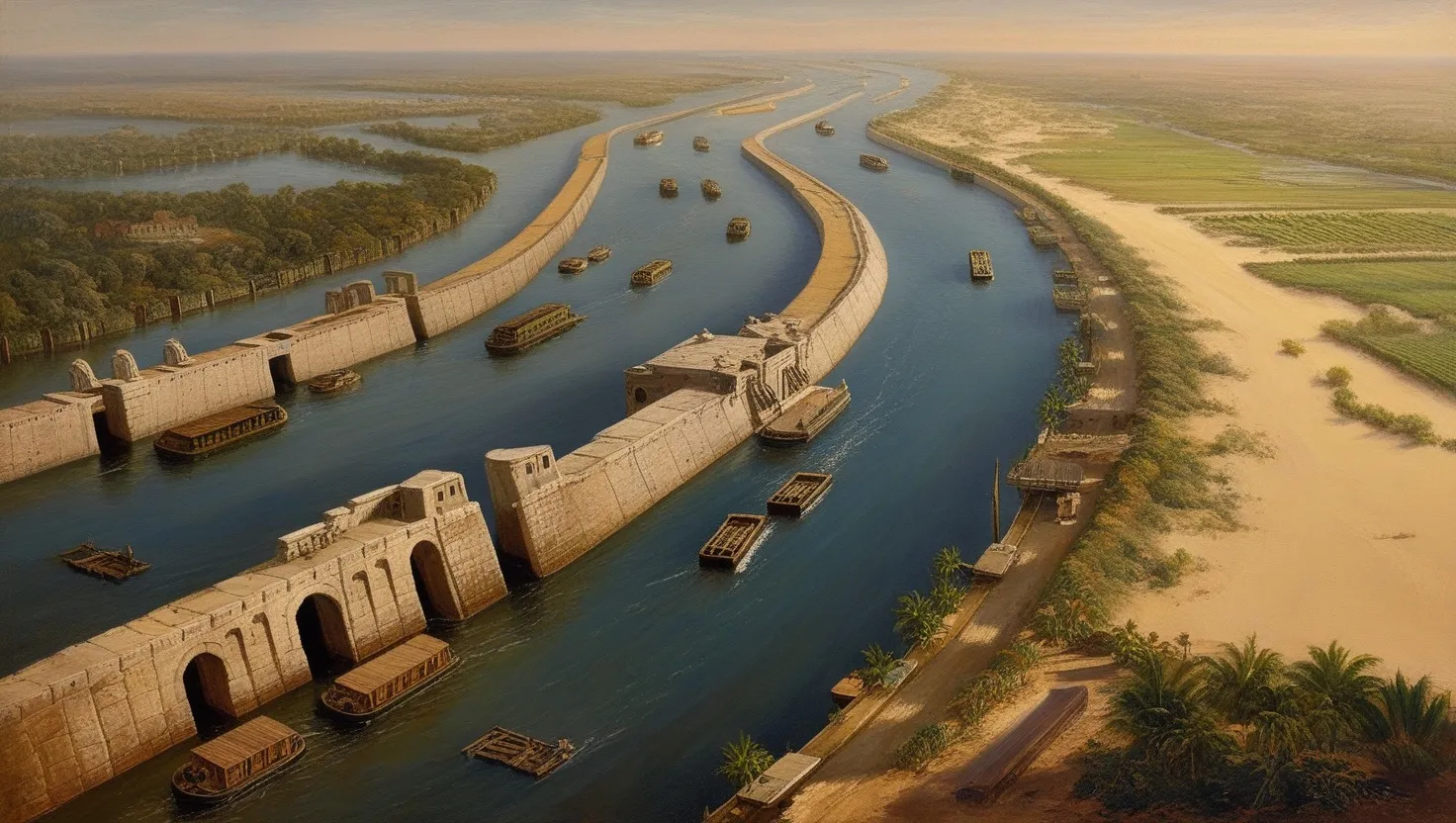
The real engineering puzzle was not the canal itself. It was feeding water into the highest point of the route. A canal climbing a hill has no river to pull from at the top. Riquet solved this by collecting rainfall in artificial reservoirs and directing it downhill through the locks. When the canal opened in 1681, France could cross itself without asking Spanish permission.
“Great works are rarely the product of great institutions. They are almost always the product of one uncomfortable person who cannot stop thinking about a problem.”
The Canal du Midi teaches something rarely discussed in engineering history. Public projects of enormous scale are not simply the result of royal command. They require private obsession. Riquet spent his own money when the king’s finances ran dry. He died before the canal opened. The king took the credit. The lesson has aged well.
The Erie Canal: The Insult That Built a Nation
Imagine proposing to dig a 363-mile canal through swampy wilderness with picks and shovels, in a young country with very little money and a great deal of skepticism. In 1817 New York, people called this plan foolish. One congressman referred to it as “Clinton’s Ditch,” mocking Governor DeWitt Clinton for even suggesting it.
Clinton dug anyway.
When the Erie Canal opened in 1825, the cost of moving a ton of freight from Buffalo to New York City dropped by nearly ninety percent. Ninety percent. Farms in Ohio and Indiana suddenly had real markets. Merchants in Manhattan suddenly had customers in territories that had felt like a different world.
But the bigger story is what it did to New York City itself. Before the canal, Philadelphia and Boston were serious rivals for the title of America’s leading port. After it opened, New York simply left them behind. The city became the commercial center of a continent because a canal made the interior of that continent accessible.
“Before the canal, Ohio was the frontier. After it, Ohio was the suburbs.”
The Erie Canal is also a quiet argument against a particular kind of economic thinking. Private investors would not have built it, because they could not have made the math work alone. The state government made a collective bet on shared infrastructure, and the profits were spread wide enough that nearly everyone on the eastern seaboard felt them.
The Suez Canal: Empire’s Bloodstream
Do you know what British soldiers called the Suez Canal zone in the late nineteenth century? They called it “the artery.” And they were not wrong.
Before 1869, European ships sailing to Asia had to go around the entire continent of Africa — a journey of months. The Suez Canal cut through a narrow stretch of Egyptian desert and collapsed that journey dramatically. French investment and Egyptian labor built it. Egyptian debt handed Britain a controlling share. British guns followed shortly after.
For nearly a century, the canal moved oil, troops, cotton, and colonial authority between Europe and Asia. It was the physical infrastructure of empire, and everyone who depended on it knew it.
Then in 1956, Egyptian president Gamal Abdel Nasser nationalized it.
Britain, France, and Israel launched a military attack to take it back. The United States and Soviet Union, for once agreeing on something, forced them to withdraw. A canal built with imperial money, operated under imperial management, passed into the hands of the country it had always run through.
“Empires do not fall because they are defeated in battle. They fall when the people who live inside their machinery decide to turn it off.”
What the Suez crisis actually marked was not just an Egyptian political victory. It was the moment the world noticed that imperial logistics depended on the cooperation of people who had been given very little reason to cooperate.
Panama: The Canal Built on a Borrowed Country
The French tried first. In the 1880s, Ferdinand de Lesseps — the man behind Suez — believed he could cut through the Panamanian isthmus the same way. He could not. The jungle killed workers by the tens of thousands. Yellow fever, malaria, and landslides ended the project and bankrupted an entire generation of French investors.
The United States took a different approach. It studied the mosquito problem and solved it through public health campaigns. It replaced a sea-level canal design with a system of lakes and locks that worked with the terrain instead of against it. The engineering solution was genuinely impressive.
The political solution was something else entirely.
Washington supported Panama’s separation from Colombia in 1903, essentially creating a new country that would then sign a treaty giving the United States control of a ten-mile-wide strip directly through the nation’s center. Panamanians watched a foreign government operate a structure that split their country in half, for decades, under terms that they had no meaningful part in negotiating.
The canal opened in 1914 and changed naval history immediately. A warship no longer had to go around South America to move between oceans. The military advantage was obvious. The political wound was quieter but just as real.
“You can build a canal in a decade. You cannot build legitimacy in a decade.”
It took until 1999 for the United States to hand full control to Panama. The handover was peaceful, organized, and long overdue. Panama has managed the canal with considerable competence since then, which suggests the delay in transferring control was never really about capability.
What All Five Canals Actually Teach Us
Here is the honest reading of these five waterways. Digging is the easier half of the job. The harder half is deciding who the water belongs to, and making sure that answer holds.
Silt settles. Locks decay. Treaties written in one century become embarrassments in the next. Every canal in history has faced the same basic test — not whether the engineering works, but whether the political agreement surrounding it can survive contact with the people who live beside it.
We still build channels today. Subsea cables carry the world’s data. Pipelines carry energy across borders. Digital infrastructure connects markets the way locks once connected rivers. Every one of them carries the same hidden question that Pierre-Paul Riquet, DeWitt Clinton, and every Panamanian dock worker already knew.
Who built this? Who benefits from it? And when those two answers stop matching, what happens next?
The history of canals does not offer a clean answer. But it does offer a warning. The person who controls the gate decides whose goods move and whose ships wait. And history has shown, repeatedly, that the people who build the gate and the people who eventually control it are rarely the same people at all.