How 5 Volcanic Eruptions Quietly Rewrote Human History, Culture, and Power
Discover how 5 volcanic eruptions reshaped civilizations, inspired iconic art, and changed history forever. Explore the surprising ripple effects geology left on humanity.
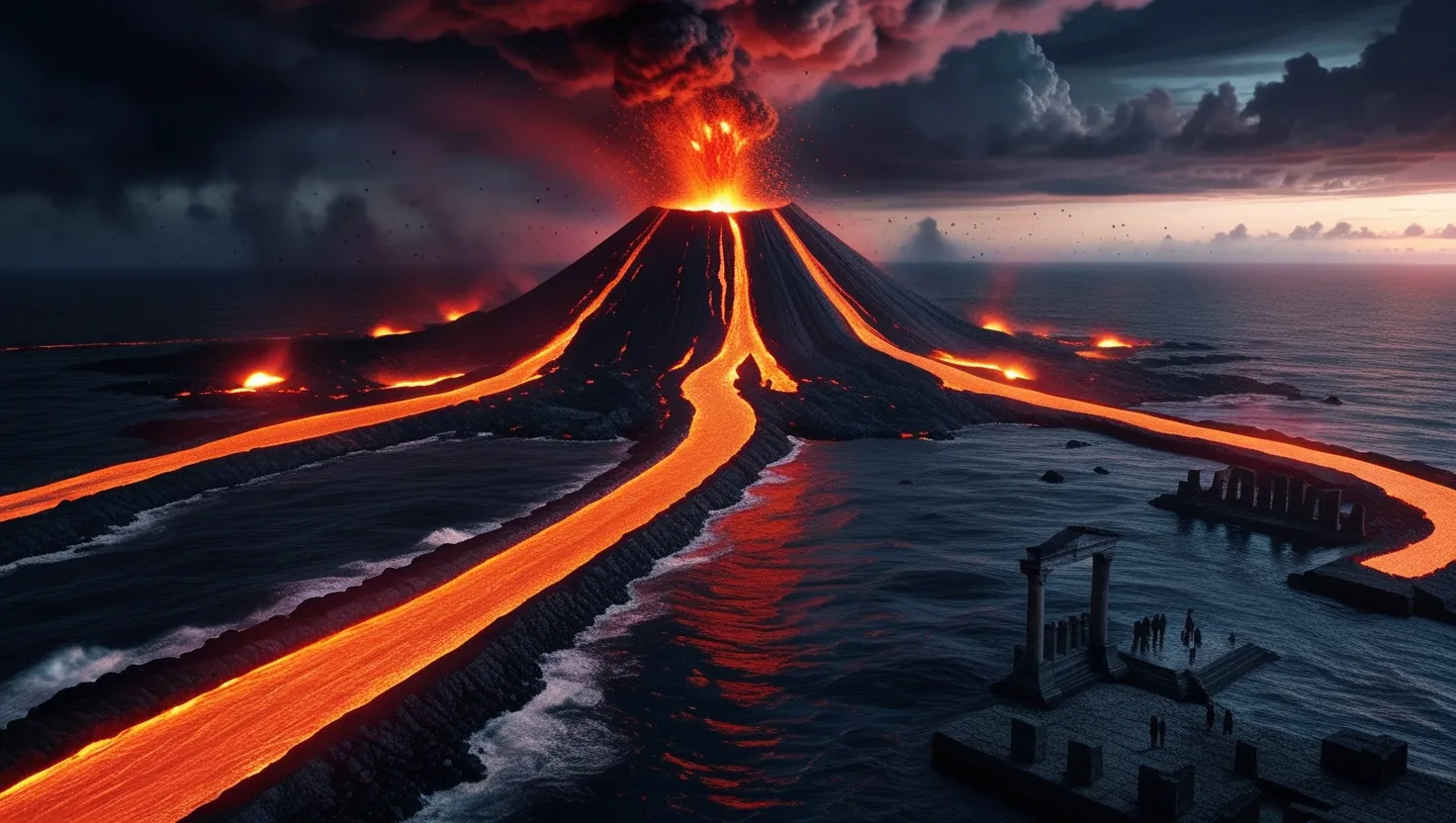
Volcanoes don’t ask permission. They don’t wait for a convenient moment in history. They simply erupt, and everything humans have carefully built — trade routes, empires, seasons, even stories — shifts in response. What’s fascinating is that most people think of volcanic eruptions as purely destructive events. But when you look closer, you find something stranger and more interesting: these explosions of rock and fire have quietly shaped art, politics, science, and the very way civilizations rise and fall.
Let’s walk through five of the most consequential eruptions in human history — not just the dramatic headlines, but the weird, overlooked ripple effects that historians rarely put front and center.
Around 1600 BCE, a volcano on the island of Thera (modern-day Santorini) exploded with a force that dwarfs almost anything in recorded memory. Scientists estimate it was four times more powerful than Krakatoa. The island essentially blew itself apart.
Now here’s what most people don’t know: the Minoans, who dominated trade across the ancient Mediterranean from their base on nearby Crete, were arguably the most sophisticated civilization of the Bronze Age. They had indoor plumbing, multi-story buildings, and a writing system we still haven’t fully decoded. After Thera, they were done. Not overnight — but within a generation or two, Minoan ports were crippled by tsunamis, their farmland buried in ash, and their cultural authority collapsed.
Into that vacuum stepped the Mycenaean Greeks. And that shift — from Minoan to Mycenaean dominance — rewired the cultural DNA of the entire Mediterranean. The Greek language, the early roots of what would become Western literature and philosophy, all of this gained ground partly because a volcano blew up and left a power gap that someone else filled.
Some scholars believe that the Thera disaster is the real event behind the Atlantis myth. Think about that for a second. An advanced island civilization, consumed by the sea in a single catastrophic event — Plato might have been writing about a cultural memory, not a fantasy.
“In all things of nature there is something of the marvelous.” — Aristotle
Jump forward to 79 AD, and we get the eruption most people actually know: Mount Vesuvius burying Pompeii and Herculaneum under meters of ash and pyroclastic material. But even here, the most interesting part isn’t the destruction — it’s what the destruction accidentally preserved.
When excavators began uncovering Pompeii in the 18th century, they found something unprecedented: a city frozen mid-breath. Loaves of bread still in ovens. Electoral graffiti on walls (“Vote for Vatia — he’s not bad when he’s sober”). Snack bars with food remnants still visible. The bodies of people who didn’t make it out, preserved in posture and expression by the ash that killed them.
Vesuvius gave archaeologists a window into ordinary Roman life that no palace, temple, or official document ever could. We learned that Romans had fast food restaurants. That they had explicit murals on street corners. That children played with toys remarkably similar to ones kids play with today.
There’s also the matter of Pliny the Younger, who watched the eruption from across the bay and wrote two letters describing what he saw in precise, almost scientific language. Those letters became the template for how volcanic eruptions are described and studied. Volcanologists still use the term “Plinian eruption” to describe explosions that send material high into the stratosphere — named directly after a 17-year-old boy watching a disaster from a safe distance and writing it all down.
Here’s a question worth sitting with: can a volcano write a novel?
Not literally, obviously. But the 1815 eruption of Mount Tambora in Indonesia — the largest volcanic eruption in recorded human history — almost did exactly that.
Tambora shot so much ash and sulfur dioxide into the upper atmosphere that it wrapped around the planet and blocked sunlight. The following year, 1816, became known as “the Year Without a Summer.” Snow fell in June in New England. Harvests failed across Europe and North America. Tens of thousands of people starved or died from secondary illness. There were food riots. Mass migration. Social collapse in pockets across two continents.
That same summer, a small group of writers and intellectuals gathered at a villa on Lake Geneva in Switzerland. The weather was so relentlessly cold and dark that they stayed indoors, read horror stories to each other by firelight, and challenged one another to write their own. One of them was an 18-year-old named Mary Shelley. The result was Frankenstein — a story about creation going wrong, about science without conscience, about a world that feels suddenly hostile and cold.
Lord Byron wrote a poem called Darkness during the same period, describing a world where the sun had gone out. He wasn’t being metaphorical. He was describing what he saw outside.
Tambora didn’t just cause famine. It generated a cultural mood — a specific shade of dread — that some of the most important literary works of the 19th century were dipped in.
“The volcano is a great equalizer. It does not care about kings.” — Anonymous, attributed to early Icelandic saga tradition
Have you ever thought about what it would mean for the whole world to witness a disaster at the same time, for the first time?
That’s what happened with Krakatoa in 1883. The explosion was heard in Australia — nearly 3,000 miles away. The tsunamis it triggered killed more than 36,000 people. But the thing that makes Krakatoa genuinely different from every volcanic disaster before it is the telegraph.
By 1883, undersea telegraph cables connected much of the world. News of the eruption spread globally within hours — something that had never happened before with a natural disaster. Newspaper editors in London, New York, and Melbourne were running reports before the ash had even settled.
This created something new: a shared global moment of catastrophe. It also pushed scientists from different countries to collaborate in real time, comparing barometric pressure readings, wave measurements, and atmospheric observations. Modern volcanology as a coordinated international science owes a significant debt to Krakatoa.
And then there were the sunsets. Ash particles from the eruption scattered in the upper atmosphere and produced extraordinary red and orange sunsets visible around the world for months. Painters noticed. Edvard Munch described a blood-red sky over Oslo in his diary around this period — some art historians believe those sunsets contributed to the image behind The Scream.
Now for the eruption most people have never heard of — and arguably the one with the most far-reaching consequences.
From 1783 to 1784, a crack in the ground in Iceland called Laki quietly poured out lava and toxic gases for eight months. There was no spectacular explosion. No dramatic moment. Just a slow, relentless release of sulfur dioxide and fluorine that poisoned Iceland’s grass, killed three-quarters of its livestock, and caused a famine that wiped out about a quarter of the island’s population.
But the gases didn’t stay in Iceland. A volcanic haze drifted across Europe. Crops failed. Winters turned brutal. The summer of 1783 was eerily hot in parts of Europe due to the atmospheric disruption, followed by an extraordinarily cold winter. Livestock died. Harvests failed.
Some historians now connect Laki’s environmental disruption — the food shortages, the poverty, the social instability — to the conditions that made France ripe for revolution six years later. Nobody at Versailles was thinking about an Icelandic fissure. But the peasants who couldn’t afford bread might have been eating less of it partly because a crack in Icelandic ground had poisoned two seasons of European crops.
“Nature is not simply the backdrop of human history. It is one of its main characters.” — paraphrased from environmental historian perspective
What connects all five of these events isn’t just scale or drama. It’s the reminder that human civilizations are built on assumptions — assumptions about predictable seasons, stable coastlines, breathable air, and reliable harvests. Volcanoes violate those assumptions without warning.
And when those assumptions break, history doesn’t pause. It accelerates. Power shifts. Art mutates. Science reorganizes. The stories we tell about who we are get rewritten.
The ground beneath your feet has been active for 4.5 billion years. The civilizations we’re so proud of have existed for, at most, a few thousand. Ask yourself: what are we assuming right now that a future eruption might prove wrong?