What Can We Learn from the Man Who Knew He Knew Nothing?
Socrates: The Philosophical Hoplite Who Shaped Western Thought's Foundations
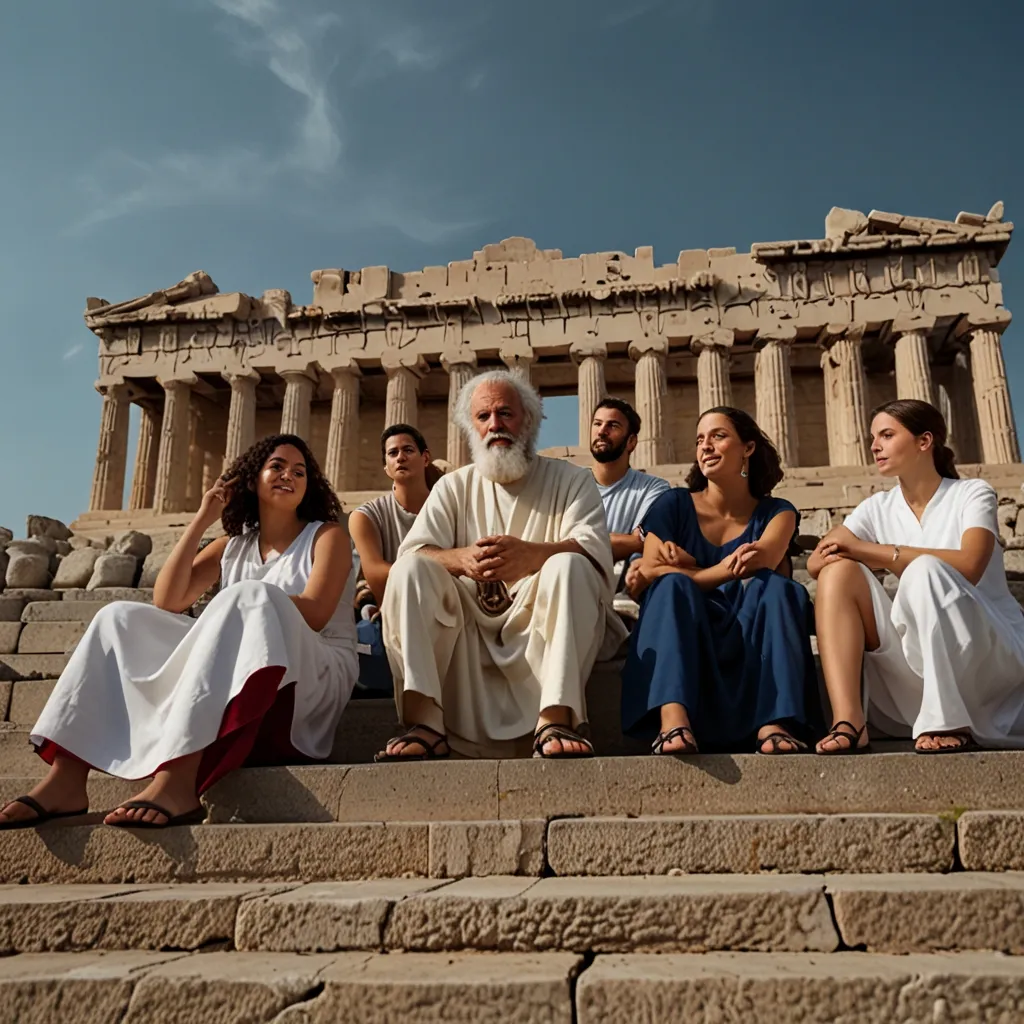
In the annals of history, there is one ancient figure who stands out as the founder of Western philosophy. This enigmatic individual is none other than Socrates, a Greek philosopher from Athens who lived from around 470 to 399 BC. Socrates is often credited with laying the groundwork for Western philosophy, and his influence extends far beyond his time.
Socrates was born in Athens, the son of a sculptor named Sophroniscus. Despite his humble beginnings, he grew up to be a man of great intellect and courage. His early life was marked by his service as a hoplite, or heavily armed infantryman, in the Peloponnesian War. During this time, he earned admiration for his bravery and endurance, particularly in saving the life of Alcibiades, a prominent Athenian general.
Upon returning to Athens, Socrates began to gain a reputation as a philosopher. He was known for his unique method of questioning, which became famous as the Socratic method. This method involved asking a series of questions to encourage critical thinking and to draw out ideas and underlying presuppositions. Socrates believed that the unexamined life was not worth living, and he spent his days questioning everyone he met, from common folk to prominent figures, about their beliefs and values.
Socrates never wrote any books himself. Instead, his teachings were passed down through the writings of his students, particularly Plato and Xenophon. Plato, who was born into one of Athens’ wealthiest families, became Socrates’ most famous disciple. He wrote numerous dialogues featuring Socrates as the main character, exploring various philosophical topics. These dialogues are some of the most comprehensive accounts of Socrates’ philosophy and continue to be studied today.
The Socratic method, as depicted in Plato’s dialogues, involves short questions and answers that lead to a deeper understanding of a subject. Socrates would often claim ignorance, saying that he knew nothing except that he knew nothing. This humility was a key part of his approach, as he believed that recognizing one’s own ignorance was the first step to true wisdom.
Socrates’ influence on Western philosophy cannot be overstated. He was the inspiration for Plato, who in turn taught Aristotle, forming the famous triad of ancient philosophers: Socrates, Plato, and Aristotle. This lineage has shaped much of Western thought, from ethics and political philosophy to metaphysics and epistemology.
Despite his significant contributions, Socrates was not without controversy. He attracted many followers among the youth and the powerful, but he also had detractors. His method of questioning and his critiques of traditional beliefs often put him at odds with the Sophists, a group of itinerant instructors who taught rhetoric for a fee. The Sophists saw Socrates as a threat to their teachings and their livelihoods.
In 399 BC, Socrates was put on trial in Athens. He was accused of impiety and corrupting the youth. The trial was a dramatic event, with Socrates defending himself against the charges. Despite the opportunity to escape, he chose to accept the death sentence, believing that it was his duty to obey the laws of Athens. His final days were spent in prison, where he continued to engage in philosophical discussions with his friends.
Socrates’ death did not end his influence. Instead, it cemented his legacy as a martyr for truth and wisdom. His ideas continued to inspire philosophers throughout history, from medieval scholars to modern thinkers like Søren Kierkegaard and Friedrich Nietzsche. Today, Socrates remains a widely recognized figure in Western philosophy, celebrated for his courage, his method of questioning, and his commitment to the pursuit of wisdom.
In conclusion, Socrates is the ancient figure who is often considered the founder of Western philosophy. His life, teachings, and legacy have had a profound impact on the development of Western thought. Through his method of questioning and his emphasis on the importance of self-examination, Socrates continues to inspire philosophers and thinkers around the world.