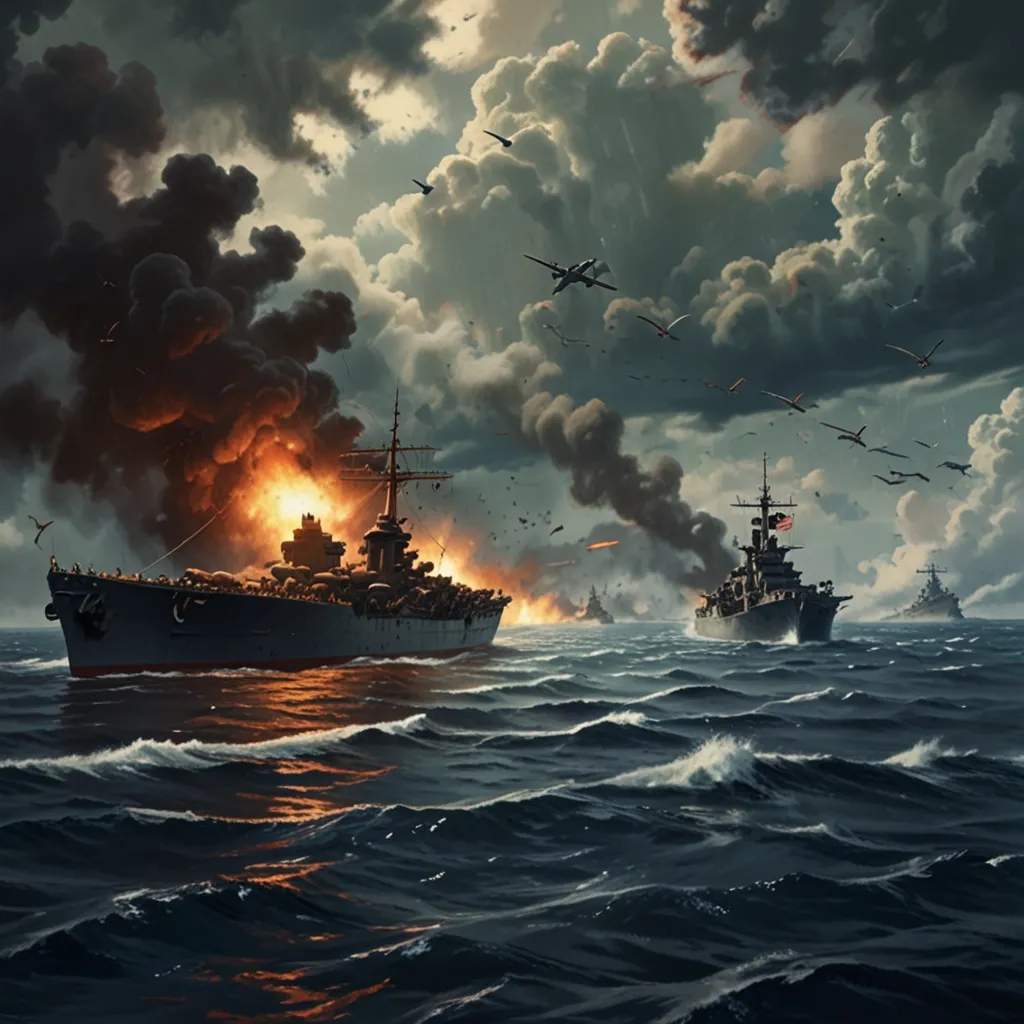
In June 1942, a pivotal battle took place in the Pacific Ocean that would change the course of World War II. This battle, known as the Battle of Midway, was a clash between the United States Navy and the Imperial Japanese Navy. It was a five-day engagement that spanned from June 3 to June 7, 1942, and it marked a significant turning point in the war.
The Japanese had been expanding their territory in East Asia and the Southwest Pacific, aiming to remove the United States as a dominant power in the region. Their strategy involved defeating the U.S. Pacific Fleet and capturing Midway Island, which they believed would give them a strategic advantage to launch further attacks on Pearl Harbor. This would secure their dominance in the Pacific and force the United States to negotiate for peace.
The Japanese fleet, led by Admiral Yamamoto Isoroku, consisted of four heavy aircraft carriers—Akagi, Hiryu, Kaga, and Soryu—along with two light aircraft carriers, two seaplane carriers, seven battleships, fifteen cruisers, forty-two destroyers, ten submarines, and various support vessels. Their mission was to engage and destroy the American fleet and then invade Midway.
However, the United States had an advantage. U.S. intelligence had broken the Japanese JN25 naval code, allowing them to anticipate the Japanese plans. Admiral Chester Nimitz, commander-in-chief of the U.S. Pacific Fleet, prepared a defense strategy. Despite not having any battleships, he had two heavy carriers, USS Enterprise and USS Yorktown, ready for battle.
The battle began on June 3, 1942, when an American reconnaissance plane spotted the Japanese invasion fleet. The next day, June 4, aircraft from the Japanese carriers attacked the U.S. base on Midway, causing significant damage. Unbeknownst to the Japanese, the U.S. carrier forces were positioned to the east of the island, ready to strike.
As the Japanese aircraft returned to their carriers to rearm and refuel, the U.S. launched a counterattack. TBD Devastator torpedo bombers and SBD Dauntless dive bombers from the USS Enterprise, USS Hornet, and USS Yorktown attacked the Japanese fleet. The Japanese carriers Akagi, Kaga, and Soryu were hit and set ablaze, while Hiryu, the only surviving Japanese carrier, launched two waves of attacks against the USS Yorktown, severely damaging it.
The U.S. responded by sending dive bombers from the USS Enterprise to attack Hiryu, leaving it burning and unable to launch aircraft. Over the next two days, the U.S. continued their attacks, forcing the Japanese to retreat. The Japanese lost four carriers, one cruiser, and hundreds of aircraft, along with approximately 3,057 men. The United States lost one carrier, one destroyer, and 144 aircraft, with about 362 men killed.
The Battle of Midway was a decisive victory for the United States. It halted Japan’s expansion in the Pacific and shifted the balance of sea power in favor of the U.S. The loss of four carriers and many experienced pilots was a blow from which Japan could not recover. The battle marked the beginning of the end of Japan’s offensive in the Pacific and paved the way for the U.S. to begin a series of island-hopping invasions that would eventually lead to the defeat of Japan.
In summary, the Battle of Midway was a crucial naval battle fought in June 1942 between the U.S. Navy and the Imperial Japanese Navy. The U.S. victory, thanks to their ability to break Japanese communication codes and strategic planning, marked a significant turning point in World War II, halting Japan’s expansion and setting the stage for the eventual defeat of Japan.