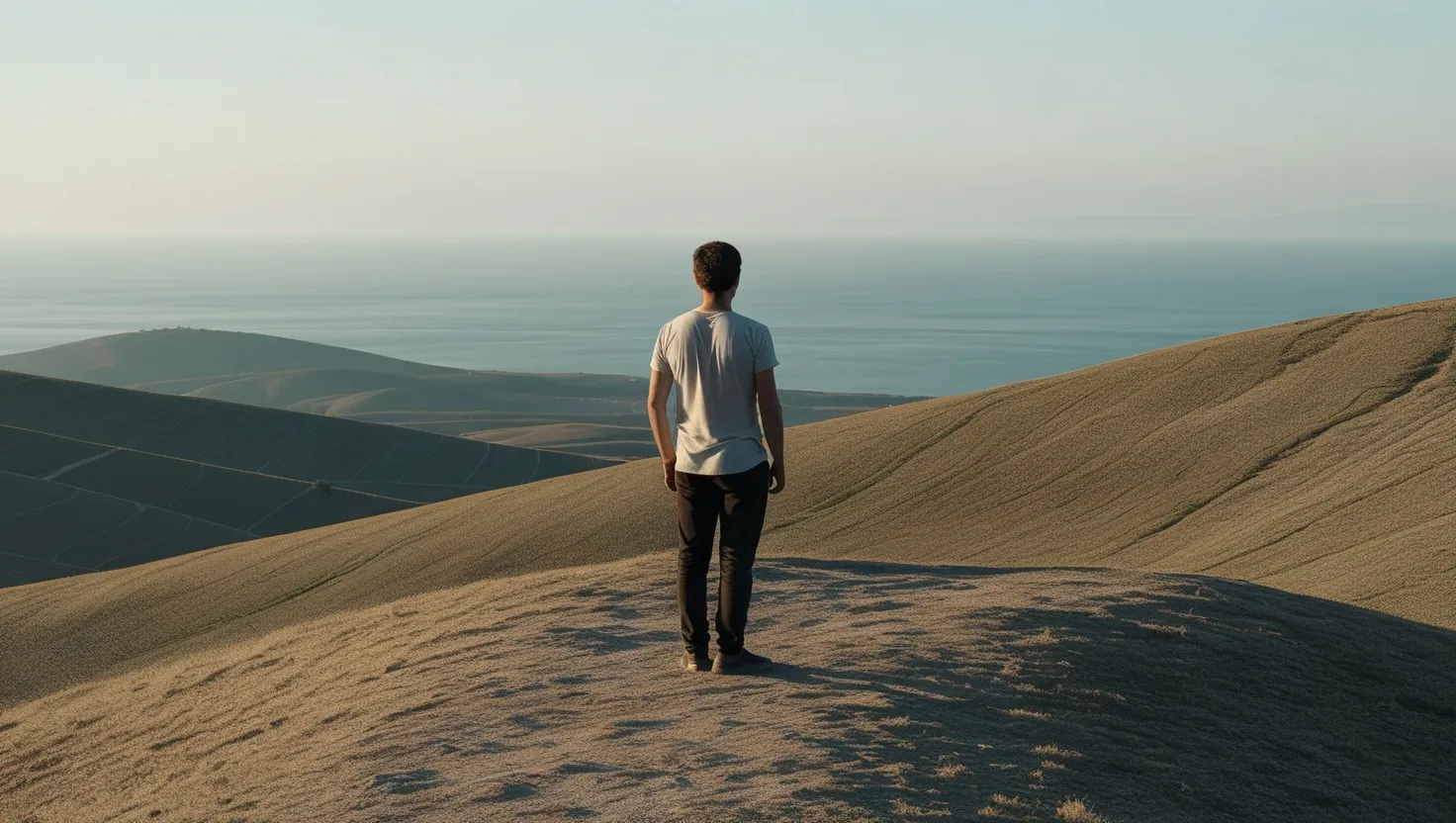
The first thing I want you to picture is simple: a person standing on a hill in ancient Crete, staring at the line where sea meets sky. No phone. No inbox. Just that long, calm line in the distance.
That person lived in what we now call Minoan civilization, an early culture on the island of Crete known for vivid art, sea trade, and a surprisingly joyful style of daily life. They were practical, but they were also playful. They built drainage systems and also painted dolphins on their walls. They stored grain in massive jars and also danced and leapt over bulls.
Now, why should you care?
Because many of the small habits that shaped their days can help us think, feel, and connect better in a world where we spend a lot of time alone, staring at glowing rectangles.
I want to walk you through five practices from Minoan life and show you how to turn them into tiny, modern habits for creativity and connection. I’ll keep it simple. I’ll talk to you like you’re tired, distracted, and maybe scrolling while half-thinking about something else. That’s okay. I’ll do the mental heavy lifting for you.
Let’s start with your eyes.
Have you noticed how your world shrinks to the size of your screen? Your focus lives about 40 centimeters from your face. Your eyes are always working at “short range.” The Minoans did not have that problem. Their towns and palaces were often built with views of the sea. Many people would have looked out at the horizon during work, walks, and rituals. Their visual life constantly moved between close-up details and far-away distances.
Here is your first practice: the horizon gaze.
Each morning, as early as you can manage, I want you to deliberately look as far as you can. Out a window, down a street, off a balcony, across a park, or just to the far wall if you truly have no view. The key is distance. Let your eyes relax into that far point for at least 30 seconds, ideally a minute or two.
It sounds almost too basic, right? But your nervous system responds strongly to how you use your eyes. Long-distance viewing tends to calm the stress system and widen your mental sense of space. Short-range viewing does the opposite: it tightens your attention, which is good for tasks but tiring when it never stops.
Ask yourself: when was the last time you just looked far away without checking a sign, a train time, or a notification?
You can even pair the gaze with a simple question: “What do I want to have more space for today?” Not a long reflection. Just a quick mental nudge.
“The real voyage of discovery consists not in seeking new landscapes, but in having new eyes.”
— Marcel Proust
The Minoans had those “new eyes” by default. Their lives were organized around the sea, and the sea constantly pulled their gaze outward. You can borrow that effect in less than a minute a day.
Now, let’s move from eyes to hands.
Think about Minoan pottery and wall painting. You might have seen pictures of their flowing lines: spirals, waves, octopus arms spreading across jars, plants winding their way up walls. What’s striking is how alive those lines look. They are not stiff. They feel like someone enjoyed drawing them.
In our world, “drawing” often feels like a skill you either have or don’t. But Minoan art suggests something different: a culture that enjoyed decorative mark-making as part of everyday objects. Jars, cups, walls, boxes — many of them were not just useful, but playfully decorated.
You probably already do a weak version of this: you doodle in the margin of a notebook, on a meeting agenda, or on the back of an envelope. Instead of seeing that as a distraction, what if you made it a quiet tool?
Here is your second practice: decorative mark-making.
Keep a very small notebook or a few sheets of scrap paper near where you work or think. When your mind feels stuck, or when you’re half-listening in a low-stakes meeting, let your hand make abstract marks. Spirals. Waves. Lines that cross and loop. Plant-like shapes. You are not “drawing a thing.” You are letting your hand move in pleasant patterns.
Why does this help?
Because your brain doesn’t only think in words. It also thinks in images, rhythms, and movements. When your hand moves in a free, rhythmic way, a different part of your mind wakes up. Often, ideas that were hiding suddenly show themselves once your attention is not squeezing them so hard.
Notice what kind of marks you naturally make. Are they sharp? Smooth? Dense? Loose? Do they change with your mood? That tiny act of noticing is already a creative habit.
You might ask: “Isn’t this childish?” Yes — and that is part of the power. The Minoans put playful, flowing shapes on serious objects like storage jars and palace walls. They did not separate usefulness from visual joy as strictly as we do. You can let yourself cross that line again.
“Art is not what you see, but what you make others see.”
— Edgar Degas
In this case, you are both the maker and the “other.” Your future self might look at those marks and feel something: calm, energy, or just a small reminder that you are more than a typing machine.
Now we move from hands to shared spaces.
The Minoans used huge clay jars, sometimes taller than a person, to store grain, oil, and other goods. These were not private kitchen cupboards. Much of this storage was communal or semi-communal, especially around palaces and large buildings. Food and resources flowed in and out in organized ways.
Today, many of us live in sealed-off units. Every apartment has its own tools, its own rarely-used ladder, its own stack of cans slowly expiring at the back of a shelf. We are surrounded by stuff and yet often feel unsupported.
Here is your third practice: shared storage rituals.
I use the word “ritual” on purpose. This is not only about saving money or space. It is about treating shared resources as a social glue.
Start small. Could you and a neighbor or friend create a simple shared pantry shelf? Maybe a box in a hallway with basic items anyone can use and replenish. Or a tool corner for drills, hammers, camping gear, or extra chairs. Or a bookshelf where books move freely between homes.
The key is that:
You contribute when you can. You borrow when you need. You communicate simply and kindly.
Ask yourself: who around you would make sense for this — neighbors, coworkers, people in your building, or even members of a club or co-working space?
When the Minoans stored goods in large jars, those jars were also places where records were kept and social roles played out. There was counting, measuring, trusting, and sharing. The jars made visible that people were linked by grain, oil, and time.
In a world of instant delivery, it might sound old-fashioned to create a shared pantry or tool library. But that is exactly why it works. It slows you down just enough to remember you are part of a local web of humans, not just a customer in a giant online system.
“Alone we can do so little; together we can do so much.”
— Helen Keller
You might start to notice tiny conversations forming around the shared items: “Hey, I put in some extra rice.” “Can I borrow the drill on Saturday?” “I left a stack of jars if anyone makes jam.”
Those small exchanges are how community quietly grows.
Let’s move from storage to movement.
In Minoan art, bodies are rarely still. You see people bending, leaping, dancing, running. The famous bull-leaping scenes show humans grabbing a bull’s horns and flipping over its back. Whether that image is fully realistic or partly symbolic, it tells us something important: play and risk and motion mattered in their culture.
Today, movement is often treated as a duty: “I need to work out.” We turn motion into a task on a list. That takes the joy out of it. The Minoan scenes remind us that movement can be playful, decorative, and social.
Here is your fourth practice: playful movement.
Once or twice a week, I want you to move in a way that has no main purpose except lighthearted enjoyment. Not steps, not calories, not progress. Just play.
This could be as simple as:
Putting on one song and dancing awkwardly in your kitchen. Tossing a ball against a wall for a few minutes. Skipping a few steps on your walk. Balancing on a curb like it’s a beam.
You might feel silly. Good. That means you’re doing it right.
Ask yourself: when was the last time you moved your body without judging how it looked or counting anything?
The importance of this is not only physical. Your thinking patterns often mirror your movement patterns. If you sit for long hours, your mind can get stuck in tight loops. When you add sudden, unplanned movement, your inner world often loosens too. Ideas can “jump” more easily between topics, just as your feet jump between positions.
“We do not stop playing because we grow old; we grow old because we stop playing.”
— George Bernard Shaw
Minoan dancers and athletes probably never counted “steps” in their day. They moved for ritual, for fun, for display, for social bonding. You do not need to recreate their sports. You just need to reintroduce motion that is not constantly measured and judged.
Finally, we come to endings.
The Minoans poured liquid offerings — wine, oil, maybe honeyed drinks — to gods and ancestors. These libations were small but meaningful actions: a bit of precious liquid given back to the earth or to the unseen.
There is something powerful about pouring a small amount of what you drink onto the ground and saying, in effect, “This is not just for me.”
We usually end our days by consuming until the last drop: last sip, last video, last scroll. Then we collapse. It feels like a fade-out, not a closing.
Here is your fifth practice: a simple libation.
At the end of your day, when you have your last drink — water, tea, wine, anything — leave a small final sip. Instead of swallowing it, pour it gently onto soil. This could be in a plant pot, a garden, or even a patch of earth near your home.
As you pour, think one sentence. It could be:
“Thank you for getting me through today.” “May tomorrow be kinder.” “May [someone’s name] be safe.”
You do not need to believe in a specific god or ancestor. What matters is that you turn the invisible end of your day into a tiny, visible act.
Why does this help?
Because your brain likes markers. Clear beginnings and endings give your nervous system a sense of rhythm. Without them, every day can blur into the next. This small pouring act tells your body, “We are done now.”
Ask yourself: how do your days end now — by accident, or on purpose?
“In ordinary life, we hardly realize that we receive a great deal more than we give, and that it is only with gratitude that life becomes rich.”
— Dietrich Bonhoeffer
The Minoans used libations as a way to connect earth, sky, sea, gods, and humans. You can use your little end-of-day pour to connect your tired present self with your hopeful future self, and with the people you care about.
Now, let’s put this all together so you can see the shape of it in your own day.
In the morning, you begin with the horizon gaze: a slow look at distance, giving your mind and eyes a sense of space.
During the day, you let your hands play with decorative mark-making when your thoughts stick; your lines and spirals become a quiet way to think sideways.
In your wider week, you set up or join some form of shared storage ritual, even if it’s just a small shared box with one neighbor; your stuff starts to serve connection, not just consumption.
A few times a week, you add playful movement, letting your body surprise itself for five minutes of non-serious motion.
At night, you end with a libation: a small pour, a short thought, a clear line between this day and the next.
None of these practices require you to move to an island, study archaeology, or change your whole life. They are small. But the Minoans show us that small, repeated acts can build a culture — and you are always building a personal culture, even if you don’t notice.
So I want to leave you with a simple question:
If you picked just one of these five Minoan-inspired habits to try today, which one feels easiest — and which one quietly excites you the most?
You do not need to answer me. But answer yourself clearly. Then give that practice three days. Let your life be your experiment.
“We are what we repeatedly do. Excellence, then, is not an act, but a habit.”
— often attributed to Aristotle
The Minoans left us ruins, jars, frescoes, and fragments. We do not know every detail of their lives. But we know enough to see a pattern: a people who connected art, sea, food, body, and ritual into daily life.
You can borrow that pattern, in tiny ways, starting with the next time you look up from your screen and let your eyes reach all the way to the horizon.