Imagine living in a world where your normal day quietly trains your eye, your manners, your voice, and even your sense of self. That was true for many people in Safavid Persia. They did not go to “mindfulness workshops” or “self-care retreats.” Their houses, their gardens, their tea, their poetry gatherings, even the way they greeted guests all worked together as a kind of daily school for refinement and connection.
I want to show you five simple habits from that world that you can copy today, even if you live in a tiny apartment and eat instant noodles. I will keep the language simple on purpose. Think of this like a “manual for being a bit more human,” using ideas that are hundreds of years old but still work.
Let’s start with the first habit: the courtyard glance.
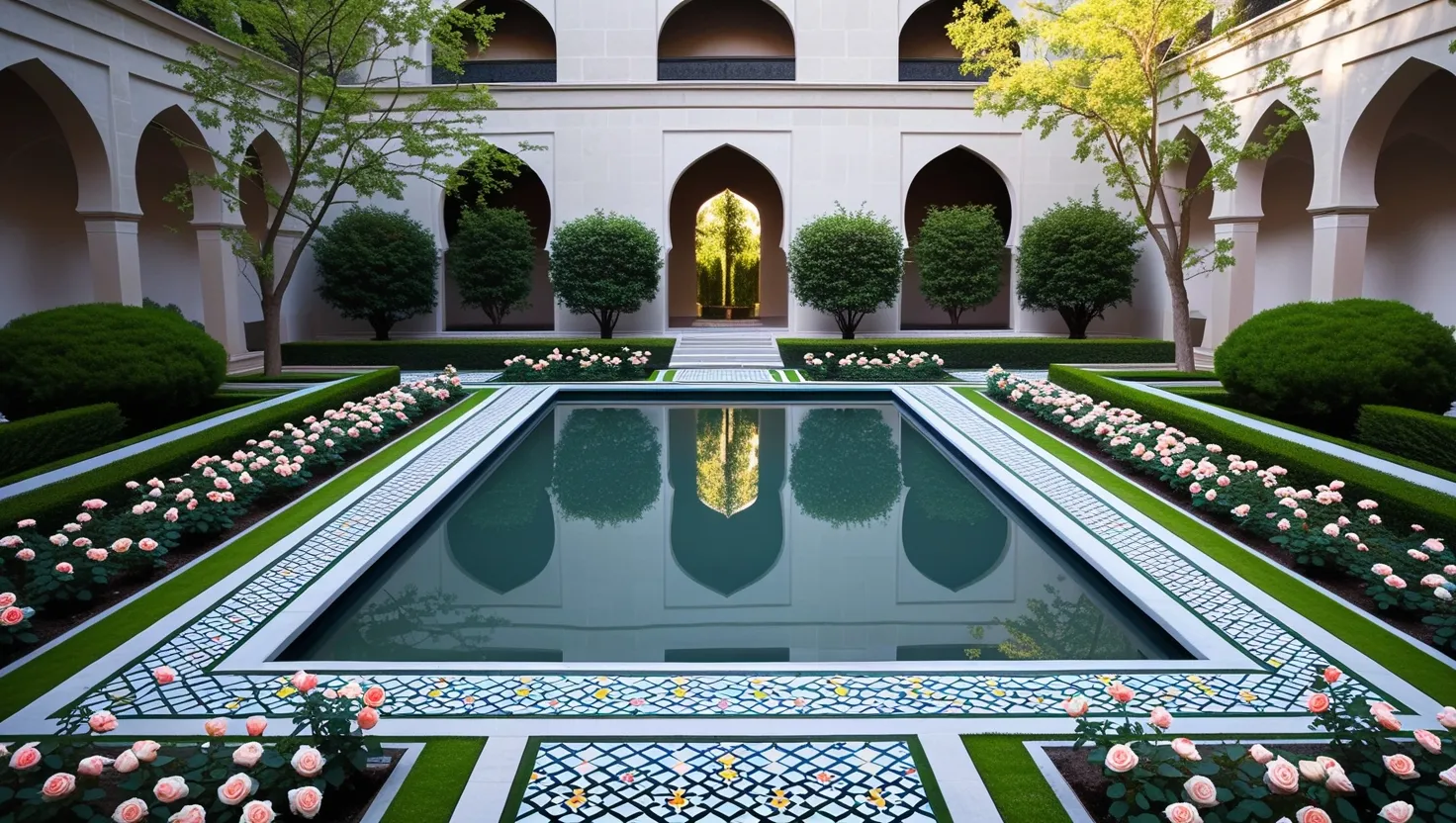
Many Safavid homes were built around a central courtyard, often with a small pool, some trees, maybe a rose bush, and paths laid out in a clear pattern. When people stepped out of their rooms, they did not first see a messy street or a random wall. They saw order. They saw balance. They saw water in the middle and plants arranged around it, often in four equal sections.
This “first look” mattered. It quietly told the mind, “The world can make sense. There can be calm in the center.” It was not just decoration. It was like a daily reset button.
You may not have a courtyard or a garden. But you can still use this idea. Choose one small spot that you will see very early each day. It could be:
A small table near your bed
A shelf by your front door
The top of your desk
On that spot, place a simple “visual anchor.” It could be a bowl of water with one flower. It could be a single candle and a stone. It could be a printed geometric pattern in a frame. The point is not to make it fancy. The point is to make it clear, ordered, and calm.
Ask yourself: when I first open my eyes or walk out of my bedroom, what do I want my brain to see? Chaos, or a small sign of order?
You might think this is too basic to matter. But remember: the Safavids built whole houses around this idea. The courtyard was not an extra. It was the center. By copying this in a tiny way, you are using architecture as a mental tool. You are telling your nervous system, “Start here. Start with balance.”
Now, let’s move to the second habit: the poetic recitation pause.
In Safavid gatherings, people did not just sit and talk about politics or gossip. They often read poetry aloud. They did not just read for information. They listened to the sound, the rhythm, the hidden meanings. Poetry was not something only “smart people” used. It was part of normal life.
There is a reason so many Persian poets are still quoted today. People used their words to say things that were hard to say directly: doubt, love, fear, hope, humor, grief. Reading those words out loud in a group gave everyone a safe way to feel and think together.
One famous line that fits here is:
“Raise your words, not voice. It is rain that grows flowers, not thunder.”
– often attributed to Rumi
Now, you may say, “I’m not into poetry.” That’s fine. But the Safavid habit was less about the label “poetry” and more about one simple action: stopping the rush of the day, reading crafted words out loud, and letting them shape your inner state for a moment.
Try this: pick just two or three lines that you like. It could be from a poem, a sacred text, a novel, even a song lyric (as long as it is not just noise). Write it down or save it on your phone. Once a day, preferably in a quiet moment, read those lines aloud. Slowly.
Ask yourself: how does my own voice sound when it speaks something careful, not random? Do I feel any small shift when I hear myself say these words?
You are not doing this to “be cultured.” You are doing it to interrupt the constant stream of unfiltered talk, messages, and thoughts. The Safavids used poetry like a reset for the inside, the same way the courtyard was a reset for the eyes.
The third habit is the craft of detail.
Safavid Persia became famous for very detailed arts: miniature paintings, tiled walls with repeating patterns, carpets with tiny, precise motifs. These works were not quick. They needed patience, very steady hands, and a mind that could stay with small things for a long time.
That same mind is something we almost lose today. We rush through most tasks. We treat “boring” chores as dead time we must escape. But the Safavid craftsman did the opposite. He turned small, repeated actions into a kind of training. The detail itself was the point.
You do not need to paint tiles. You already have many small tasks. Washing dishes. Folding clothes. Formatting a report. Wiping a counter. Sorting files. Usually, you try to finish them as fast as possible.
What happens if, once a day, you pick one of those tasks and do it like a Safavid craftsman?
You slow everything down. You notice the temperature of the water, the shape of each plate, the way the soap foam forms. Or you notice the alignment of each line in your document, the spacing between words, the look of the final page. You act as if someone will judge you not on how quickly you finish, but on how carefully you move.
Ask yourself during that task: can I give full attention to this tiny thing, just for five minutes?
This is not about perfectionism. It is about training your attention like a muscle. If you can stay with the detail of one dish, you are more likely to stay with a hard conversation or a complex problem later. The Safavid world understood that fine art starts with fine attention. We can easily forget that.
The fourth habit is the welcoming ritual.
In Safavid culture, hospitality was not an afterthought. It was almost a moral duty. When someone entered a house, there were physical signs of welcome: a bowl of fruit, a sweet drink, a wash for the hands, maybe rose water, maybe a small dessert. The guest did not feel like a task to “fit in.” The guest felt like the main event.
One simple idea sat behind this: the host should show, with the body, not only with words, “I am glad you are here.”
There is a famous saying that fits this spirit:
“Let the beauty of what you love be what you do.”
– often attributed to Rumi
In this case, what you “do” is how you receive a person.
Think about your own life. When someone comes to your place, how do you greet them? Maybe you say “Hey” and go back to what you were doing. Maybe you throw a drink at them from the fridge and sit on your phone.
What if you copy the Safavid pattern in a very small, clear way?
Decide on one standard gesture. For example:
Always offer a glass of cool water within the first minute.
Or always offer a small snack (even just a few nuts).
Or always place one clean, folded towel in the bathroom for them.
Do this every time, even if the visit is short.
Ask yourself: if someone judged how much I value people only by my first two minutes of hosting, what would they think?
The power of this habit is not in the object (water, snack, towel). The power is in the message: “You matter. I prepared something for you.” Safavid hosts used fruit and sherbet. You can use whatever fits your world. The important part is that the act is consistent and conscious.
You can also extend this to the workplace. When a colleague sits down with you, can you look up fully, close your laptop for ten seconds, and give them full attention before diving into the topic? That is also a welcoming ritual. It says, “You are not just a task. You are a person.”
The fifth habit is the polished mirror.
In Persian poetry, the mirror comes up over and over as a symbol. A clear mirror reflects truth without distortion. A dusty mirror shows a blurred image. The idea was simple: the heart or the mind needs polishing, like metal, so it can reflect reality, including your own self, more clearly.
One line often associated with this tradition says:
“Yesterday I was clever, so I wanted to change the world. Today I am wise, so I am changing myself.”
– often linked to Rumi
Changes in yourself start with seeing yourself as you are.
In Safavid times, mirrors were physical objects but also strong metaphors. Today we stare at mirrors all the time, but usually only to check hair, skin, or clothes. We rarely use them like the poets did: as tools for honest, quiet self-checks.
Try this: keep a small mirror near where you sleep. It can be simple and cheap. Each night, before you lie down, hold it or stand in front of it for just one minute. The rule is clear:
You are not allowed to judge how you look.
You are only allowed to answer two inner questions:
What is one thing I did today that I am proud of, even a little?
What is one thing I could do a bit better tomorrow?
You don’t need to say the answers out loud. You just need to look at yourself with the intention of being honest, not harsh. Over time, this very small act becomes a kind of personal ritual, like the closing of the day’s book.
Ask yourself: when was the last time I looked at myself not to criticize, but to understand?
This “mirror habit” is a modern way to keep the Safavid poetic idea alive. You polish your inner mirror by checking it with kindness and clarity every day. You learn to see both your strength and your growth areas without panic.
Now, if we pull these five habits together, we can see a pattern.
The courtyard glance trains your eyes to seek order and calm.
The poetic recitation pause trains your voice and inner language.
The craft of detail trains your attention and patience.
The welcoming ritual trains your social presence and kindness.
The polished mirror trains your honesty with yourself.
Do you notice something? None of these require extra money. None require a special trip. They all use things you already have: a small space, some words, daily chores, human visits, and a mirror.
The Safavid world was not perfect. It had wars, power struggles, and strict rules. But inside that world, many people used daily habits to make life more graceful and connected. They did not always “talk about self-improvement.” They built it into architecture, routine, and manners.
You can do the same, in a simple way.
Tomorrow morning, what will your first glance be? Can you set up a tiny “courtyard” corner tonight?
During the day, when will you stop for three lines read aloud, just for you?
Which routine task will you treat like a small art, for five minutes?
How will you greet the next person who steps into your space?
And tonight, when you look into that little mirror, what will you admit you did well, and what will you quietly decide to try again?
If you can answer these questions with actions, even in clumsy, small steps, you are already borrowing from a very old culture to shape a more refined and connected modern day. You do not need to be clever. You just need to repeat simple, human gestures with a bit more care. That is how the Safavid legacy can live in your kitchen, your hallway, your voice, and your heart.