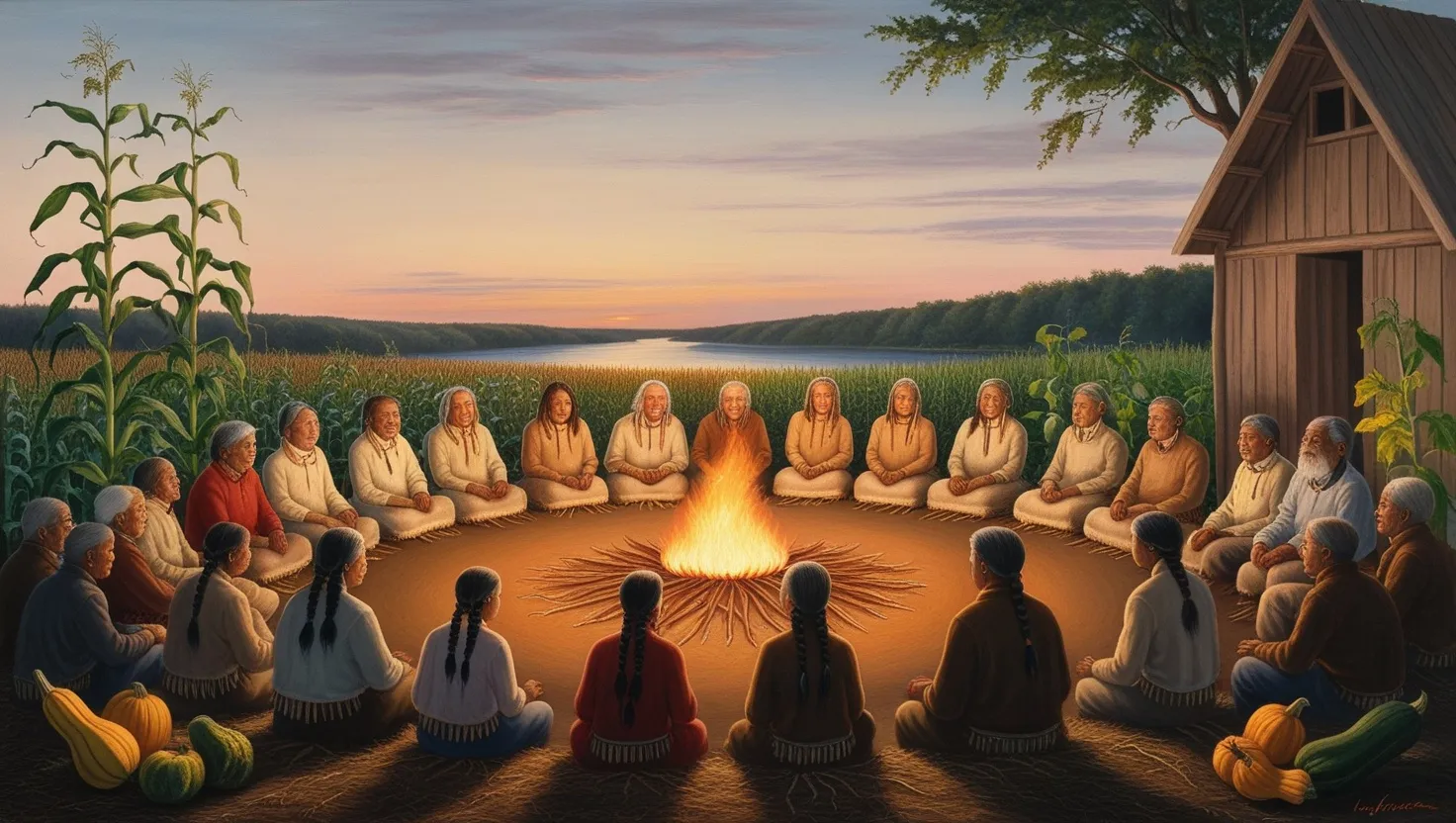
I keep coming back to a phrase attributed to Haudenosaunee thinking: “In every deliberation, we must consider the impact on the seventh generation.” Read that twice. It is not poetry. It was policy.
Before I get into the five practices, let me ask you something. When was the last time you made a decision by thinking about people who will not be born for another hundred years? Most of us struggle to think past next Tuesday.
The Haudenosaunee Confederacy, sometimes called the Iroquois Confederacy, was a political union of six nations: the Mohawk, Oneida, Onondaga, Cayuga, Seneca, and later the Tuscarora. They governed themselves for centuries using a system so effective that some historians argue it shaped the structure of the United States Constitution. Benjamin Franklin studied their council meetings. Think about that. The framers of one nation borrowed ideas from a confederacy they were actively displacing.
But this article is not a history lesson. It is a toolbox. Here are five practices, stripped of ceremony, that you can use starting tomorrow morning.
Start With Thanks Before You Start Scrolling
Haudenosaunee gatherings often open with something called the Thanksgiving Address. It is a long recitation thanking the earth, the water, the plants, the animals, the wind, the sun, the moon, and the Creator. Every single one gets named. Nothing is assumed.
Chief Oren Lyons once said, “We are looking ahead, as is one of the first mandates given us as chiefs, to make sure and to make every decision that we make relate to the welfare and well-being of the seventh generation to come.”
Notice how thanks and long-term thinking are tied together in his words. Gratitude is not soft. It is a discipline that keeps you honest about what you depend on.
Try this tomorrow. Before you check your phone, name five things out loud that you did not create yourself but rely on completely. Clean water. A working pair of lungs. A person who checks on you. A skill someone taught you. A tool that helps you earn a living.
Does that feel silly? Try it anyway. The people who built confederacies that lasted centuries were not embarrassed to speak to a river.
Grow Your Goals Like the Three Sisters
Corn, beans, and squash. Farmers up and down the Northeast grew these three together for generations, and agricultural scientists today confirm what Haudenosaunee farmers already knew without lab coats: the three plants function as a system.
Corn gives beans something to climb. Beans pull nitrogen from the air and feed it into the soil, which corn and squash both need. Squash spreads its broad leaves low to the ground, blocking weeds and locking in moisture. Remove one, and the other two struggle.
Here is a question for you. What are you currently trying to do alone that would work better as three connected parts?
Say you want to get healthier. The corn is your main structural habit, maybe a consistent sleep schedule. The bean is the supportive habit that feeds the main one, maybe short walks after meals. The squash is the protector, maybe a boundary around screen time at night that keeps the other two from getting trampled.
Businesses do this too, often without naming it. A product needs a structure, a distribution partner, and a defense against competitors eating into margins. Haudenosaunee farmers figured out interdependence with seeds. We are still catching up with spreadsheets.
Talk It Out Until Everyone Is Actually Done Talking
Here is where things get uncomfortable for anyone raised on quick votes and majority rule. Haudenosaunee councils did not vote and move on. They talked until agreement was real, not just declared.
A single dissenting voice could hold up a decision. That sounds inefficient until you realize what it prevented: the quiet resentment that builds when someone is outvoted and forced to comply anyway.
Political scientist Donald Grinde wrote about this style of governance, noting how the requirement for near-unanimous consent forced leaders to actually listen rather than simply count hands. Contrast that with how most families and companies operate today. Someone proposes something, three people nod, one person stays silent, and six months later that silent person quits or stops speaking to their spouse.
Try replacing your next group decision with a round of speaking. Everyone answers three questions out loud: What do I need? What worries me? What would make this work for me? If you cannot reach full agreement, write down the unresolved concern and set a date to revisit it.
It takes longer. It also tends to actually hold.
Ask What the Seventh Generation Would Think
This is the practice most people quote and least people apply. The Great Law of Peace, the oral constitution of the Confederacy, instructed leaders to weigh decisions against their effect on people seven generations into the future. That is roughly 140 years.
John Mohawk, a Seneca scholar and writer, described this principle as a form of accountability that Western politics rarely demands: leaders answering not to voters next election cycle, but to descendants who cannot vote at all.
So here is a question worth sitting with. What decision are you about to make where the honest seventh-generation answer would embarrass you?
A loan with terms you have not read closely. A habit that trades your health for convenience. A shortcut at work that dumps a problem onto someone else’s desk. The seventh-generation question does not ask you to be a saint. It asks you to stop pretending the future is someone else’s problem.
Keep a Fire That People Actually Gather Around
Fires held a literal and symbolic place in longhouse life. People brought disputes to the fire rather than letting them fester in private corners. The fire demanded tending, and so did the relationships surrounding it.
Chief Jake Swamp, a Mohawk faithkeeper known for the Tree of Peace planting ceremonies, spoke often about how peace requires deliberate maintenance. Peace is not the absence of conflict. It is the presence of a structure that catches conflict before it turns into rupture.
You do not need an actual fire. You need a fixed time each week where people bring their unresolved friction into the open instead of letting it curdle in silence.
Twenty minutes. One candle or bowl in the middle of the table if you want a physical anchor. Two questions for each person: What is working right now? What needs attention? No phones. No interruptions. End with one small action each person commits to before the next meeting.
Ask yourself honestly: does your household or team have anything resembling this? If not, what is currently substituting for it? Group texts at midnight? Passive aggressive comments during dinner? A slowly widening silence?
Why Any of This Still Matters
None of these five practices require you to adopt a belief system that is not yours to claim. They are structural habits, tested over centuries, aimed at keeping people connected to each other and to consequences beyond their own lifetime.
Oren Lyons put it plainly in another interview: “We do not inherit the earth from our ancestors, we borrow it from our children.” Simple sentence. Heavy weight.
What would change in your week if you treated your decisions, your goals, and your disagreements the way the Haudenosaunee treated council fires and cornfields? Not as isolated events to survive, but as living systems that need tending, patience, and an eye on the people who come long after you have stopped checking your phone in the morning.
Start with the gratitude list tomorrow. See where it leads.