Did You Know Christianity Has Its Own Mystical Traditions That Rival Eastern Religions?
Unveiling the Hidden Tapestry of Christian Mysticism Through the Ages
When people hear the word “mysticism,” Christianity might not be the first thing that pops into their heads. More often, it’s linked with Hinduism, Buddhism, or even modern New Age practices involving crystals or astral projection. But, surprisingly, the term mysticism actually has its roots deeply embedded within Christianity. While applying “mysticism” to religions like Islam or Judaism can get tricky, within Christianity, its historical context makes it less of an issue.
So, what exactly is Christian mysticism? It’s a broad topic that touches on essential aspects and figures throughout Christian history—from the early church fathers, through monastic traditions, and spanning across both Eastern Orthodox and Western Catholic spiritual practices.
Let’s step back a bit to define what mysticism even means. The term is notoriously tough to pin down because it can vary significantly depending on who you ask. Generally, mysticism involves experiences that people have with what they consider the Absolute or God.
In Christianity, we talk about moments where individuals feel a direct, often profound connection with God. Theologians and scholars have tried to define these experiences in different ways. For example, a well-regarded scholar today, Bernard McGinn, suggests mysticism in Christianity revolves around preparing for and responding to the immediate presence of God.
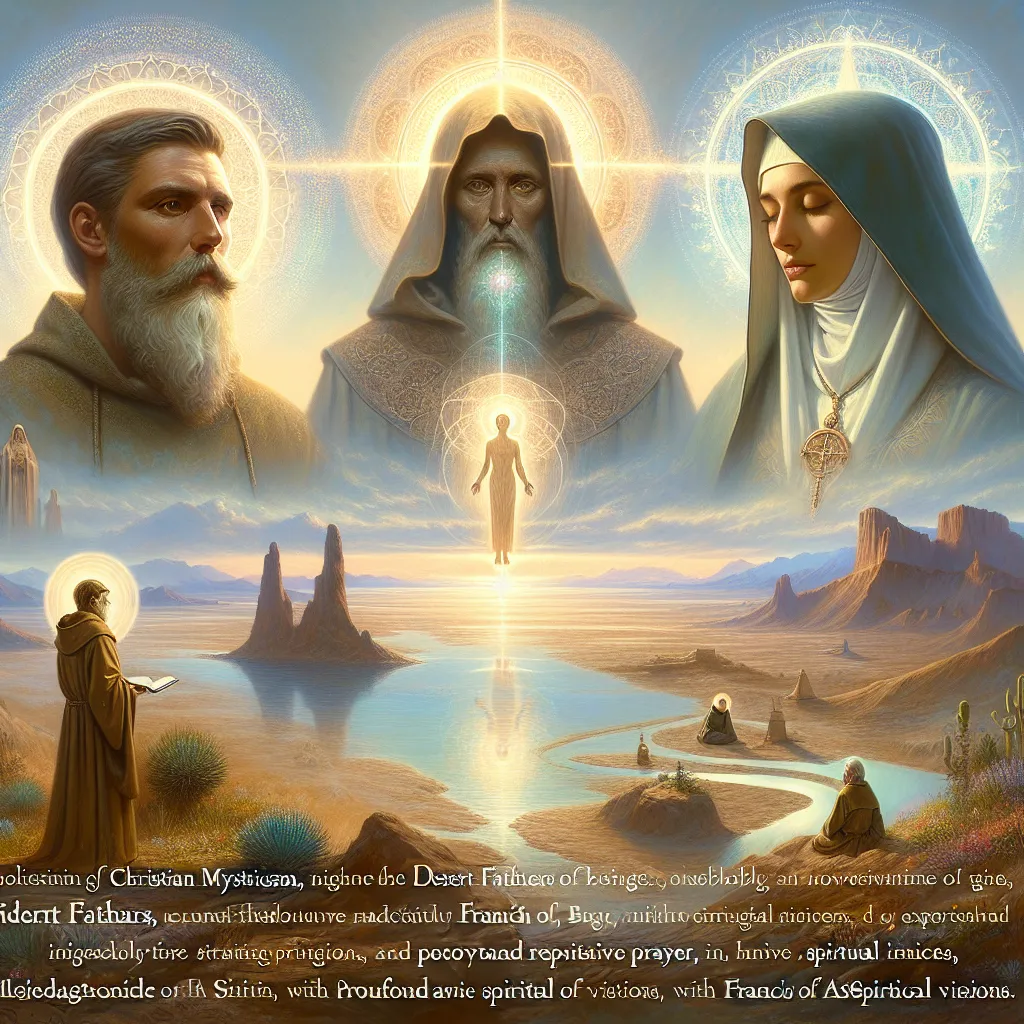
Mysticism isn’t just about visions or lofty spiritual experiences. For many Christian Mystics, the journey involves rigorous practices and a deep inner life. The early Christian monastic movement, particularly the Desert Fathers and Mothers, played a massive role in laying down the foundation for this tradition. They went to extremes, living in isolation and dedicating their lives entirely to prayer and self-denial, seeking a closer union with God.
Women also made significant contributions to Christian mysticism. Figures like Hildegard of Bingen, known for her mystical visions, and the Beguines, a movement of laywomen, were instrumental. These women described their mystical experiences in vivid, often poetic language, with many experiencing a deep, almost romantic, love for God.
As we move into the Middle Ages, monastic orders such as the Benedictines and Franciscans cultivated environments where mystical practices flourished. Prominent figures like Francis of Assisi brought a new kind of mysticism focused on living out one’s spiritual values in the world.
Across history, scholars like Meister Eckhart developed complex theological systems to describe these mystical relationships with God. Eckhart, for instance, talked about the ‘ground’ of the soul and God being one and the same. Even though some of his ideas were controversial, they left a lasting impression on Christian thought.
In the Eastern Orthodox tradition, mystical practices like hesychasm, which involves repetitive prayer and bodily postures, aimed for direct experiences of God’s presence. Gregory Palamas, a prominent defender of hesychasm, developed a theological distinction between God’s unknowable essence and his perceivable energies, balancing the mystical experiences with doctrinal clarity.
Even during and after the Protestant Reformation, where some might think mysticism would fade, figures like Jacob Boehme and Emanuel Swedenborg continued these mystical traditions, showing that the quest for experiencing God’s presence transcends doctrinal boundaries.
Today, Christian mysticism still captures the imagination of many, whether in monastic settings or among those looking for deeper spiritual experiences outside traditional frameworks. From Gregory of Nyssa to John of the Cross, these mystics offer a rich, diverse tapestry of spiritual insights that continue to inspire.
Despite the complexity and the occasional controversy, Christian mysticism remains a testament to the enduring human desire to connect with something greater. It reminds us that spirituality, in all its forms, deeply influences human history and continues to shape our lives today.