History books love to credit kings, generals, and politicians for the big turning points. But if you look closely, really closely, at some of the most dramatic shifts in human civilization, you keep finding the same quiet force working behind the scenes — faith. Not the Sunday-morning, feel-good kind. The kind that makes people march into danger, defy empires, and sometimes die for an idea they cannot even see.
Let me walk you through five moments where religious belief did not just influence history — it made it.
The Year Constantine Changed Everything
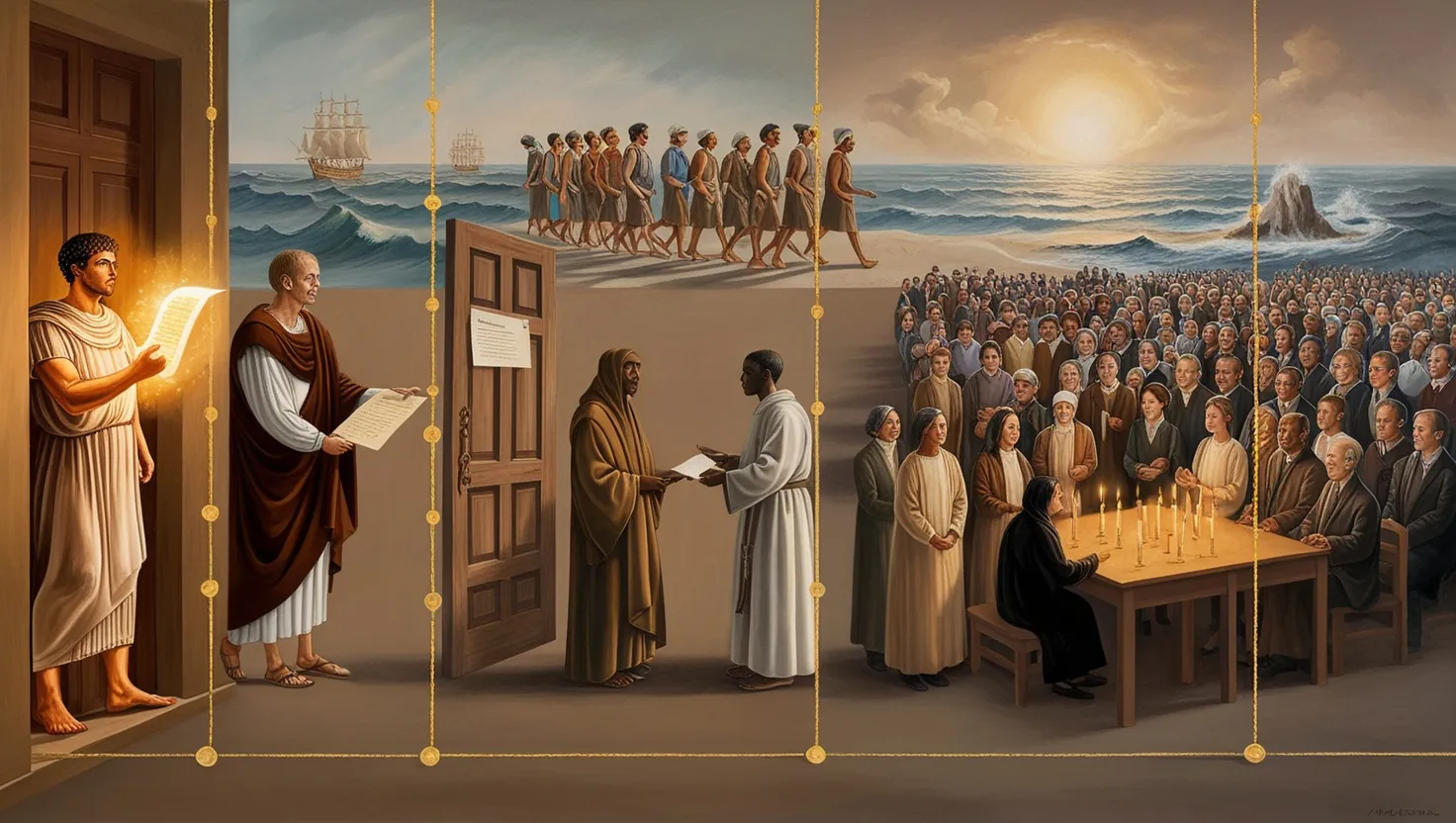
Imagine you are a Christian living in Rome around 300 CE. Your neighbors can report you to authorities. You worship in secret. Your faith is illegal, and getting caught practicing it could mean death. Then, in 313 CE, Emperor Constantine and his co-emperor Licinius sign the Edict of Milan, and overnight, everything changes.
Most people know this as “the moment Christianity became legal.” But that is only half the story. What actually happened after that edict is what makes it remarkable. Churches did not just build prayer rooms. They built hospitals. Orphanages. Schools. Shelters for the poor. The Christian idea that every human life carries inherent dignity was suddenly backed by legal protection, and believers ran with it.
What we now call “Western civilization” — its hospitals, its charity institutions, its education systems — owes a huge debt to that single legal document issued in a city most people cannot find on a map.
“Give me the liberty to know, to utter, and to argue freely according to conscience, above all liberties.” — John Milton
Here is something to think about: can a religion truly change society without political permission? The Edict of Milan suggests the answer is complicated. Faith built the vision; law opened the door.
A Monk, a Hammer, and a Printing Press
On October 31, 1517, a German monk named Martin Luther reportedly nailed a list of 95 complaints to a church door in Wittenberg. He was angry about indulgences — basically, the church selling “forgiveness tickets” to rich people. Luther wanted a theological debate. What he got was a revolution.
Here is the part that rarely gets taught in school. Luther’s ideas spread not because he was charming or powerful, but because the printing press had been invented about 60 years earlier. Within weeks, his 95 Theses were copied and distributed across Europe. Within months, they were in homes, taverns, and universities in multiple countries. For the first time in history, one person’s religious argument could reach millions before any authority could stop it.
The Protestant Reformation that followed did not just split the church. It forced ordinary people to read the Bible themselves, in their own language. Latin was the language of the clergy; German, French, and English became the languages of faith. And when people start reading and thinking for themselves, something very hard to reverse happens — they start questioning everything.
The individual conscience as a moral authority, democratic representation, freedom of speech — these are not modern secular inventions. They grew, awkwardly and painfully, from a religious argument in 16th-century Germany.
“Here I stand. I can do no other.” — Martin Luther
Ask yourself: how much of what you believe about your right to think freely traces back to a monk who simply refused to back down?
When Faith Made People Uncomfortable Enough to Act
The transatlantic slave trade was the largest forced migration in human history. Between the 16th and 19th centuries, approximately 12 million Africans were transported to the Americas under conditions of unspeakable brutality. Governments, merchants, and even churches participated in or ignored it for centuries.
What finally broke it?
The answer is not a dramatic military victory or an economic collapse. It is a group of Quakers in Philadelphia in 1688 writing the first formal protest against slavery in American history. Then more Quakers. Then evangelical Christians in Britain led by William Wilberforce and others who spent decades petitioning Parliament. They organized boycotts of sugar produced by enslaved labor — and convinced hundreds of thousands of ordinary British families to stop buying it. That is a consumer boycott in the 1790s, which is extraordinary.
Their argument was theological before it was political: every human being is made in God’s image, therefore no human being can be another’s property. It sounds simple. But that idea, preached from pulpits and printed in pamphlets, created a moral movement that governments eventually could not ignore.
Britain abolished the slave trade in 1807. The United States followed in spirit if not immediately in law. This was faith doing the slow, unglamorous, decades-long work of changing what an entire civilization considered acceptable.
“I never made a sacrifice. We ought not to talk of sacrifice when we remember the great sacrifice which He made who left His Father’s throne on high.” — David Livingstone
A Walk to the Sea That Embarrassed an Empire
In 1930, the British Empire controlled India with a combination of law, military force, and economic policy. One of those policies taxed salt — something every Indian needed to survive — while making it illegal for Indians to collect their own.
Gandhi’s response was to walk 240 miles to the coast and pick up a handful of salt.
This sounds absurd until you understand what Gandhi was doing. He was drawing on two Hindu concepts: ahimsa (non-violence) and satyagraha (truth-force or soul-force). These were not just spiritual ideals — Gandhi had spent years developing them into a precise political methodology. The idea was that moral suffering, openly accepted without retaliation, would expose the violence of the oppressor and shift the conscience of the watching world.
And it worked. Thousands joined the march. Hundreds were beaten by British police and refused to fight back. The international press covered it. The British Empire, which prided itself on being civilized, looked anything but.
What most people miss is that Gandhi did not borrow these tactics from Western political theory. He built them from Hindu scripture, the Bhagavad Gita in particular, and from his reading of Jainism and Tolstoy’s Christian pacifism. The Salt March was a religious act dressed in political clothes.
“In a gentle way, you can shake the world.” — Mahatma Gandhi
The method Gandhi pioneered went on to inspire Nelson Mandela, Martin Luther King Jr., and protest movements across six continents. One man, one spiritual framework, one walk to the beach — and the world genuinely shifted.
The Church as a Courtroom for Justice
By the 1950s, African Americans in the United States had endured nearly a century of legal segregation after the formal end of slavery. They could not eat at the same counters, attend the same schools, or vote without violent intimidation. The law was against them, and so was much of the social order.
The Civil Rights Movement, which eventually produced the Civil Rights Act of 1964, was organized almost entirely through Black churches. This is not a minor detail — it is the whole story. Black churches were the only institutions African Americans fully controlled. They were the meeting places, the communications networks, the training grounds, and the spiritual fuel for everything that followed.
Martin Luther King Jr. was a Baptist minister before he was a civil rights leader, and he never really separated the two roles. His speeches were sermons. The marches began and ended with prayer. The songs people sang in the face of fire hoses and police batons were hymns. Redemptive suffering — the Christian idea that suffering accepted with dignity can transform the moral understanding of those who witness it — was not just a theological concept for King. It was a campaign strategy.
When protesters sat at lunch counters and were pelted with food and insults, they had been trained not to respond. That training came from church. When King wrote his famous letter from Birmingham Jail, his entire argument was rooted in Augustine, Aquinas, and the prophets of the Hebrew Bible.
The Civil Rights Act that resulted was signed by a president, but it was written, demanded, and paid for by people who showed up to a movement because their faith told them justice was not optional.
“Injustice anywhere is a threat to justice everywhere.” — Martin Luther King Jr.
Here is a question worth sitting with: if African American churches had not existed as independent institutions, would the Civil Rights Movement have had the infrastructure to succeed?
These five events span sixteen centuries and four continents. They involve different religions, different cultures, and radically different political circumstances. But they share something. In each case, religious belief did not just comfort people privately — it gave them a framework for action, a language for moral argument, and sometimes a courage that ordinary self-interest simply cannot produce.
Faith, when it is serious and not merely performative, has a habit of making people do inconvenient, costly, and sometimes world-altering things. That is probably worth remembering.