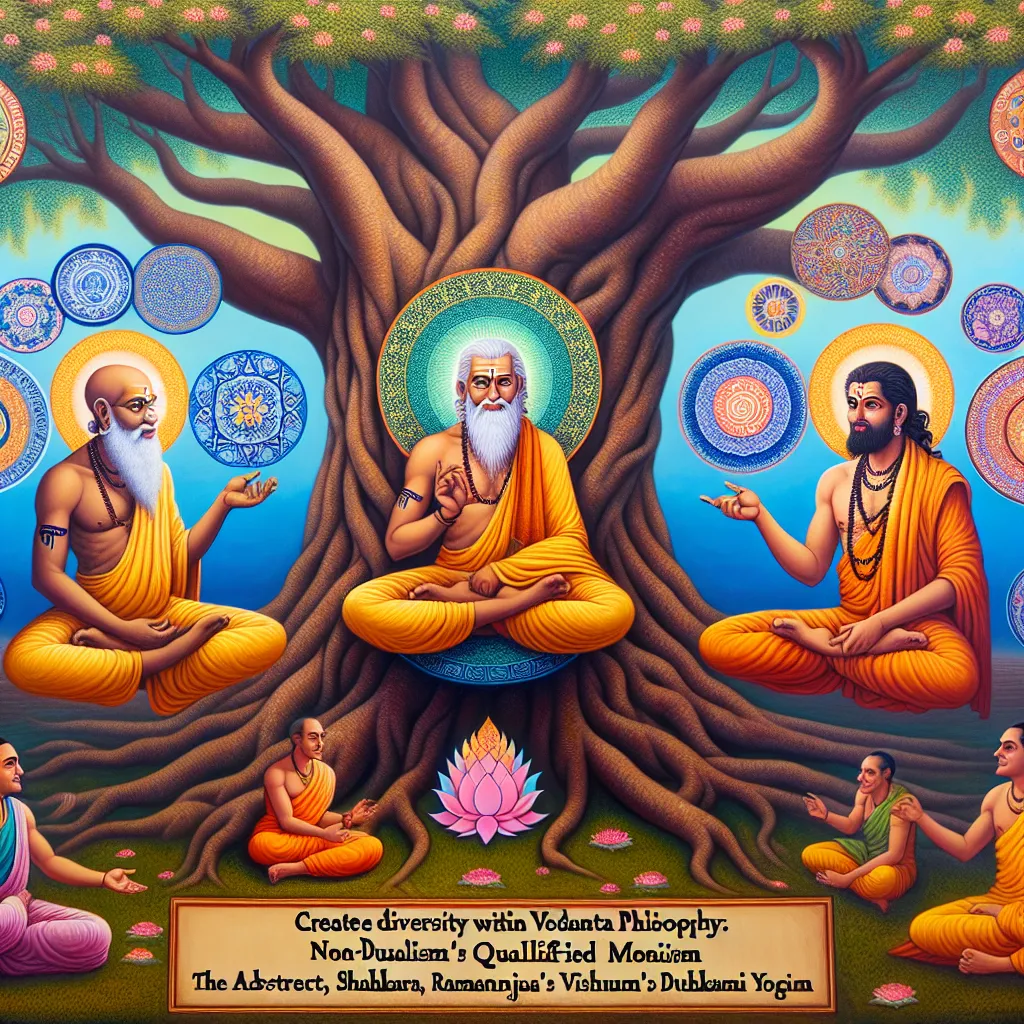
Vedanta is a crucial and renowned philosophy within Hinduism, or Sanatana Dharma. Advaita Vedanta, the non-dualistic school, is the most famous outside India. However, it’s just one aspect of this diverse tradition. Through these narratives, we admire how varied interpretations within the same religion can be.
We’ve now arrived at the concluding part of our series on Vedanta. We’ve covered Shankara’s absolute non-dualism and Ramanuja’s qualified monism. Now, we explore Madhva’s dualism, presenting an entirely different viewpoint.
Madhva’s school, known as Dvaita Vedanta, stands in direct opposition to the non-dualistic interpretations. He was born in the late 13th century near Udupi, in Karnataka, into a religiously diverse environment. His disbelief in Advaita interpretations led him to develop his own philosophical path.
Madhva’s Dvaita Vedanta divides reality into two fundamental categories: independent and dependent. The only independent reality is Vishnu (Brahman), with everything else dependent on Him. Unlike Shankara, who envisioned Brahman as formless and attributeless, Madhva saw Brahman as a personal God, full of attributes.
This school proposes that we, as individuals (atman or jiva), are entirely separate from Brahman. According to Madhva, the reality we experience is not an illusion but is genuinely real. He prioritized direct perception and scripture as means of knowledge, which differed significantly from Shankara’s sole reliance on scriptural knowledge due to the illusory nature of the world.
Madhva’s devotion to Vishnu marked the crux of his philosophy. He believed bhakti yoga (the path of devotion) was the only way to achieve liberation (moksha). Worship involves pure love, prayer, offerings, etc., and while karma yoga and gyana yoga are important, they are preparatory stages leading to true devotion.
Madhva’s influence is evident in various devotional movements, including today’s Hare Krishna movement. His legacy, rooted in the devotion to a personal deity, continues to appeal to many.
Indeed, Madhva, Shankara, and Ramanuja have illustrated the rich diversity within Vedanta, offering multiple paths within Hinduism towards understanding and liberation. Their philosophies weave a complex and colorful mosaic that remains influential even today.
And so, while this concludes our series on Vedanta, there’s a vast ocean of Indian religious traditions still to explore. Stay tuned for more deep dives into these rich intellectual currents. See you next time!