How much do we really understand about the universe beyond our galaxy? The Hubble Telescope allows us to peer as far as 13 billion light years away, yet it doesn’t answer all our burning questions. Questions like, “What’s the universe made of?” or “Could there be undiscovered matter forms?” Magic as the Hubble is, visual images alone aren’t enough. But what if we had something more—like messengers bringing us physical data from the far reaches of space? Enter cosmic rays.
Cosmic rays were discovered back in 1912 by Victor Hess. He set off with a balloon during an eclipse to measure atmospheric radiation. Contrary to the belief that such radiation came from the earth’s crust, Hess found it increased with altitude and wasn’t from the sun. The surprising conclusion? This radiation was from outer space.
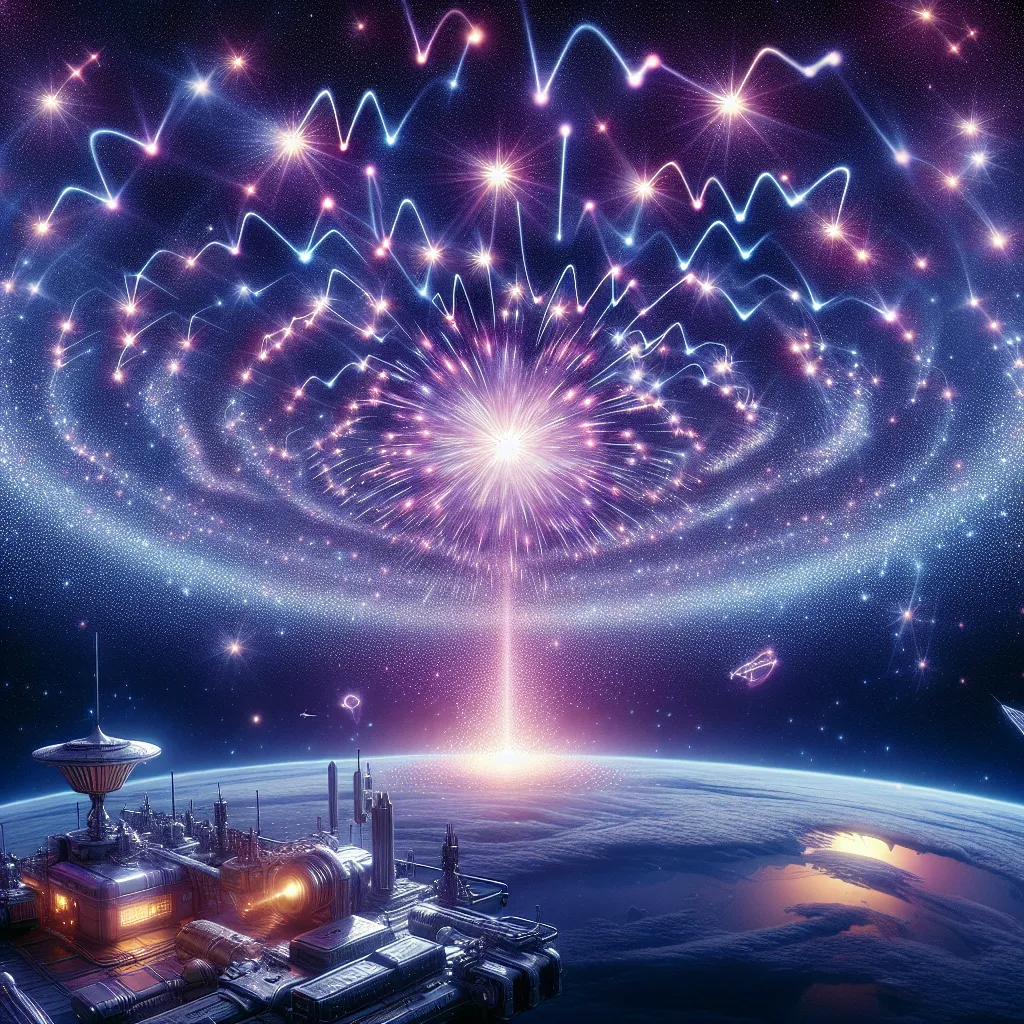
Our universe is brimming with astronomical wonders. Stars of all sizes, black holes, asteroids, and more fill the cosmic landscape. When a massive star explodes into a supernova, it shoots out trillions of particles. These exciting travelers, despite being termed ‘rays,’ are actually high-energy particles, not photons. Unlike light traveling straight, these particles zigzag, trapped in magnetic fields generated by such explosions. This magnetic dance accelerates them to almost light speed before they’re free.
There are countless cosmic rays in space, many having journeyed billions of years to reach Earth. When these particles hit our atmosphere, they collide, generating secondary cosmic rays—lighter and less energetic. While most get absorbed in the atmosphere, some touch the ground, even passing through us. Though the radiation at sea level is minimal, airline crews at higher altitudes experience much more exposure.
What’s fascinating about cosmic rays is they carry information about their origins. By studying these particles, scientists can determine the abundance of elements like hydrogen and helium in the universe. But cosmic rays also hint at deeper cosmic secrets. Thanks to the Alpha Magnetic Spectrometer (AMS) on the International Space Station, our grasp of this data is growing. This advanced experiment measures particle speed, direction, radiation, mass, and whether it’s matter or antimatter. Despite looking identical, the opposing charges of matter and antimatter allow detection with magnets.
The AMS is a cosmic ray detective, collecting data on 50 million particles daily. This real-time information relayed to CERN might reveal astonishing insights about antimatter, dark matter, and counter cosmic radiation—crucial for space travel.
As we await groundbreaking discoveries, look up on a clear night. The International Space Station, hosting the AMS, might just be visible. It’s out there, decoding the cosmic messages sent by particles to unlock the universe’s mysteries.