There was once a time when events in the universe were seen as random miracles or the workings of divine forces. But ancient Greek civilizations began to explore logic and rationality to explain how the world worked. This led to a significant shift in understanding through thinkers like Galileo and Newton, who introduced classical mechanics. The universe was then viewed as a precise, mechanical clock, where phenomena could be predicted and explained through observations and mathematical equations.
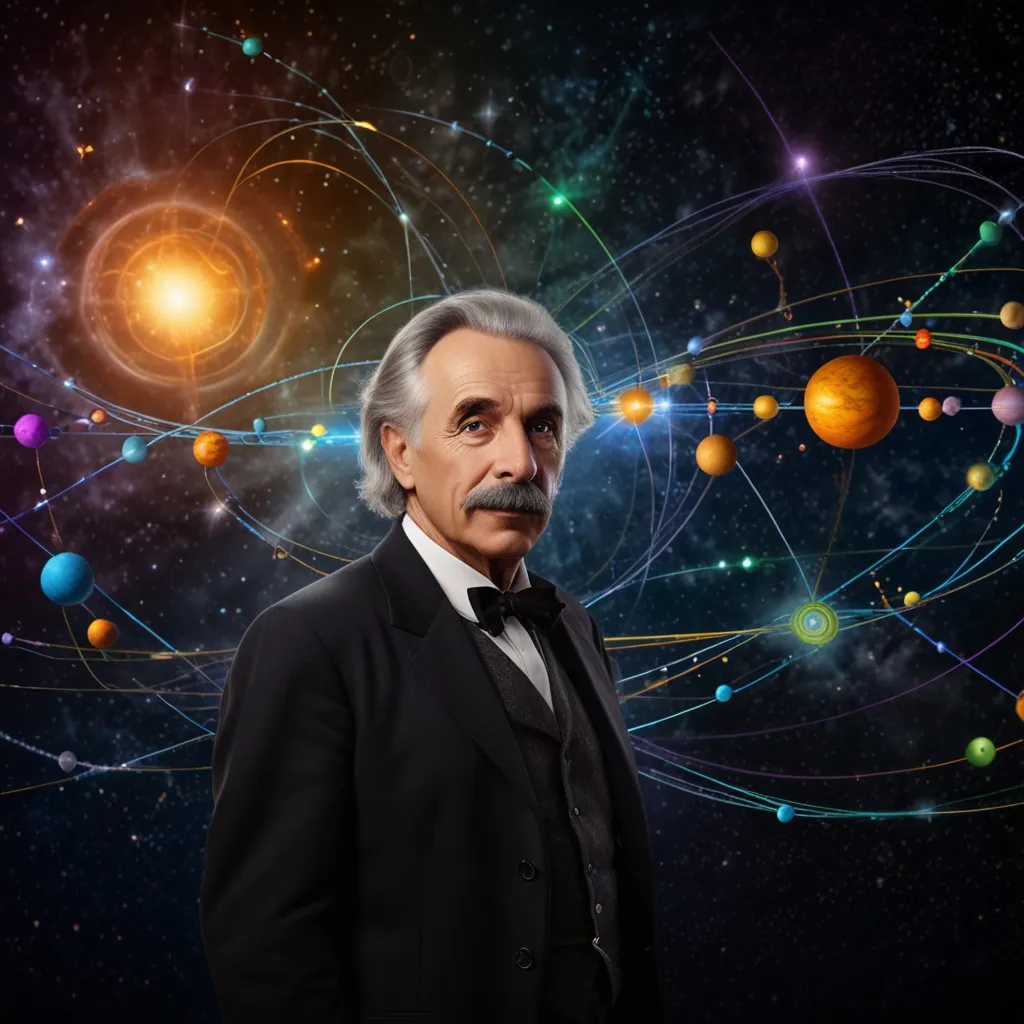
The early 20th century brought another profound shift with the advent of relativity and quantum mechanics. Suddenly, time and the exact location of particles were no longer fixed. Pioneers like Einstein, Planck, Bohr, and Schrödinger led this charge, changing our understanding of the universe once again.
However, the story didn’t end there. A more recent development in physics, though less publicized, has been equally transformative: Quantum Field Theory (QFT). QFT has made quantum mechanics more complete and is the foundation of the Standard Model of particle physics, the best theory we have today to explain almost everything.
Quantum mechanics was a great leap forward but had its limitations. It failed to describe various phenomena, particularly when objects moved at speeds close to light and didn’t account for particles’ creation and annihilation. This is where Quantum Field Theory steps in.
Quantum Field Theory blends classical field theory, special relativity, and quantum mechanics. Unlike quantum mechanics, QFT includes fields for every particle in the Standard Model. These fields extend across all of space-time, creating and annihilating virtual particles constantly. It’s like an ocean with turbulent waves, where enough energy creates measurable particles.
In QFT, particles are excitations in these fields, and energy transfer between fields mediates interactions or forces. This theory elegantly accounts for particle creation and annihilation and is fully relativistic, avoiding causality violations.
Despite its beauty, QFT isn’t perfect. It doesn’t include gravity yet because we lack a quantum field theory for gravity, theoretically mediated by gravitons. This gap leaves QFT incomplete but still the most accurate framework we have.
In essence, QFT reveals that everything in the universe, from stars to our thoughts, is interconnected through these fields. It’s not just a poetic notion; it’s a physical reality. Our understanding of the universe makes us a part of this beautiful, complex web of excitations, all tied together by the aforementioned quantum fields. And that’s a stunning realization of how far we’ve come in comprehending our place in the cosmos.