Did you know that we share a surprising amount of DNA with other living things, including tomatoes? While it’s common knowledge that humans and apes share a common ancestor, our connections to the rest of the living world run even deeper.
All living things, from the orangutan at your local zoo to the tomato on your sandwich, share a fundamental building block: DNA. This molecule, composed of just four nucleotides, forms the blueprint of life. The sequence of these nucleotides creates the immense variety of life on Earth.
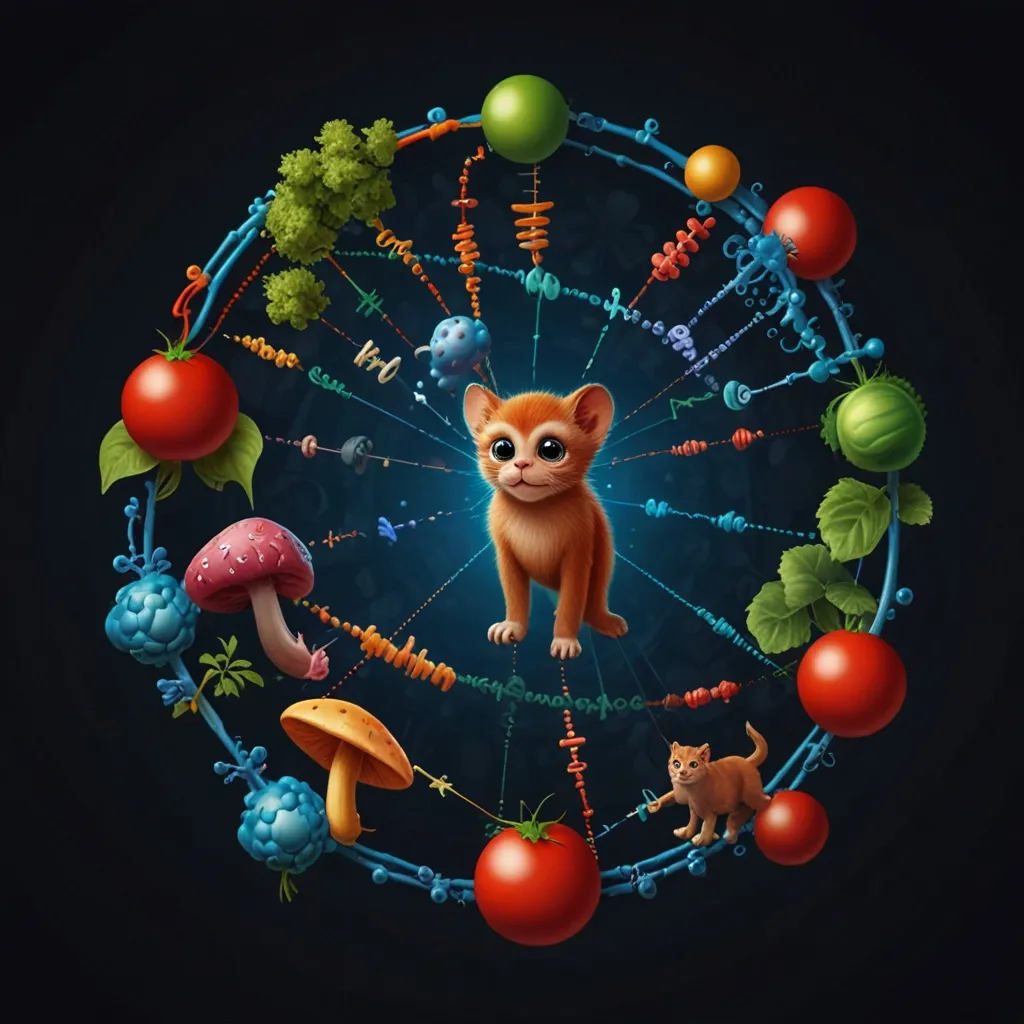
Researchers have discovered that plants, animals, worms, your pet cat, and even mushrooms have common DNA sequences, confirming that all life shares a common ancestor. This ancestor, known as LUCA (Last Universal Common Ancestor), likely existed around 3 to 4 billion years ago. LUCA was probably a single-celled organism at a time when Earth was still in its infancy.
Imagine that every time you chop down a tree, kill a chicken, or order a mushroom pizza, you’re interacting with distant relatives. Humans share 99.9% of our genes with each other, 99% with chimpanzees, 90% with cats, 70% with worms, 60% with mushrooms, and 50% with tomatoes and onions.
The evolutionary paths we share reveal fascinating connections. For example, our common ancestor with mushrooms split off about a billion years ago, which might explain why eating a mushroom can feel more like eating chicken than a salad.
So, the next time you look at a tomato or savor a mushroom on your pizza, remember the deep and intricate web of life that ties us all together.