How Does a Never-Ending Number Shape Our Universe?
Circles, Pyramids, and Quantum Computers: The Timeless Voyage of Pi
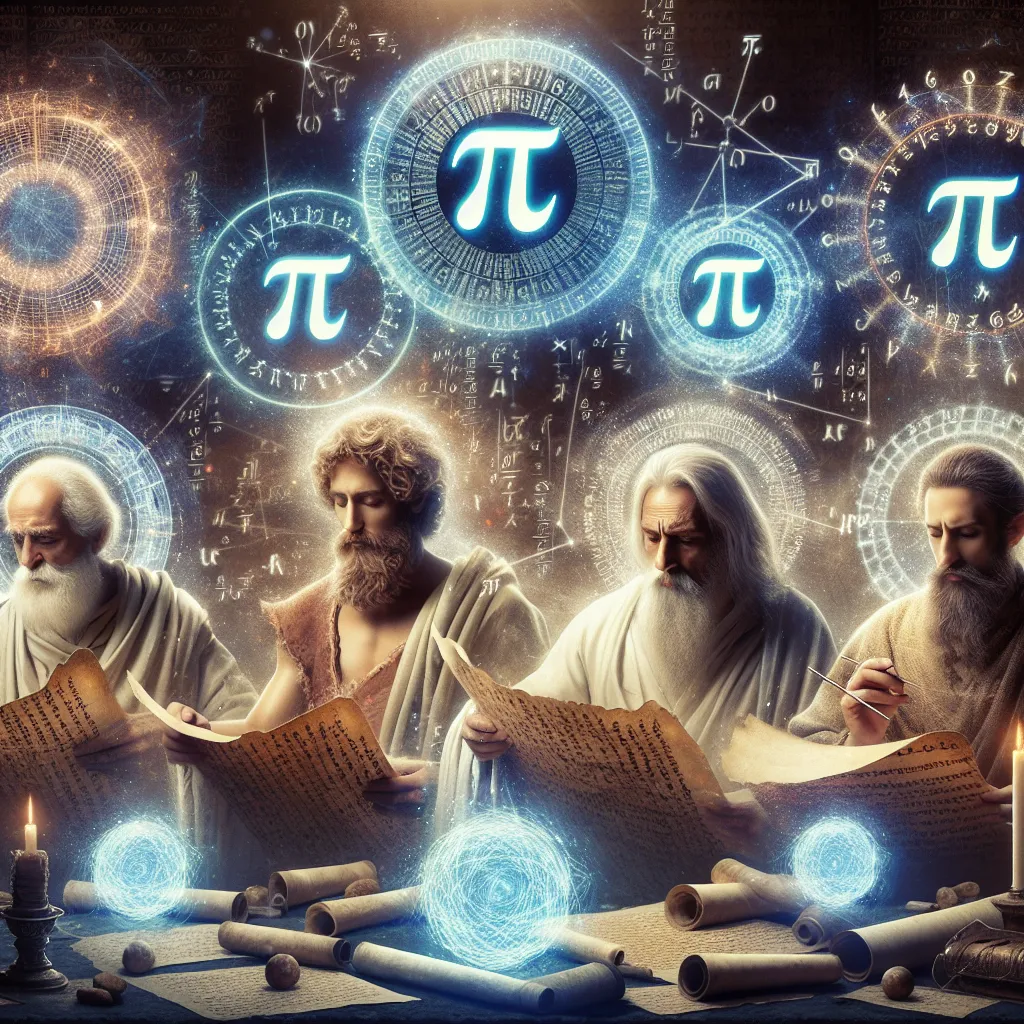
Measuring a circle sounds easy at first. You can grab a ruler to measure its diameter or radius. But when it comes to the circumference, things get trickier. You might need a piece of string or a measuring tape. Yet, there’s an interesting twist: the relationship between a circle’s circumference and its diameter is a constant, known as pi.
Historians don’t know exactly when pi was discovered, but this intriguing number has been part of human knowledge for nearly 4,000 years. Ancient mathematicians from Greece, Babylon, China, and India knew about pi, and there’s evidence it played a role in constructing the Egyptian pyramids. By inscribing polygons within circles, mathematicians had calculated pi to ten decimal places by the 1400s.
Yet, pi never shows its exact value. That’s because it’s an irrational number, meaning it can’t be expressed as a simple fraction of two whole numbers. No matter how far you go in writing out its decimal form, it never ends—starting with 3.14159 and going on forever! To keep things simple, we use the Greek letter π.
Today, we use computers to push the limits of how many digits of pi we can calculate, with quantum computers reaching up to two quadrillion digits. People even compete to memorize thousands of these digits, setting records beyond 67,000.
Surprisingly, in most scientific fields, the first forty digits of pi are usually enough. So, where is pi used? Well, it’s essential in any calculations involving circles, like figuring out the volume of a soda can or the orbits of satellites. Pi also helps in studying curves and periodic systems, contributing to our understanding of clocks, electromagnetic waves, and music.
In statistics, pi aids in calculations involving the normal distribution curve, which is crucial for standardized tests, financial models, and scientific results. In the realm of particle physics and experiments conducted by the Large Hadron Collider, pi’s role is significant, considering the circular motion of tiny particles.
Even in proving complex theories like light functioning as both a particle and a wave, pi is pivotal. It has been used to calculate the universe’s density, despite the universe having far less “stuff” than the endless digits of pi. So, pi is much more than just a mathematical curiosity—it’s a key player in understanding our world and beyond.