Is There a Hidden Planet Lurking in Our Solar System?
The Pluto Paradox and the Quest for the Elusive Planet Nine
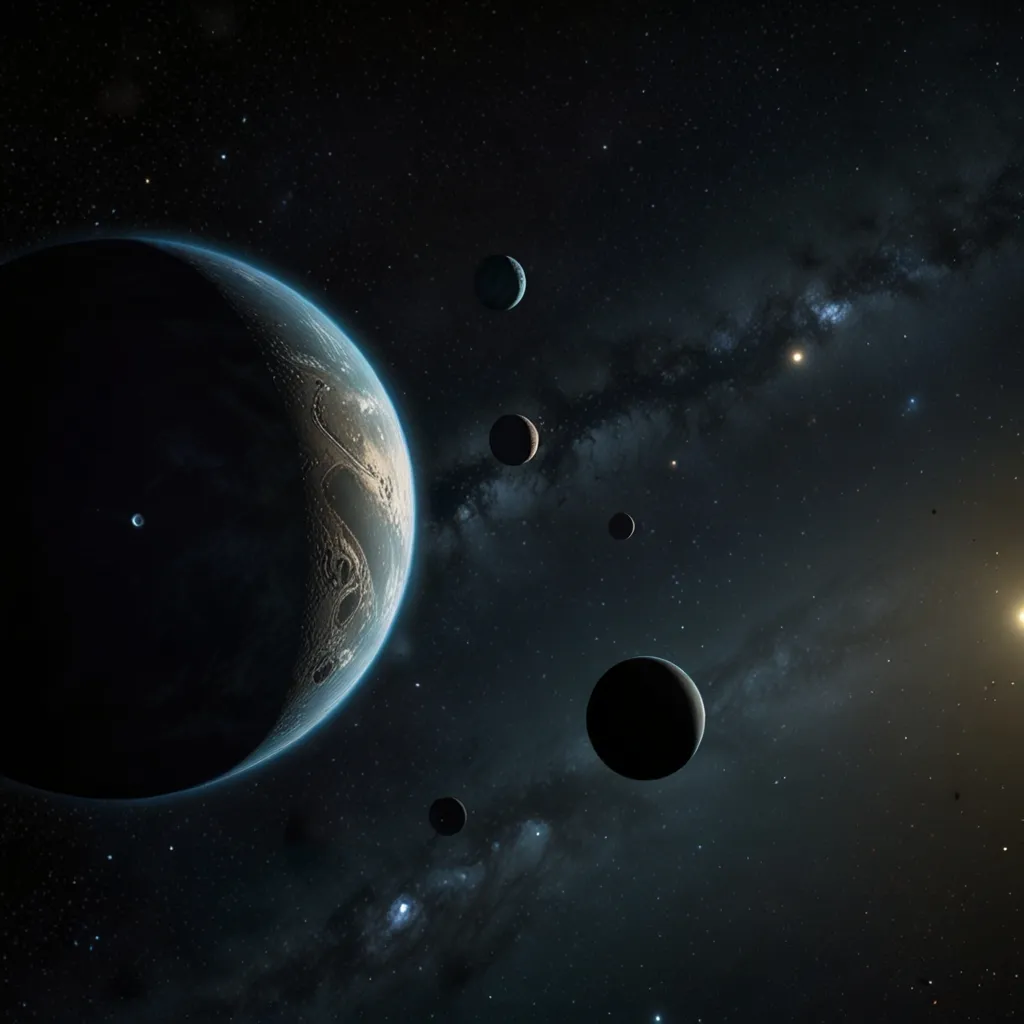
When I was a kid, we learned about nine planets in our solar system. But things change. Pluto, discovered in 1930, was once the ninth planet. That lasted until 2006 when it got reclassified as a dwarf planet, leaving us with just eight main planets.
The story of Pluto’s demotion began with Uranus, the seventh planet. Scientists noticed its orbit wasn’t quite right, even with Neptune, the eighth planet, taken into account. They predicted there must be a ninth planet affecting Uranus’s orbit. When Pluto was found, it seemed like the mystery was solved. But Pluto wasn’t massive enough to be the culprit behind the orbital oddities of Uranus and Neptune.
Back to square one, scientists have been hunting for this hypothetical “Planet Nine” ever since. The idea is similar to how we discovered other planets historically. Before telescopes, Mercury, Venus, Mars, Jupiter, and Saturn were known because they’re visible to the naked eye. Uranus was found in the 18th century thanks to advances in astronomy, and later, Neptune was discovered because its gravitational effects on Uranus hinted at its presence.
But what about this elusive Planet Nine? Despite modern telescopes and advanced technology, it remains unseen. One theory suggests it’s dark and far from the sun, so few photons reach and reflect back from it, making it incredibly difficult to detect. It would be like trying to spot a pea miles away.
Scientists debate its existence. Some suggest that an unknown planet could explain the peculiar orbits of Uranus, Neptune, and other distant objects, known as Trans-Neptunian Objects or TNOs. Observations show these objects behaving unexpectedly, clustered in their approach to the sun, and tilted in their orbits.
In 2016, two astronomers from Caltech proposed that a ninth planet, potentially four to ten times the mass of Earth but much smaller than Neptune, could explain these peculiar orbits. This “shepherding” effect would account for the anomalies observed far beyond Neptune.
What might Planet Nine look like? It could be:
- A rocky “super-Earth,” which is unusual for our solar system since such planets are typically found closer to their star.
- An ice giant with a hidden liquid ocean, similar to Jupiter’s moon Europa.
- A gas giant like a mini-Neptune, with a core of rock and a thick, faint atmosphere.
The possibility of Planet Nine being a primordial black hole has also been suggested, though this theory is less favored.
Scientists have offered various origins for this mysterious planet. It might have been ejected from our solar system early on, captured from another star system, or a rogue planet that our sun’s gravity snagged.
Until we find Planet Nine, its existence is speculative. Newer telescopes, like the James Webb Telescope, improve our chances of discovering it. Perhaps it’s already in current telescope data, waiting for an alert eye to spot it.
The search for Planet Nine not only captures the imagination but also drives home how much there is still to learn about our cosmic neighborhood. The mysteries out there keep the quest for knowledge vibrant and ever-evolving.