Imagine a world where sound waves can create tiny, imploding bubbles that emit brief, intense flashes of light. This phenomenon, known as sonoluminescence, has fascinated scientists for decades and continues to be a mystery that challenges our understanding of fundamental physical processes.
Sonoluminescence was first discovered in 1934 by German chemists who were working with sonar systems during World War I. They observed that intense sound waves could initiate chemical reactions in liquid solutions, and later experiments revealed that these sound waves could also produce light. The discovery sparked a wave of interest, but the exact mechanism behind this light emission remains unclear even today.
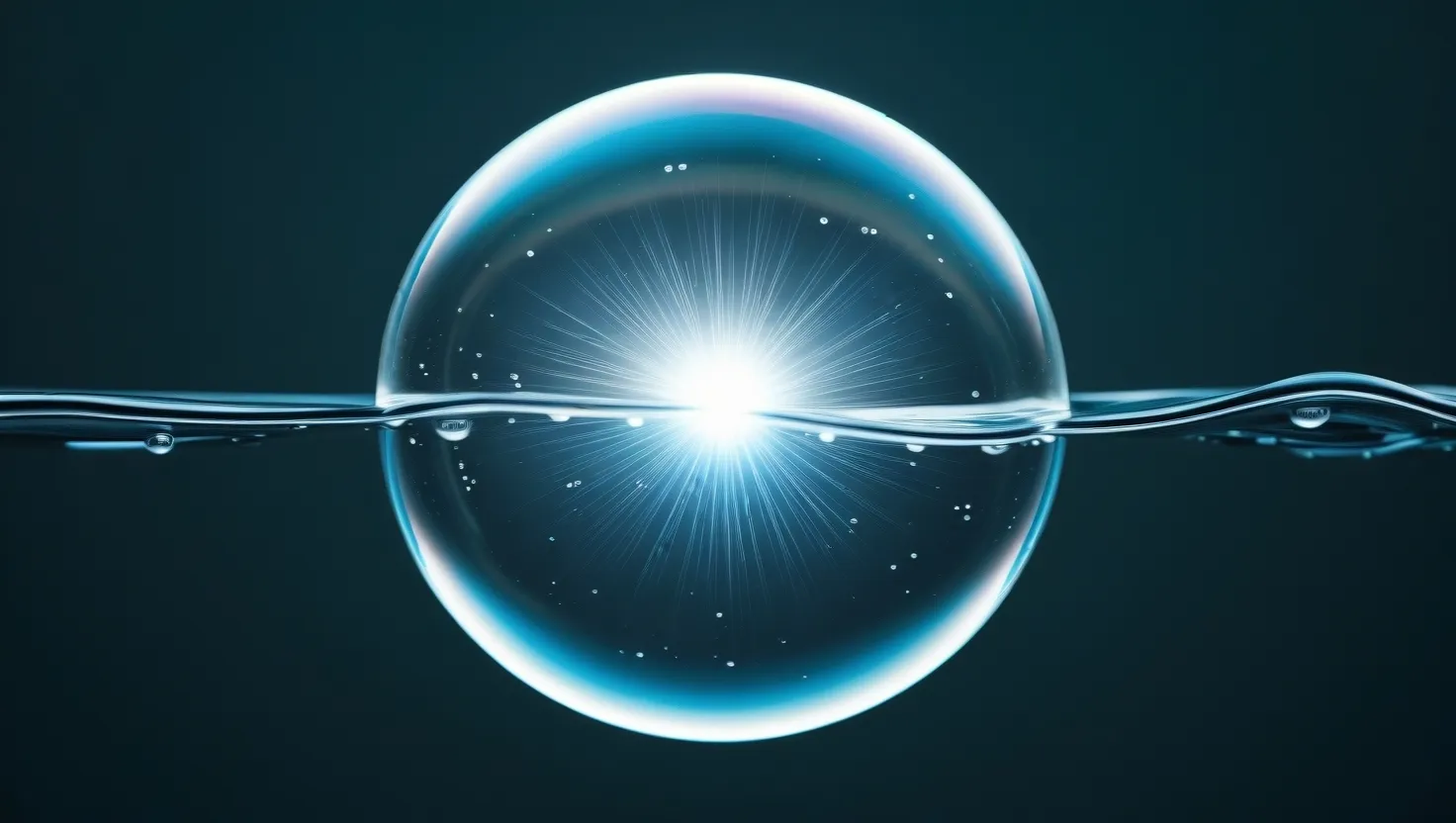
To understand sonoluminescence, let’s start with the basics. It involves creating a bubble of gas, usually air, within a liquid, typically water. This bubble is then subjected to intense sound waves, which cause it to expand and contract rapidly. During these contractions, the bubble collapses with such force that it emits a burst of light. This process is repeated over and over, creating a periodic flash of light that can be observed with the naked eye.
The key to sonoluminescence lies in the acoustic suspension of the bubble. In a laboratory setting, a standing acoustic wave is set up within the liquid, and the bubble sits at a pressure antinode of this wave. This precise positioning allows the bubble to expand and collapse in a highly controlled manner, emitting light each time it collapses. The frequencies of resonance depend on the shape and size of the container, making each experiment unique.
One of the most intriguing aspects of sonoluminescence is the extreme temperatures achieved inside the collapsing bubble. These temperatures can reach up to 12,000 kelvins, which is hotter than the surface of the sun. This heat is generated through a process known as adiabatic heating, where the compression of the gas inside the bubble increases its internal energy without any heat transfer to or from the surroundings. The result is a tiny, incredibly hot environment that sustains pressures far beyond what would be expected under normal conditions.
The light emitted by these bubbles is not just any ordinary light; it is primarily ultraviolet and lasts for only a few picoseconds. To put this into perspective, a picosecond is one trillionth of a second, making these flashes incredibly brief. The peak intensities of these light bursts can be as high as 1-10 megawatts, which is an astonishing amount of energy considering the tiny size of the bubble.
Several theories attempt to explain the mechanism behind sonoluminescence. One of the most popular theories suggests that the light is produced through thermal processes. According to this theory, the rapid collapse of the bubble generates high temperatures and pressures that ionize the gas inside, leading to thermal bremsstrahlung radiation. This radiation is similar to the light emitted by hot, ionized gases in stars.
Another theory, though more exotic, proposes that the light could be generated by quantum effects. This hypothesis, suggested by physicist Julian Schwinger, involves the conversion of virtual photons into real photons due to the rapid movement of the bubble’s interface. This idea is related to the Casimir effect and the Unruh effect, both of which deal with the behavior of particles in extreme conditions.
Despite the various theories, the exact mechanism of sonoluminescence remains a topic of debate. Researchers continue to study both single-bubble sonoluminescence (SBSL) and multi-bubble sonoluminescence (MBSL) to gain a deeper understanding. SBSL, where a single bubble is studied, provides more accurate data because the bubble is not influenced by neighboring bubbles. In contrast, MBSL involves multiple bubbles and is more complex due to interactions between them.
The potential applications of sonoluminescence are vast and exciting. In medical imaging, for instance, the high-energy light emitted by these bubbles could be used to create detailed images of the body. The process could also have implications for energy production, as it demonstrates a way to concentrate energy to extremely high densities. Although these applications are still in the early stages of research, they highlight the significant potential of this phenomenon.
Sonoluminescence also has a natural counterpart in the animal kingdom. The mantis shrimp, for example, uses a similar mechanism to stun its prey. When the shrimp snaps its claws, it creates a sonic shockwave that generates cavitation bubbles in the water. These bubbles collapse with such force that they produce a flash of light, a phenomenon that has fascinated both biologists and physicists.
The study of sonoluminescence is not just about understanding a peculiar phenomenon; it also challenges our fundamental understanding of energy and quantum effects. It shows us that even in simple experiments, complex and extreme conditions can be achieved, pushing the boundaries of what we thought was possible.
In conclusion, sonoluminescence is a fascinating phenomenon that continues to intrigue scientists and the general public alike. Its ability to convert sound waves into light through the collapse of tiny bubbles opens up new avenues for research and potential applications. As we delve deeper into the mysteries of sonoluminescence, we are reminded of the awe-inspiring complexity and beauty of the physical world around us.