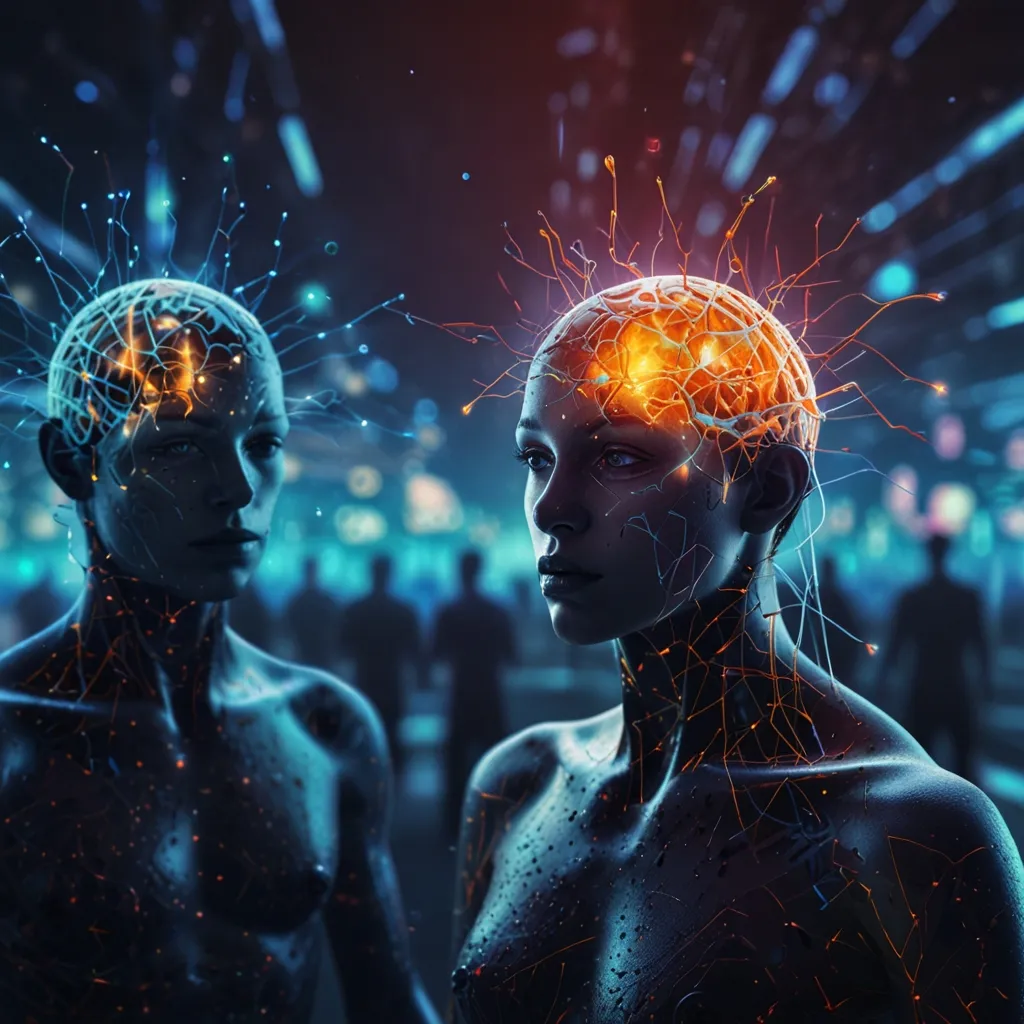
Imagine a world where death becomes a concept of the past. Instead of dying, our minds get uploaded into a digital universe. In this simulated paradise, we’d exist through avatar bodies and still influence the real world. The idea of mind uploading sounds amazing, but what would it really take to make this science fiction into reality?
The main hurdle is scanning a brain in insane detail and recreating that detail flawlessly in a digital format. The human brain has about 86 billion neurons, linked by at least a hundred trillion synapses. All these connections form a pattern called the connectome. Unfortunately, we haven’t mapped it out yet.
Each neuron connection, or synapse, differs slightly. Some are faster, some slower. Some adapt quickly as we learn, while others remain stable. Beyond these direct connections, neurons can broadcast signals that affect multiple neurons simultaneously. To replicate a person’s mind, we’d need to map all these complex interactions. Plus, we have glia cells, which outnumber neurons and also influence brain activities. Our knowledge about these cells is still limited.
Assuming we someday grasp the full complexity of the brain, how would we go about scanning it? Today’s best non-invasive method, MRI, offers a resolution of about half a millimeter. But to detect a single synapse, we need a resolution of about a micron, which is a thousandth of a millimeter. This is way beyond what MRI can handle without damaging tissues.
Scanning a dead brain with an electron microscope is an option, but even that tool isn’t advanced enough and would require the subject to be deceased. If we ever get to the point where we know what needs to be scanned and develop the tech to do it safely, we’d still face the challenge of recreating all that info digitally.
Though computing power and storage are improving rapidly, they’re not there yet to handle such enormous data sets. Artificial neural networks already assist in various tasks like internet searches, digital assistants, and self-driving cars. But none have yet been built with 86 billion neurons.
Capturing the entire mind accurately is crucial. Any missed detail could create a flawed digital mind. While the idea of mind uploading is theoretically possible, we’re likely centuries away from having the required technology and understanding.
Moreover, this concept raises ethical and philosophical questions. Who would get to upload their minds? Would these digital minds have rights? Could such technology be misused? Even if mind uploading becomes feasible, the debate over whether we should pursue it remains wide open.