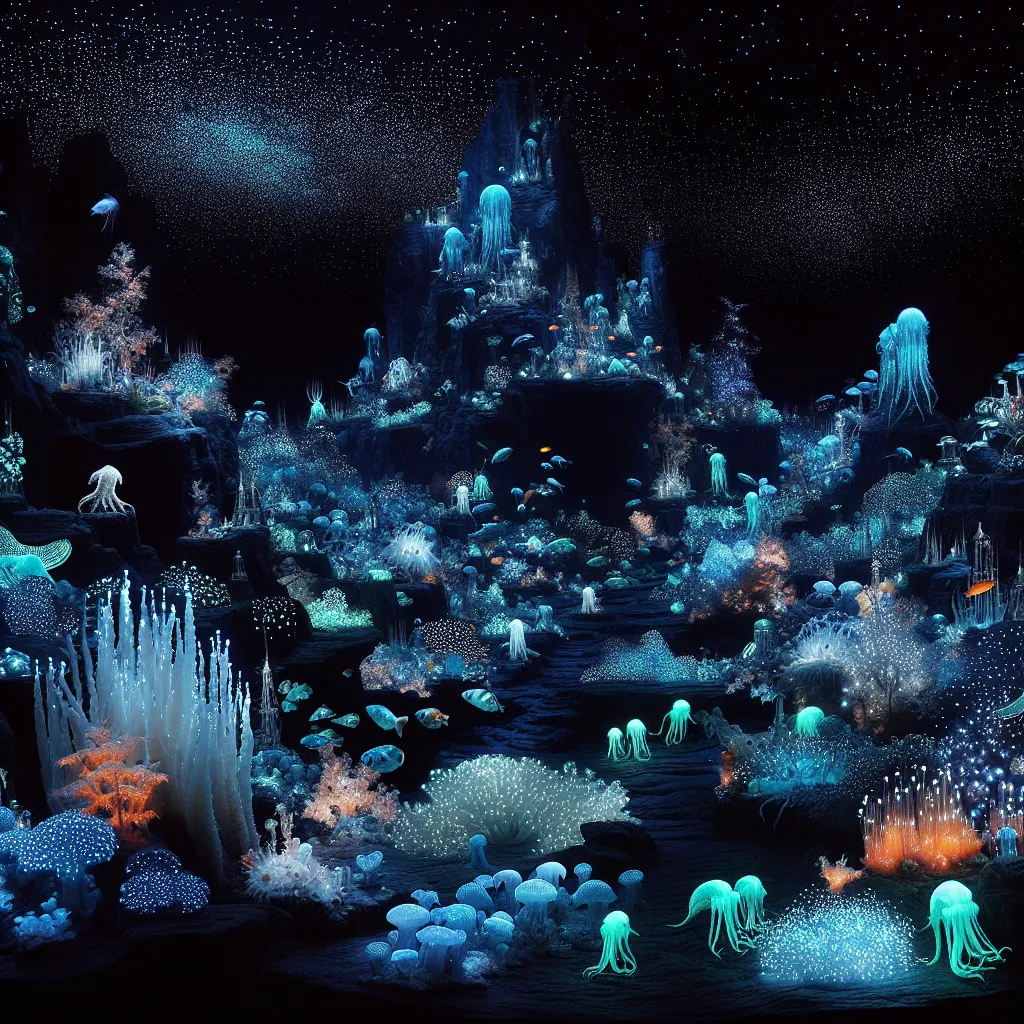
Let’s take a dive into the mysterious deep sea, a place where almost nothing is as it seems. For those lucky enough to descend those two and a half hours into the darkness, they know it’s a pitch-black world teeming with otherworldly creatures. Imagine blinking lights and bioluminescence everywhere—like underwater fireflies! Dr. Edith Witter of the Ocean Research and Conservation Association developed a camera to capture these stunning visuals. What you see are animals with glowing eyes and pulsating colors, some designed to avoid predators and others to lure in prey.
Surprisingly, we’ve only explored about 3% of the ocean. Yet, even this small fraction has revealed wonders like the highest mountains, deepest valleys, and even underwater lakes and waterfalls. There’s so much life, more densely packed than in tropical rainforests, suggesting that the ocean is still largely a mystery to us.
Now, let’s bring it up to the shallow waters and the fascinating creatures there, like the cephalopods, which you might know as squid or octopuses. Watching an octopus settle on a reef and blend seamlessly into the background is like witnessing magic. They can change their skin’s color and texture in an instant to camouflage themselves, a skill essential for escaping predators or sneaking up on prey.
Squid have their own tricks. When male squids fight, they turn white and engage in a unique battle by bouncing their rears together. Males can also split their coloration, showing one side with aggressive colors to rivals and a gentler side to potential mates. It’s like wearing two different suits at once.
Cuttlefish, too, are little Houdinis of the ocean. A giant Australian cuttlefish can back into a crevice and make its tentacles look just like algae, rendering it nearly invisible. Even during fights, these creatures change their skin’s patterns to avoid actual harm.
One particularly mind-blowing moment is seeing an octopus disguised as a rock, sliding across the ocean floor, blending into its environment seamlessly. It’s the ultimate in natural cloaking technology.
In these shallow waters, full of predators like the barracuda, the ability to blend into the background is crucial. Watch an octopus change its skin color and texture in seconds to match the algae-covered floor. If it’s spooked, it can eject a cloud of ink and swell up to look more intimidating.
The wonders of the ocean, both deep and shallow, continually reveal new and fascinating lessons. There’s a reason marine biologists are drawn to this watery world; it’s a treasure trove of the unknown, waiting to be discovered.