When we observe the world, we usually see a vibrant array of colors. Our eyesight, the most dominant human sense, only perceives a minute segment of the electromagnetic spectrum. This visible spectrum spans frequencies between 4.3 x 10^14 Hz to 7.5 x 10^14 Hz, leaving out other electromagnetic waves like radio waves, microwaves, infrared light, ultraviolet light, X-rays, and gamma rays.
Light is energy in the form of an electromagnetic wave, simplified by the energy equation E = hν, where E stands for energy, h is Planck’s Constant, and ν is the frequency. All electromagnetic waves essentially follow this principle, with higher frequencies being more energetic. However, what makes light special is its speed. Photons, the tiny massless particles comprising light, travel at the universe’s maximum speed, setting an upper limit for information transfer and maintaining causation across the cosmos.
Einstein’s theory of relativity brought a new dimension to understanding the universe, showing how our perceptions shift as we near light speed. Everyday speeds in cars or airplanes are too slow to notice these effects, but hypothetically, moving closer to the speed of light would immerse us in a bizarre reality where nothing looks as it typically would.
A common everyday example related to this concept is the ambulance siren you hear changing pitch as it passes by—a phenomenon known as the Doppler effect. This effect extends to light waves, significantly impacting high-speed astronomical observations. Most galaxies appear redshifted, meaning their wavelengths stretch as they move away from us. Conversely, some galaxies moving towards us exhibit blue shift.
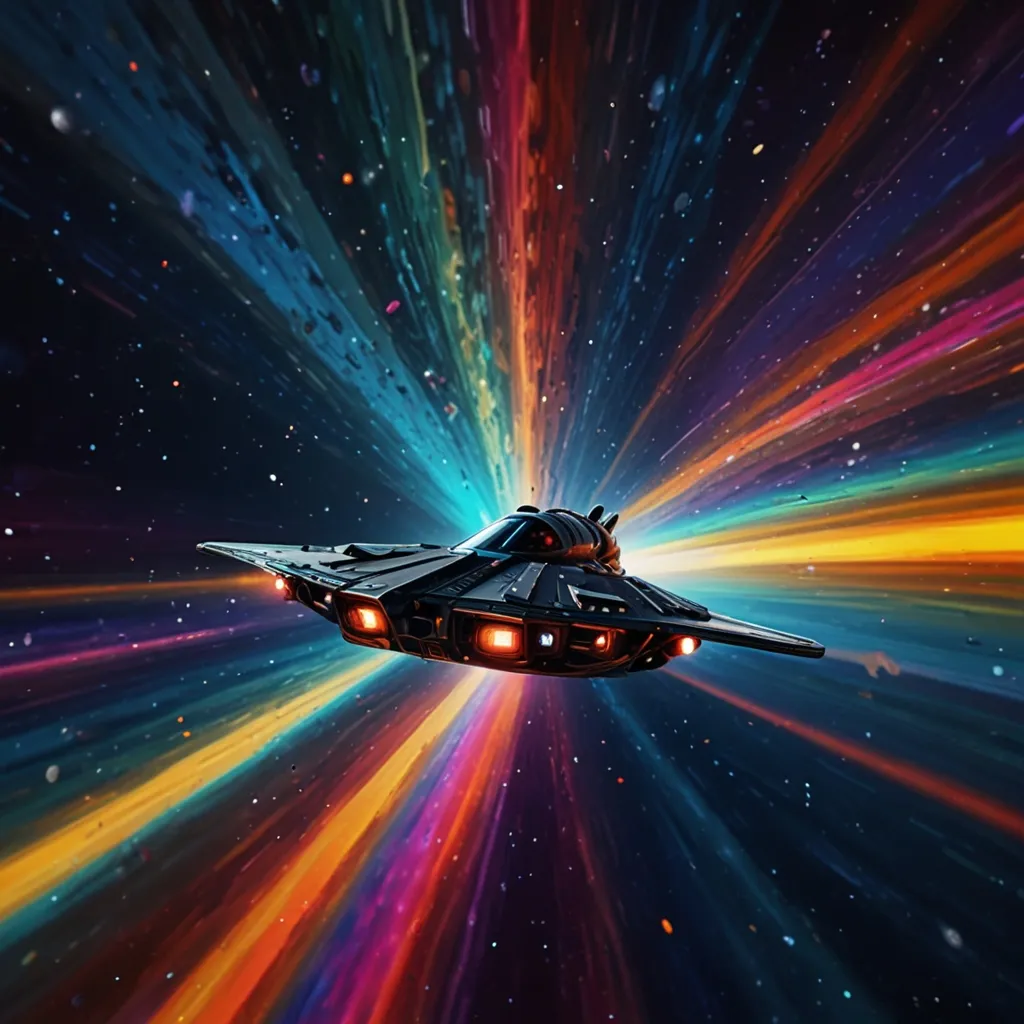
Imagine traveling in a spaceship near light speed—say at 20% of light speed—and approaching a traffic light in space. The relativity theory implies that you would perceive the red light as yellow due to the Doppler effect. Speed up to 25% of light speed, and the red light appears green—a visually deceptive universe shaping what you perceive.
Relativistic aberration or the “Searchlight effect” is another trippy result of nearing light speed. Light appears brighter in your direction of travel since you’re intercepting more photons, but dimmer behind you due to fewer photons hitting your eyes. Your surroundings would warp, and lengths would contract, seeming to squash objects together, though they’d appear curvier due to how photons from different parts of the object reach you at different times.
Furthermore, time itself alters at relativistic speeds. Traveling rapidly, time slows down for you relative to a stationary observer. A journey to Proxima Centauri, which normally takes 4.5 light years, feels like just 3.6 light years. Conversely, objects appear farther away in the front view of your spaceship, while seeming much closer in the rear view due to this length contraction.
This distortion makes your forward view akin to a fisheye lens effect, where the view broadens and warps drastically, turning reality into an almost dream-like vision. Our conventional perception of time and space shatters, replacing it with a relative, dynamic view in constant flux.
This mind-bending exploration underscores a significant lesson: the universe is inherently relativistic. Our terrestrial experiences are only a fragment of the universe’s true nature. Moving near light speed would reveal hidden aspects, different colors, altered distances, and varying time perceptions, pulling us away from the notion of a fixed objective reality. Everything is indeed relative, shaped by how we traverse through space and time.
Should we develop the technology for near-light-speed travel, our future generations may perceive this new reality as their normal. Our current understanding of reality will drastically evolve accordingly, proving that the universe, at its core, is a realm of endless relativistic wonders.