What holds a civilization together? Not armies, not kings, not even religion alone. It is law — the shared agreement that certain behaviors are acceptable and others are not. But laws do not appear out of thin air. They are written by people in specific moments of crisis, ambition, or revolution. And some of those laws, written thousands of years ago, are still quietly running the world you live in today.
Let me walk you through five legal codes that did not just govern their time — they shaped all of time after them.
The Code of Hammurabi — The First Public Law
Picture this. It is 1754 BCE. You live in Babylon. You have no idea what will happen to you if someone steals your ox or breaks your arm. The king decides. His priests decide. Whoever has power decides. And that is terrifying.
Then Hammurabi, the king of Babylon, does something no ruler had done so boldly before. He carves 282 laws onto a seven-foot block of black basalt and places it in a public temple for everyone to see. Rich or poor, priest or farmer, you can walk up and read what the law says.
“Justice is truth in action.” — Benjamin Disraeli
Now here is what most people miss about Hammurabi’s Code. Yes, it contains the famous “eye for an eye” rule. But the deeper revolution was not the punishment — it was the publicity. Law was no longer a secret weapon in the hands of the powerful. It was public property. Written down. Visible.
Have you ever wondered why laws today must be published before they can be enforced? That idea starts here. You cannot punish someone under a law they were never allowed to know about. Hammurabi established that principle almost four thousand years ago.
The code also covered things we consider surprisingly modern — medical malpractice, wages for workers, rights of women to own property in certain circumstances, and liability for building contractors whose houses collapsed and killed people. If your poorly built house fell on someone, you paid with your life. That is stricter than most modern construction law.
The Twelve Tables of Rome — Law Stolen Back from the Priests
Around 450 BCE in Rome, the common people — called plebeians — were furious. Laws existed, but only the aristocratic priests knew what they were. A rich man could make any claim in court, and the poor man had no way to verify whether the law actually said what the priest claimed it said.
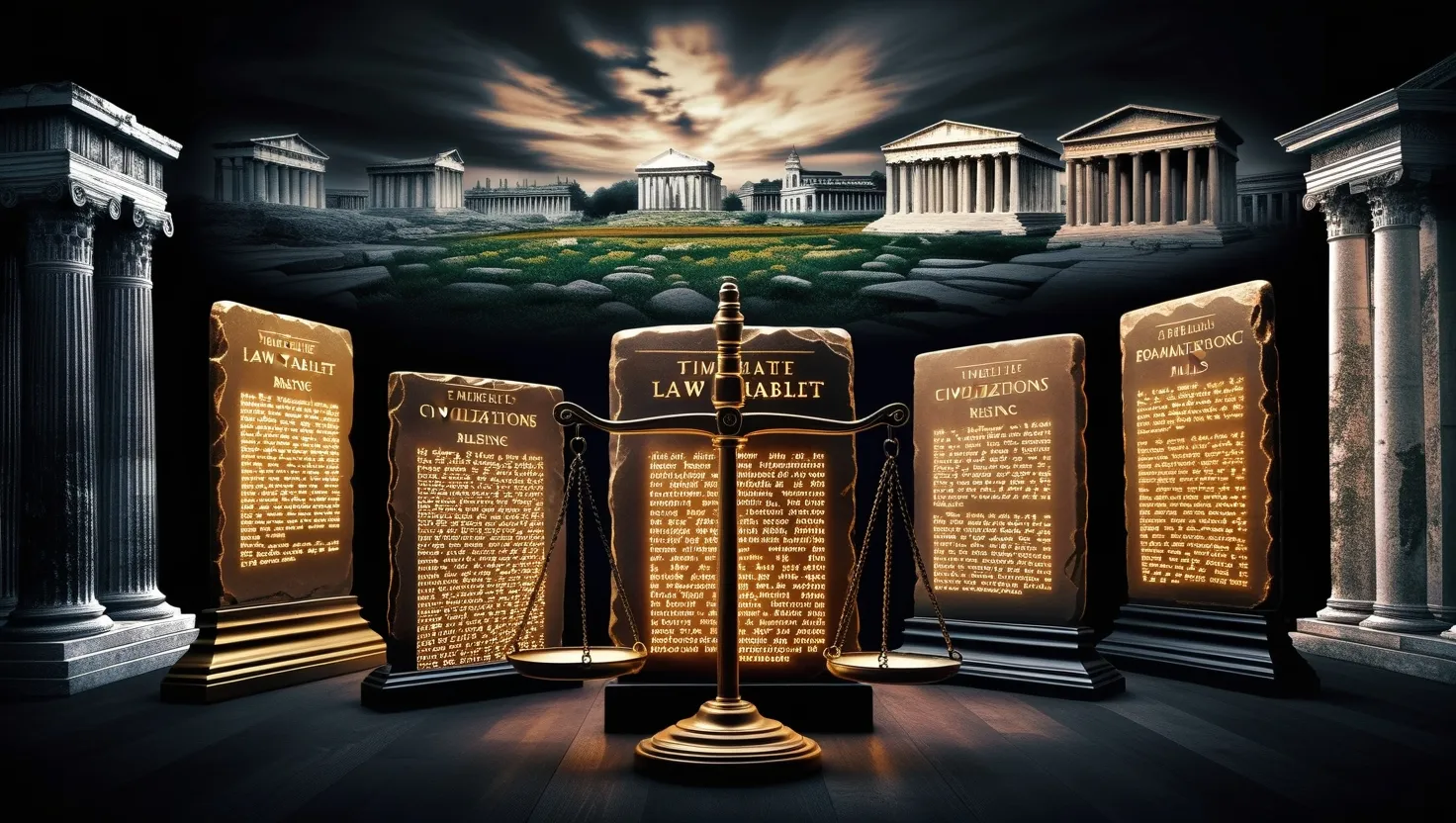
So the plebeians fought back. They demanded that the laws be written down. What emerged were the Twelve Tables — literally twelve bronze tablets displayed in the Roman Forum. Every Roman citizen could now know the law. The priests lost their monopoly.
“The more laws, the less justice.” — Marcus Tullius Cicero
Here is an angle most history books skip. The Twelve Tables were not especially kind laws. Some were brutal — a father could legally sell his child into slavery three times before the child gained independence. But the real achievement was structural. Evidence had to be presented in court. Defendants had rights. Citizens could appeal judgments. And legal proceedings had to be public.
Does that sound familiar? It should. You are reading the early DNA of every modern courtroom.
One particularly fascinating detail: the Tables banned marriages between patricians and plebeians. This rule was later repealed under public pressure — making it one of the earliest recorded examples of a law being changed because ordinary people demanded it. The idea that laws can be challenged and revised by citizens? That starts here too.
Justinian’s Code — The Roman Empire’s Greatest Export
The Roman Empire fell in 476 CE. But its legal thinking did not die. It was preserved, organized, and reborn under a Byzantine emperor named Justinian I in the 6th century.
Justinian gathered a team of legal scholars and gave them an enormous task: take five hundred years of Roman laws, commentaries, contradictions, and imperial decrees, and turn them into one coherent system. What they produced was the Corpus Juris Civilis — the Body of Civil Law.
“Law is reason, free from passion.” — Aristotle
Think of it like a massive software update. All the old, conflicting code was cleaned up and reorganized. The structure they used — dividing law into rules about persons, things, and actions — is still the basic framework taught in civil law schools today.
Here is what makes this remarkable. Most of continental Europe — France, Italy, Spain, Germany, and beyond — uses civil law systems that trace directly back to Justinian’s Code. When you sign a property contract in Paris or a business agreement in Madrid, you are working inside a legal framework that a Byzantine emperor assembled fifteen hundred years ago.
The common law world — Britain, the United States, Australia — went a different route. But even there, Roman legal thinking crept in through university education and legal scholarship. Justinian’s Code outlasted the empire that created it by more than a millennium.
Magna Carta — The King Is Not Above the Law
In 1215, King John of England was a disaster. He taxed excessively, imprisoned people without trial, and ignored the rights of his barons. The barons had had enough. They met the king at Runnymede meadow and forced him to sign a document — the Magna Carta — at sword point.
John signed it. Then immediately asked the Pope to annul it. The Pope agreed. So technically, the Magna Carta was void within weeks of being signed.
And yet here it is, eight hundred years later, still considered one of the most important legal documents in human history. How does that happen?
“The greater the power, the more dangerous the abuse.” — Edmund Burke
Because ideas are harder to kill than documents. The Magna Carta introduced a principle that people kept returning to: no one — not even the king — is above the law. Clause 39 specifically said no free man could be imprisoned or punished except by lawful judgment of his peers or by the law of the land. That is the origin of habeas corpus. That is the origin of due process.
What is often overlooked is that the original Magna Carta was not written for ordinary people. It was written to protect wealthy barons. But over centuries, as people reread and reinterpreted it, its language expanded. “No free man” started to mean more people. Rights that belonged to barons were gradually claimed by everyone.
The Magna Carta directly influenced the English Bill of Rights in 1689, which influenced the United States Constitution, which influenced dozens of constitutions written after World War II. One reluctant signature in a muddy field started a chain reaction that is still running.
The Napoleonic Code — The Law That Conquered Through Ideas
Napoleon Bonaparte lost most of his battles in the end. But he won something more permanent. The legal system he imposed on France in 1804 — the Napoleonic Code — spread across the world and never fully retreated.
Before Napoleon, France was a legal mess. Different regions had different laws. Feudal rules mixed with royal decrees. Church law overlapped with civil law. The Napoleonic Code swept all of that away and replaced it with something clean, logical, and written in plain language that ordinary people could read.
“I have fought sixty battles and I have learned nothing which I did not know at the beginning. Look at Caesar; he fought the first like the last.” — Napoleon Bonaparte
The Code established that all citizens were equal before the law. It abolished feudal privileges. It separated church and state in legal matters. It protected the right to own private property. And crucially, it was written clearly enough for a non-lawyer to understand — which was deliberately radical.
Napoleon exported the Code through conquest. Italy, Belgium, the Netherlands, parts of Germany, Spain — all came under its influence. When French colonizers moved to Louisiana, Quebec, and parts of Latin America, they brought the Code with them. Louisiana still uses a civil law system today, making it legally distinct from every other American state.
Here is the quiet irony: Napoleon is remembered as a tyrant and a conqueror. But the legal framework he spread promoted equality, secular governance, and codified rights. His armies were eventually defeated. His code was not.
These five documents — carved in stone, chiseled in bronze, inked on parchment — share one truth. Law is not natural. It is not inevitable. It is a choice that people made, usually in moments of conflict or desperation, about how they wanted to live together. Every court case argued today, every constitutional debate broadcast on the news, every contract signed in a boardroom, carries traces of these choices inside it.
The laws that govern your life were written by people who were afraid, angry, ambitious, or idealistic. Some of them were right. Some of them were wrong. All of them were human.
And that means the next chapter of legal history has not been written yet. That part is still yours to argue about.