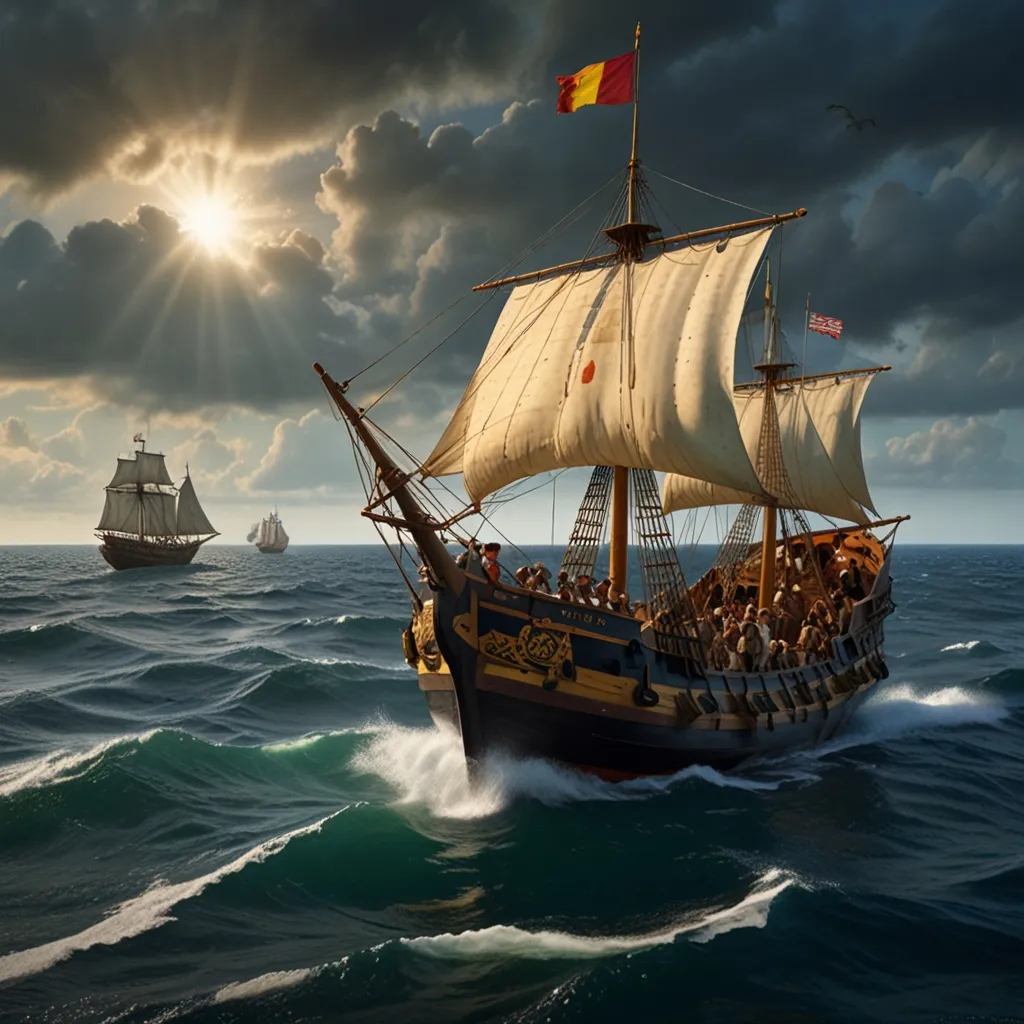
Christopher Columbus, the famous Italian explorer, set sail on a historic voyage across the Atlantic in 1492. But who exactly sent him on this groundbreaking journey? The answer lies in the sponsorship he received from the Catholic Monarchs of Spain, King Ferdinand II and Queen Isabella I.
Columbus had a dream of finding a new sea route to the East Indies, hoping to profit from the lucrative spice trade. He spent years lobbying various European monarchs for support, but it wasn’t until he met the Catholic Monarchs that his dream began to take shape. The monarchs, who had recently ended the Granada War, were eager to expand their empire and spread Christianity.
In January 1492, Columbus finally secured the support he needed. The Catholic Monarchs agreed to sponsor his voyage, and in August of the same year, Columbus set sail from Spain with three ships: the Santa Maria, the Pinta, and the Niña. His journey was not just about exploration; it was also about spreading Christianity and claiming new lands for Spain.
Columbus’s first voyage was a significant success. He landed on an island in the Bahamas, which he named San Salvador, and explored the Caribbean, visiting islands that are now known as Cuba and Hispaniola. He returned to Spain in early 1493, bringing with him captured natives, gold, and exotic plants and birds. His letter to the monarchs, detailing his discoveries, was widely circulated and sparked immense interest across Europe.
Over the next decade, Columbus made three more voyages to the Americas, each time exploring new lands and establishing colonies. His journeys opened the way for European exploration and colonization of the Americas, though they also had a devastating impact on the indigenous populations.
Despite his achievements, Columbus’s legacy is complex. While he is often celebrated as a hero who discovered the New World, many historians now view his actions as part of a broader narrative of colonialism and exploitation. The term “discovery” itself has been criticized for prioritizing European explorers over the native populations who had lived in the Americas for thousands of years.
Columbus’s story is a reminder of the intricate and often controversial history of exploration and colonization. His voyages marked the beginning of a new era in world history, one that would forever change the course of human civilization.