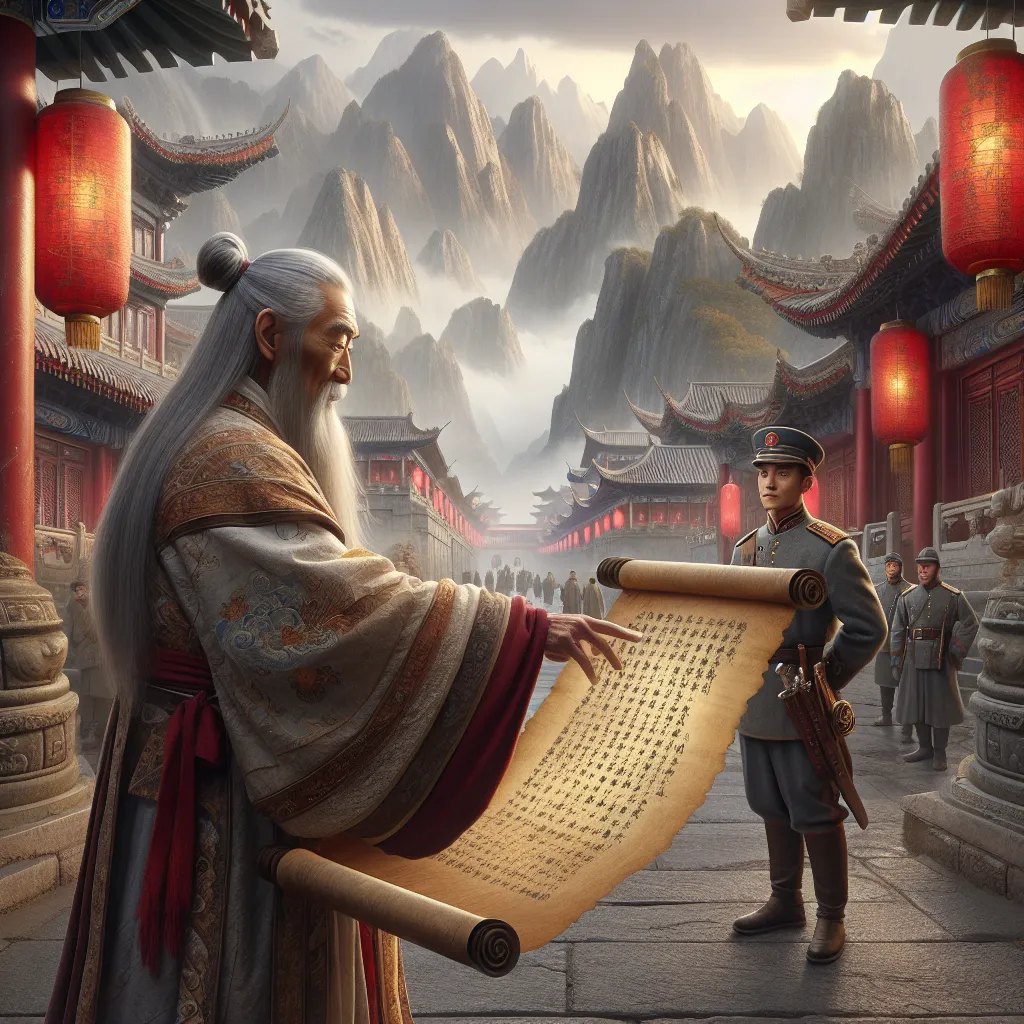
Way back in around 500 BCE, in ancient China, there was an impressive scholar named Laozi, often called Lao Tzu, which means “the old master.” He worked as a record keeper for the ruling dynasty, holding a significant position within the empire. However, disillusioned by political turmoil and corrupt leaders, Laozi decided to leave everything behind. He gave up his job, his belongings, and started walking towards the mountains, determined to live out his days as a hermit.
On his way out of China, Laozi was stopped by a guard named Yin Xi, who recognized him and requested he share some of his wisdom before leaving. Laozi agreed and penned down his knowledge in about 5,000 Chinese characters, or 81 short chapters, which he handed over before crossing the border, never to be seen again. This text, known as the Tao Te Ching, became the foundation of Taoism, a key religious and philosophical tradition in China.
It’s a romantic story, although the historical accuracy is debatable. There’s no solid proof Laozi existed, but the impact of the Tao Te Ching on world history and particularly on Taoism is undeniable. Taoism stands alongside Confucianism and Buddhism as one of China’s principal traditions. The elusive central concept of Tao, often translated as “the way” or “the path,” is mentioned repeatedly but remains challenging to define.
The Tao represents something that cannot be fully described or understood. It’s seen as the natural flow or the process of the universe, a unity underlying all varied experiences. In Taoist thought, adhering to the Tao means living in harmony with this natural flow, often expressed through the concept of “wu wei,” translated as “inaction” or “action without intent.” This doesn’t imply doing nothing, but rather not forcing one’s will upon events, letting things unfold naturally like flowing water.
Another influential text, the Zhuangzi, expands on these themes with humor and irony. The Zhuangzi debunks rigid philosophies by blurring lines between right and wrong, emphasizing that ultimate truth lies in the Tao, which transcends all dualities and human conceptions of right and wrong.
As Taoism evolved, it grew from scattered philosophical musings into organized religious forms. By the 2nd century CE, Zhang Daoling, claiming a vision from Laozi, founded the Way of the Celestial Masters, establishing a more structured faith. Over time, Taoism became interwoven with various rituals, deities, and practices, including alchemy and Chinese medicine, making a broad impact on Chinese culture and beyond.
Taoism’s interaction with Buddhism, particularly the Chan (Zen) school, was highly influential, leading to a blend of ideas and practices, though sometimes marked by competition and conflict. Today, Taoism continues to attract interest worldwide, often through movements like Tai Chi and Feng Shui in the New Age contexts.
In essence, Taoism invites us to live simply, flow with the rhythm of nature, and embrace humility and patience. It resonates because it speaks to a fundamental human yearning for a more harmonious existence in tune with the universe. Regardless of your stance on these ideas, there’s something undeniably appealing about just letting go and aligning with the natural way.