Death is the one appointment none of us can cancel. Every culture, every faith, every grandmother who ever lived has had to look at this fact and find some way to make peace with it. What strikes me most, after reading what different religions actually teach about dying, is how much they disagree on the details and how much they agree on the basics. Let me walk you through five major views, and you can decide which one speaks to you.
Buddhism treats death as a doorway, not a wall. The whole point of the teaching is that nothing is permanent, not your body, not your mood, not even your sense of self. So when death arrives, it is simply another change, like a season turning. What matters most, according to Buddhist teaching, is the state of your mind in that final moment. A calm, aware mind at the point of death shapes what comes next in the cycle of rebirth. This is why monks sit beside dying people and chant, not to perform a show, but to help steady the dying person’s attention.
Have you ever noticed how differently funerals look across Buddhist cultures? In Tibet, bodies are offered to vultures in what is called a sky burial. In Japan, cremation is standard. The methods differ, but the message stays the same: nothing lasts, including this body you are so attached to. One famous line attributed to the Buddha captures the whole philosophy in a single breath:
“All conditioned things are impermanent. Work out your salvation with diligence.”
This is not meant to scare anyone. It is meant to loosen your grip. If you know the leaf will fall, you stop being shocked when autumn comes.
Christianity tells a very different story, one with a beginning, a fall, and a rescue. Death, in this view, was not part of the original plan. It entered through sin, and it stays as a kind of enemy, though one that has already been defeated. Christians believe that Christ’s resurrection broke death’s final hold, which is why Paul could write with such boldness:
“O death, where is thy sting? O grave, where is thy victory?”
That one line has been read at more funerals than almost any other sentence in human history. Heaven, hell, and purgatory all show up in Christian teaching as ways of describing what happens after the final breath, though believers argue plenty among themselves about the specifics. What unites most Christian funerals is this strange mixture of grief and celebration happening in the same room. People cry, and then they sing. Does that combination make sense to you? It did to the people who built entire cemetery cathedrals and wrote requiem masses meant to be performed, not just read.
Islam offers a cleaner, more direct structure. Death is a doorway to barzakh, a waiting period before the final judgment. The Quran describes paradise in vivid terms, gardens, rivers, shade, and describes hell with equal vividness as punishment for a wasted life. Muslims are taught to hope for a death with the shahada, the declaration of faith, on their lips. Burial happens fast, usually within a day, with no elaborate coffin, just simple cloth and a body facing Mecca. Why the rush? Because in this tradition, respect for the dead means returning them to the earth quickly and without fuss.
One hadith often quoted at funerals puts it plainly: “Die before you die.” It means stop waiting until your final hour to think seriously about your life. Mourning in Islam is intense but short, usually three days, except for widows who observe a longer period. The community rallies hard around the grieving family. Nobody faces loss alone.
Judaism takes a quieter approach to the whole question of what comes after. The Torah barely discusses the afterlife at all. Sheol gets a mention, a shadowy place, vague and uncertain. Later rabbis developed richer ideas, Olam Ha-Ba, the world to come, and even concepts of bodily resurrection, but the tradition never obsesses over these details the way other faiths sometimes do. Instead, Judaism puts its energy into how the living treat the dying and the dead.
Sitting shiva, reciting the Kaddish prayer, lighting a yahrzeit candle on the anniversary of a death, these practices are not about figuring out cosmic mysteries. They are about community, memory, and honoring a life that was lived. Isn’t that a refreshing shift in focus? Instead of asking where did they go, Jewish tradition asks how do we carry them forward in how we live. Ecclesiastes captures this earthy, practical wisdom:
“For the living know that they shall die, but the dead know not anything.”
Hinduism, meanwhile, offers perhaps the boldest claim of all five traditions: you have done this before, many times, and you will do it again. Death is described as changing clothes, nothing more dramatic than that. The soul, called atman, is eternal and simply moves from one body to the next based on karma accumulated across lifetimes. The ultimate goal, moksha, is to escape this cycle entirely.
Krishna says it directly in the Bhagavad Gita:
“The soul is never born, and it never dies. It is not slain when the body is slain.”
Cremation is standard in Hindu practice, often followed by immersing the ashes in a sacred river like the Ganges. Rituals for the dead, called shraddha, involve feeding the poor and making offerings to ancestors, a way of keeping family bonds alive even across the boundary of death. Family members often chant near a dying person, hoping to help them focus their final thoughts on the divine rather than fear.
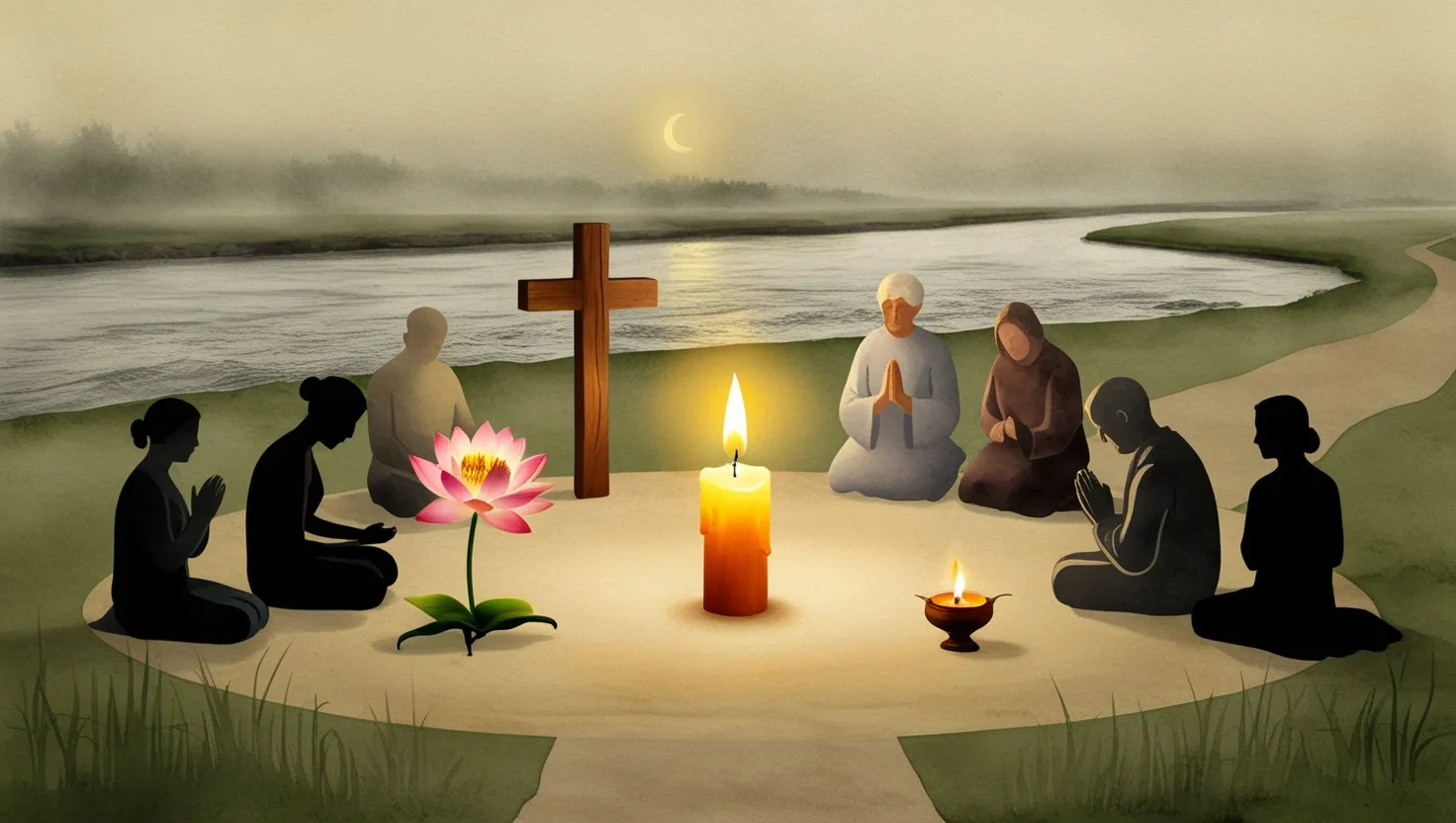
So what do we do with all these differences? Here is what strikes me: every single one of these traditions, despite wildly different cosmologies, insists on the same basic practice. Be present with the dying. Honor the dead properly. Comfort the people left behind. None of them treat death as something to handle alone or in silence.
Think about how unusual that is in a secular setting. Many people today face death stripped of any of these frameworks, no rituals, no community obligation, no shared language for grief. They are left improvising their way through the hardest moment of their lives. Maybe that explains why so many people, even those who are not religious, end up borrowing pieces of these traditions anyway, a candle here, a moment of silence there, a gathering of friends who sit together instead of scattering.
What would change in your own life if you spent five minutes today thinking seriously about your own mortality? Not in a morbid way, but the way these traditions encourage, as a tool for living better right now. The Buddhist monk wants you calm. The Christian wants you hopeful. The Muslim wants you prepared. The Jew wants you present for others. The Hindu wants you detached from fear. Different paths, same destination: a life lived with more clarity because death is not ignored.
That might be the real gift hiding inside all this theology. Not an answer to what happens after we die, since nobody can prove any of these claims, but a set of instructions for how to face the one certainty everybody shares. How you treat death often says everything about how you are treating life.