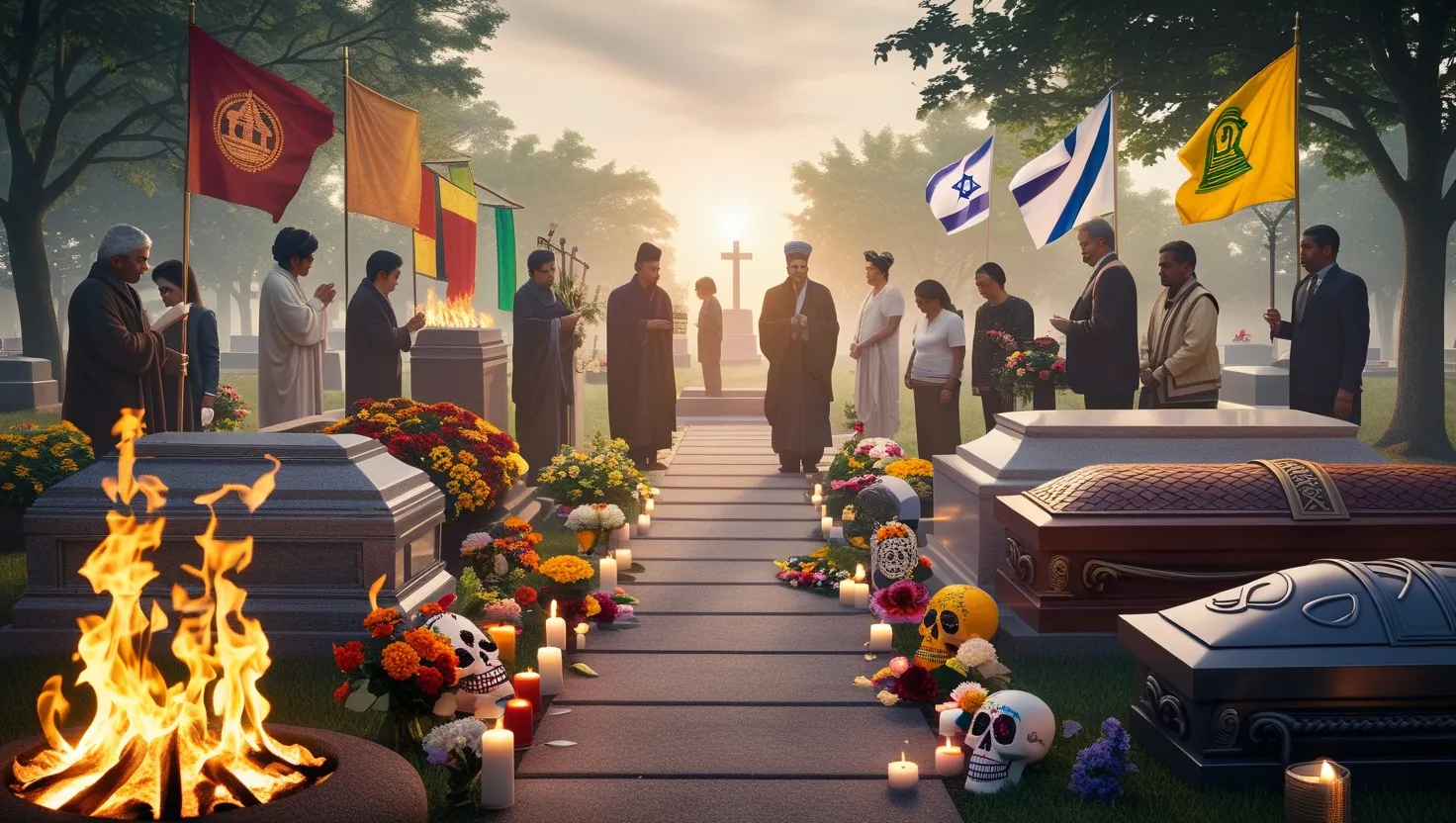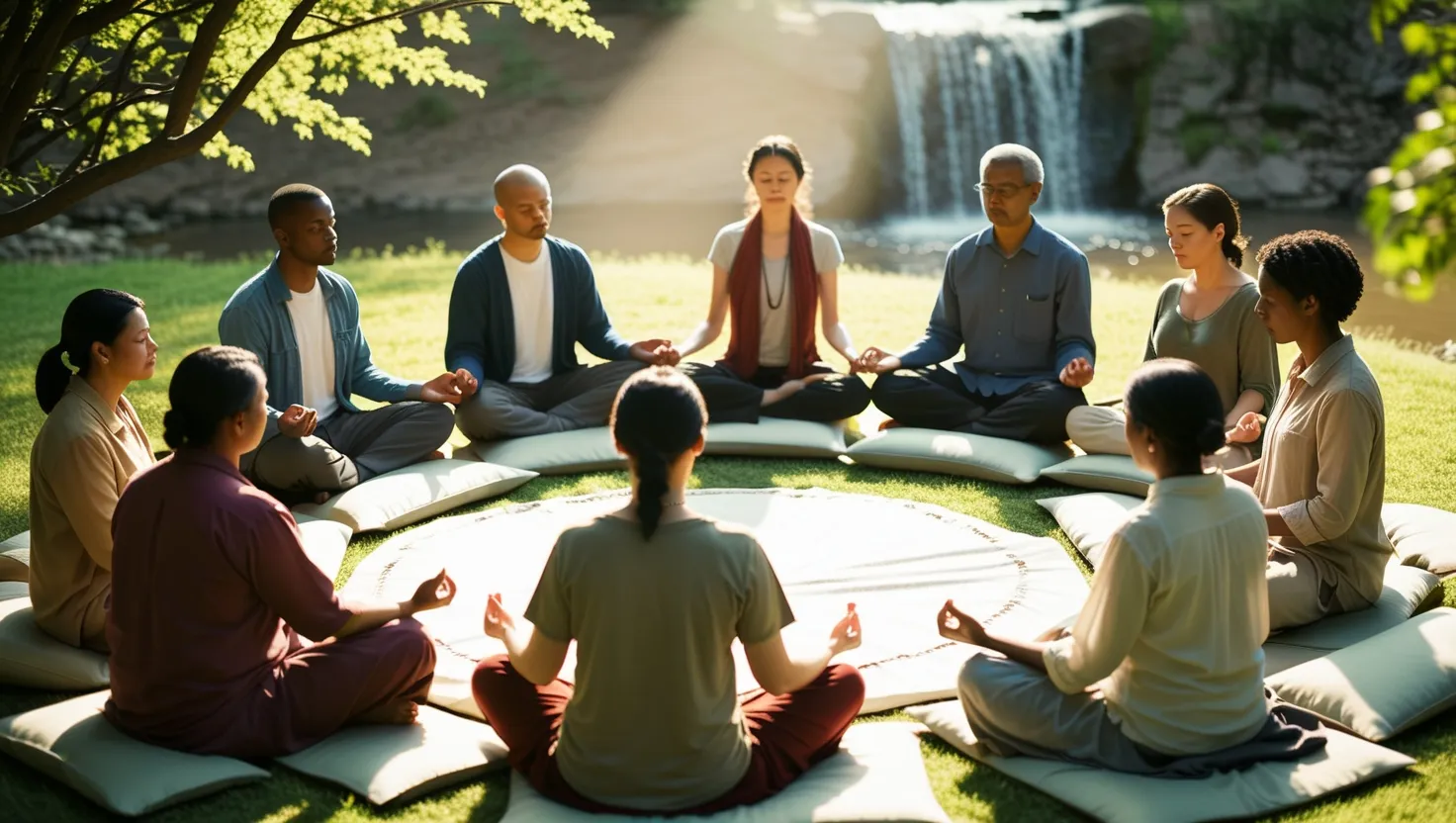
Spiritual community is a very old human experiment: people saying, “Let’s try living together in a way that helps our souls grow, not just our wallets or our egos.” When we look at five different religious visions of this experiment, we don’t just see five religions. We see five different answers to one simple question: how do we help each other become better, kinder, clearer human beings?
Let me walk you through these five without fancy language, as if we were just sitting together and asking, “How do people actually do this in real life?”
The Buddhist sangha is one of the oldest “let’s live together on purpose” groups in history. Monks and nuns leave normal life: no job, no marriage, no bank account of their own. At first, that may sound extreme. Why would anyone walk away from all that? The quiet secret is this: they are not only leaving something; they are entering something.
They enter a space where almost every part of daily life has been thought through as a tool for inner change. What time to wake up. How to eat. How to speak. How to apologize. How to vote on important issues. Even how to sweep the floor. The rules are not there to control them like robots. They are there so people don’t waste energy on constant drama and confusion.
Think about that for a moment. How much of your day gets burned up on small fights, confusion, gossip, and stress? Imagine a place where a lot of that is already sorted out. Would your mind have more space to calm down?
One lesser-known part of the sangha is how practical and democratic it can be. Decisions are often made in meetings where everyone of a certain rank has a voice. There are set methods for handling accusations, conflicts, and even how to remove a misbehaving teacher. That might sound boring, but it matters. It means “spiritual community” is not just about good feelings in meditation; it is about building fair systems that protect people from abuse and ego.
Here is something else we rarely talk about: monks and nuns are not meant to stay isolated from the world. In many traditions, they depend on lay people for food and support. In return, they offer teaching, example, and blessings. So the sangha is not just the monks; it is a living relationship between those who leave household life and those who stay in it. It is a two-way street, not a holy bubble.
“The Sangha is not an idea, it is a living body where each cell nourishes the whole.”
If you have ever thought, “I just need to work on myself alone,” you might ask: are you skipping the power of shared discipline and shared courage? The sangha model quietly says, “You don’t have to carry awakening by yourself. We can carry it together.”
Christian monastic communities tried a different version of this shared life. Picture a small stone building in the middle ages. Bells ring at set times. People stop what they are doing and pray. Then they farm, cook, copy books, teach children, care for the sick, and study. Day after day. Year after year.
One surprising fact: many of these monasteries were like ancient “data centers” of wisdom. While wars and plagues rolled through Europe, they preserved not just religious texts, but also science, philosophy, and literature. They did not only save “holy” books; they copied things like Aristotle, medical knowledge, and early math. Their search for God ended up preserving tools for human progress.
Another quiet detail: their rule books are almost like early self-help manuals for group life. They deal with jealousy, boredom, laziness, pride, and conflict. For example, they created ways to match work with a person’s strength so no one broke down from overwork or idleness. The community was like a laboratory: can we shape daily life so people have a better chance of becoming patient, humble, and wise?
Here is something to think about: what if spiritual growth is not just about “big” moments but about how you handle washing dishes, showing up on time, or listening to someone you dislike?
“Pray as you can, not as you can’t.”
That simple line, often shared in Christian circles, points to another insight from monastic life: one size does not fit all. Some monks were better at study, some at manual work, some at prayer, some at leadership. The community’s job was not to force everyone into one mold but to shape a rhythm where different gifts served the whole.
Would you live in a place where your day is almost completely structured if it meant your heart might be freer?
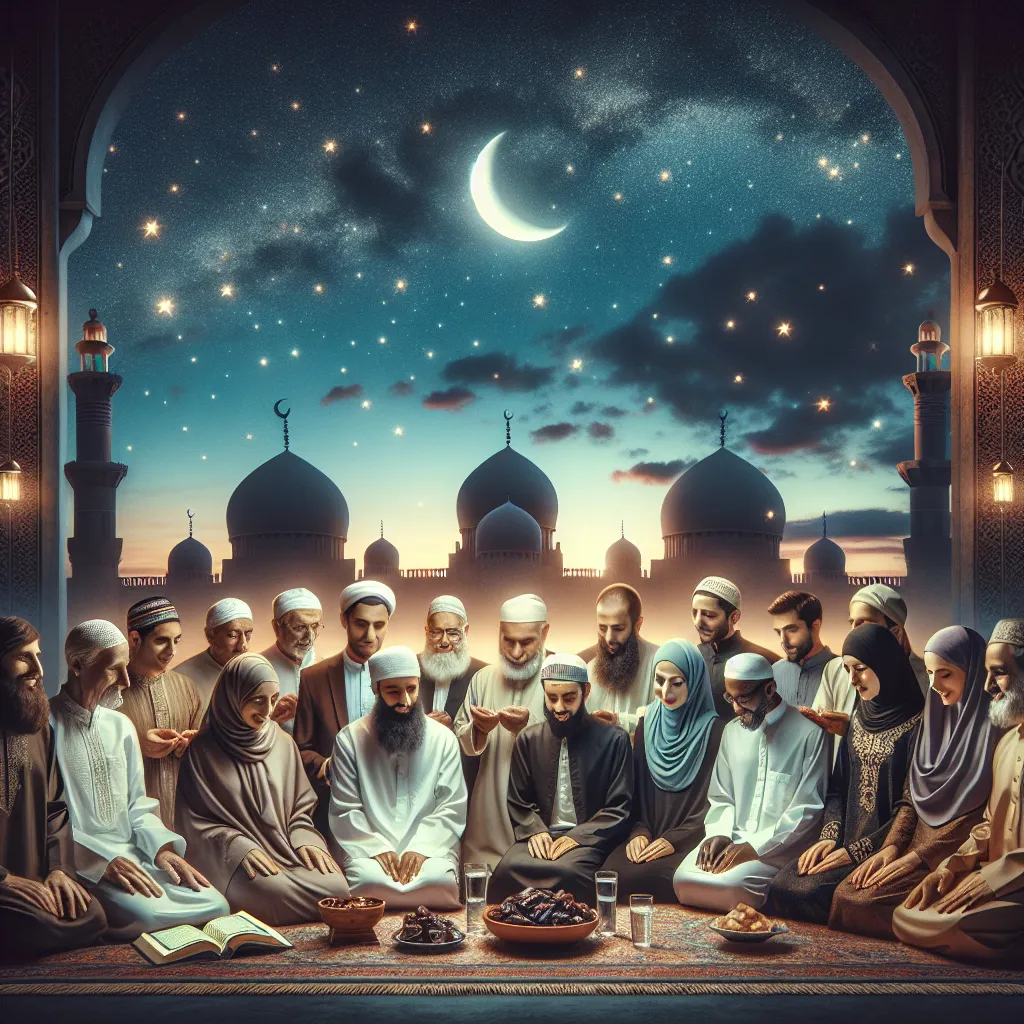
The Islamic idea of the ummah shifts the level from small houses and monasteries to the whole globe. Instead of a single building or village, think of millions of people, in many languages, who see themselves as one community under God.
The Hajj gives a powerful picture of this. People arrive from all over the world. Rich and poor. Famous and unknown. They all dress in simple white cloth. Suddenly, a billionaire and a farmer look the same. That is not an accident. It is a living reminder: when you stand before God, your status falls away.
But the ummah is not just a once-a-year crowd. It is a web of shared practices—prayer times, fasting in Ramadan, charity, legal rules, ethics—that connects people who may never meet. One less obvious angle: the ummah includes very strong local variety. A Muslim in Indonesia, Nigeria, Turkey, and the United States may follow the same basic pillars, but their food, language, music, and local customs are very different. The idea is unity without flattening everyone into copies.
Ask yourself: how do you feel about belonging to something bigger than your country or your culture? Does that scare you or comfort you?
The ummah also comes with a sense of mutual responsibility. When a disaster hits one part of the world, others are called to help, not just out of kindness but out of seeing the other as “one of us.” This can create a strong sense of moral duty that goes beyond borders.
“The believers are like one body; when one part hurts, the whole body suffers.”
Even if you are not Muslim, that picture is simple and sharp: real community means your pain is not just your pain. Someone, somewhere, feels it as theirs too. In a world that pushes us to think “me first,” that is a radical idea.
Jewish community life offers yet another angle: how to stay yourself when you are far from home for a very long time. For centuries, Jewish people lived scattered across many countries, often facing pressure to give up their traditions. Yet they kept their identity through strong local communities, often called kehillot.
These communities were much more than places to pray. They acted like mini-societies. They set up schools so children learned not only reading and writing but also their history and laws. They organized charity so widows, orphans, and the poor were not left alone. They arranged weddings, funerals, and care for the sick. They even dealt with disputes among neighbors.
A key idea here is covenant: a shared promise between people and God, and also between people and each other. It is not just “we like being together.” It is “we are bound to each other, even when it is hard, and we have duties to one another.”
Have you ever felt that modern life is full of “connections” but short on real, binding commitments?
What is often overlooked is how much this network of obligation protected people’s dignity. A poor person was not just a random stranger in need; they were part of the same covenant family. Helping them was not optional charity; it was expected faithfulness.
Another interesting angle: a lot of Jewish law involves very small daily actions—how to eat, how to rest, how to keep special times. These rules kept identity alive not only on holidays, but in ordinary Wednesday afternoons. So the community didn’t only live in special buildings; it lived in kitchens, markets, and family tables.
“More than the Jews have kept the Sabbath, the Sabbath has kept the Jews.”
That famous line captures a subtle truth: the practices designed to preserve the people ended up shaping the people who practiced them. The ritual that was meant to protect community identity also formed the inner lives of individuals.
Now think of Hindu satsang, and you see a different style of community again—more fluid, less formal, but still powerful. The word satsang can be understood simply as “being in the company of truth.” In practice, this often means people gathering to chant, listen to a teacher, discuss, meditate, or read sacred texts together.
One important detail: satsang is often not a fixed institution with heavy structures. It can form around a teacher, a temple, a shared practice, or even a living room gathering. It can shift, move, grow, or shrink. The glue is shared longing rather than strict rules.
Have you ever felt that you don’t fit into rigid religious systems but still want a group that feeds your deeper side?
In satsang, people may come from different social backgrounds, castes, or even religious labels, but they sit side by side during practice. Often there is a strong focus on direct experience—feeling peace, devotion, or insight—over complex theology. Someone may come for the music and end up staying for the silence that follows.
A lesser-known angle is how satsang can act as a safety net for emotional and mental struggle. In many groups, people talk openly about fear, loss, failure, and confusion in front of others. The shared chanting and teaching create a container where people feel less alone with their inner pain.
“Company of the wise makes the foolish wise; company of the foolish makes the wise foolish.”
This old idea shows why satsang matters: who you sit with shapes who you become. It is not magic; it is influence. If you spend two hours every week with people speaking about truth, kindness, and inner growth, your mind starts to bend in that direction, even if slowly.
Now, if we look across these five visions together, what do we see?
We see that community is a spiritual technology. It is like a tool humans keep redesigning to help us grow beyond our usual limits. The Buddhist sangha uses clear rules and shared discipline. Christian monastic life uses rhythm and stability. The Islamic ummah uses global connection and common practices. Jewish communities use covenant and mutual responsibility. Hindu satsang uses shared aspiration and flexible gathering.
They all answer the same human problem: on our own, we get stuck.
Let me ask you: where, in your life, do you try to do the hardest inner work completely alone? And what would it look like to invite even one other person into that effort?
Another surprising insight: none of these models are purely “individual” or purely “collective.” They are not saying “only you matter” or “only the group matters.” They are experiments in balance.
The sangha does not just swallow the individual; it protects personal practice. The monastery does not just crush personality; it channels personal gifts. The ummah does not erase cultures; it holds them within a larger frame. The kehillah does not forget each member’s struggles; it builds systems to meet them. The satsang does not demand everyone believe the same; it invites them to grow side by side.
So these communities give us another way beyond our usual two options: selfish isolation or rigid crowd-thinking. They show that you can belong strongly and still grow uniquely.
“It is not good for man to be alone.”
That ancient sentence is simple but cuts to the heart. Most of us know this when it comes to survival and comfort. We forget it when it comes to our spiritual and moral life. We imagine we will somehow fix our deepest patterns in secret, with no witnesses, no support, and no accountability.
If there is one message I would want you to carry from all this, it is this: collective life can be designed to lift you up, not drag you down.
Imagine a small group where:
You agree to meet regularly,
You share honestly,
You practice some form of stillness together,
You serve others together,
You hold each other gently to your best values.
Does that not sound like a modern echo of these ancient models?
You don’t have to copy monks or travel to Hajj or rebuild a medieval village. But you can learn from their patterns. You can ask:
What do I want my “rules of life” to be?
Who can I share them with?
How can I make sure no one in my circle is left isolated in crisis?
How can I join something bigger than myself without losing my mind or conscience?
In the end, these five religious visions are not just museum pieces. They are practical invitations. They remind us that we become who we are, together. Not by accident, but by the way we choose to live, pray, work, rest, and care—in community that points beyond itself to something higher.