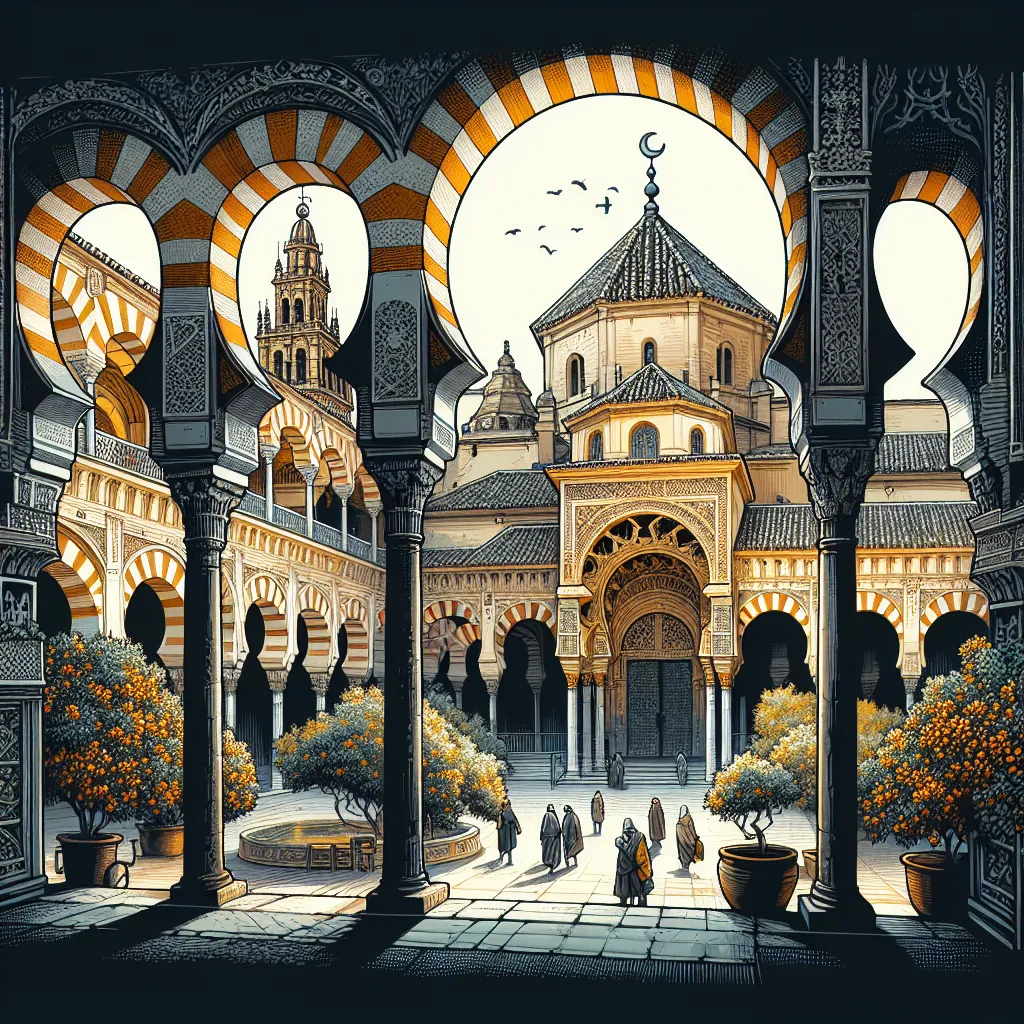
Andalucia has a rich history where cultures and religions blend seamlessly. One of the most striking examples of this is the Mosque-Cathedral of Cordoba. This building beautifully captures the confluence of Islam and Christianity, making history come alive as you wander through its stunning halls.
The region, often referred to as Andalucia or al-Andalus in Arabic, was under Muslim rule for over 500 years. Muslim armies first arrived on the Iberian Peninsula in 711, a date that’s easy to remember. It was the Umayyad Empire that set up its rule here, especially after Abdul Rahman I fled Damascus due to the Abbasid Revolt. He established al-Andalus with Cordoba as its heart, a position the city maintained for many centuries. Abdul Rahman I also initiated the construction of the grand mosque in Cordoba around 756, making it the center of religious life for Muslims in the area.
Cordoba flourished under the Umayyad Caliphate, becoming a hub of art, literature, science, and music. The period was known for its intellectual openness and relative tolerance toward other religious groups like Christians and Jews, who also contributed to the sharing of ideas. Subsequent rulers expanded the mosque to accommodate the growing population. By the 10th century, the mosque had taken on the shape we recognize today, complete with a large courtyard, a fountain for ablutions, iconic columned halls, and a towering minaret.
The mosque played a central role during the Umayyad period until the empire’s collapse in the mid-11th century. Despite the rise of new empires like the Almoravids and Almohads, Cordoba and its mosque never fully regained their former glory. The Almohads chose Seville as their capital, shifting the political and cultural focus there. However, Cordoba remained an important city, and its mosque continued to be used.
In 1236, Christian forces conquered Cordoba as part of the Reconquista. The mosque wasn’t demolished; instead, it was transformed into a cathedral. Over the centuries, new features were added, including a chapel in the 14th century, a Gothic nave in the 15th, and a Renaissance section that lets in plenty of light. The old minaret was converted into a bell tower. Yet, many features of the mosque have been preserved, making it a unique building that serves as both a place of worship and a museum.
Walking through its halls, you can almost hear the echoes of history. From the 8th-century columns and horseshoe arches to the prayer niche where Muslims once prostrated towards Mecca, the building speaks volumes. Even the courtyard, with its orange trees and the bell tower that was once a minaret, tells the tale of a city that has seen profound change. The Mosque-Cathedral of Cordoba, locally known as the Mezquita, stands as one of the world’s historical marvels, embodying the dynamic history, culture, and religion of al-Andalus.
Whether you’re intrigued by its Islamic architecture, its Christian heritage, or simply its historical significance, the Mezquita has something for everyone. It serves as a reminder of the people who once walked its halls, seeking spiritual solace—whether they were Muslims or Christians.