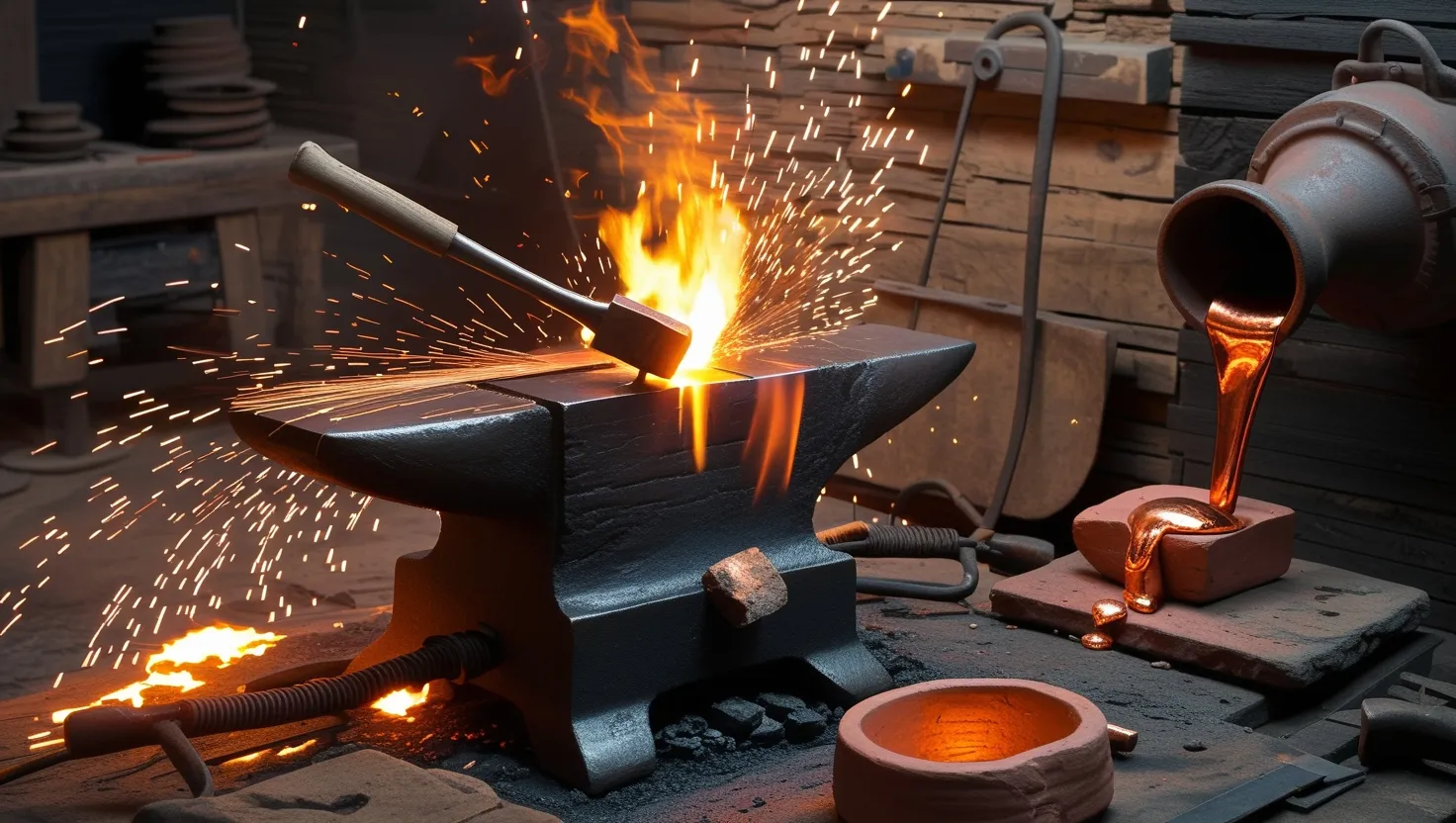
Imagine sitting by a fire with me, watching sparks fly as we chat about how a few simple tricks with rocks and heat changed everything for us humans. You know those shiny tools and tough swords in old stories? They didn’t just appear. People figured out metals step by step, and each big win let us build bigger, fight smarter, and live differently. Let’s walk through five huge breakthroughs that shaped our world. I’ll keep it simple, like telling a story to a friend who’s never thought about this before. Ready? Stick with me.
First off, picture this: around 5500 BCE in places like the Balkans, folks noticed some rocks got gooey when super hot in a fire with charcoal. That’s smelting—pulling copper out of ore. Before that, people just picked up pure copper nuggets from the ground and hammered them cold. Boring and weak. But smelting? Game changer. Now they could melt it, pour it into molds, and make axes, jewelry, even statues. Why does this matter to you? Because it kicked off the Copper Age. Villages turned into towns as tools got better for farming and cutting trees.
Have you ever wondered why early people didn’t just keep hammering nuggets forever? Smelting let them make shapes they dreamed up, not just what nature gave. One lesser-known bit: in Serbia’s Vinča culture, they hid smelting spots like secrets, guarding the “magic fire” that birthed metal. Think about it—your phone case or bike frame traces back to that first melt.
“Metals are the material basis of modern civilization.” – Isaac Asimov
Now, let’s jump to bronze around 3300 BCE. Someone mixed copper with tin—about 10% tin makes it way harder. No more soft copper bending like foil. Bronze held edges for spears and plows. But here’s the twist most skip: tin was rare, from far-off places like Afghanistan. Trade routes exploded. Societies that controlled tin got rich and powerful fast. The Sumerians in Mesopotamia built empires on it. Unconventional angle? Bronze wasn’t just for war. Artisans cast bells that rang across valleys, calling people to rituals. Sound familiar? Church bells today echo that.
Question for you: What if your town controlled the only road to a rare ingredient? You’d rule, right? That’s what happened. Lesser-known fact: In Thailand’s Ban Chiang site, they made bronze drums 4,000 years ago, used for rain dances. Not weapons—music and weather magic. Bronze democratized beauty, not just blades.
Iron smelting hits around 1200 BCE, probably in Anatolia or India. Iron ore is everywhere, unlike picky tin. But it needs crazy heat—over 1,100°C—to melt. Early furnaces were clay pits with bellows pumping air. Bloomeries spat out spongy “blooms” of iron they hammered pure. Why revolutionary? Iron’s tougher than bronze, and cheap. Farmers plowed deeper fields; armies swung heavier swords. The Hittites guarded the secret first, but it spread like wildfire, ending bronze elites.
Ever think iron saved the poor? Yeah, no rare tin needed. Hidden gem: In Africa, Nok culture in Nigeria smelted iron by 500 BCE using termite mounds as natural furnaces—bugs built perfect air shafts. Smart, right? Iron plowshares fed millions, sparking population booms. Without it, no big cities.
“Iron is the king of metals; it rules the world.” – Ancient Hittite proverb
Steel? That’s iron leveled up. Early steels like India’s wootz from 300 BCE were pattern-welded blades, famous as Damascus steel—wavy patterns from folded layers. But mass steel waited for 1856. Henry Bessemer, a Brit, blew air through molten pig iron in a pear-shaped converter. Whoosh—oxygen burned out carbon junk, making strong, low-cost steel in 20 minutes. Before? Steel took weeks of finicky work.
Picture rails snaking across continents. Bessemer’s trick built them, plus bridges and ships. Unconventional view: It wrecked old blacksmith guilds. Jobs vanished, but factories rose. Lesser-known: Bessemer failed first tries because of phosphorus in ore—fixed by adding basic lime, birthing the Gilchrist-Thomas process. Steel skyscrapers? Born here. Ask yourself: Could we have cars without cheap steel? Nope.
Aluminum’s my favorite wild ride. In the 1800s, it was rarer than gold—Napoleon served VIPs on aluminum plates, silver for nobodies. Why? Locked in tough bauxite ore. Then, 1886: Charles Hall (American, 22 years old) and Paul Héroult (French) cracked it independently. Dissolve alumina in molten cryolite, zap with electricity—pure aluminum floats out. Factories churned it cheap.
Light as plastic, strong as steel—planes, cans, foil. Hidden story: Hall started in a woodshed with borrowed gear. Héroult beat him by days. Today, it’s 8% of Earth’s crust, but we ignored it for millennia. Weird angle: Aluminum sparked the airplane age. Wright brothers’ frames? Wood and fabric. Post-aluminum? Aluminum wings flew us global. What everyday thing do you use that’s aluminum without knowing?
“Aluminum changed the world more than steel did.” – Charles Hall
Let’s pause. You’ve followed copper’s melt, bronze’s edge, iron’s spread, steel’s boom, aluminum’s flight. Each built on the last, like steps up a ladder. But dig deeper—metals aren’t just hard stuff. They shift power. Copper priests hoarded knowledge. Bronze traders drew maps. Iron farmers fed kings. Steel bosses built factories. Aluminum pilots conquered skies.
Now, lesser-known twists across eras. Ever hear of crucible steel from 1740s England? Benjamin Huntsman melted iron and charcoal in sealed clay pots for clock springs—precise, pure. Or superalloys in the 1920s: nickel-chromium with tiny aluminum bits for jet turbines. They withstand 2,000°F. Without them, no space race.
Question: Imagine life without these. Hammers only? No thanks. In China, around 200 BCE, they cast iron plows while Europe hammered blooms—Asia surged ahead. Africa’s bloomeries used acacia charcoal for purer iron. India’s wootz inspired modern scalpels. These weren’t just tech wins; they were cultural flips.
Back to Bessemer. His converter roared like a dragon, spitting 30-ton batches. Workers wore asbestos suits—dangerous dawn of industry. But it slashed steel from $50 to $2 per ton. Railroads linked farms to cities overnight. Skyscrapers pierced clouds because steel beams didn’t sag.
Aluminum’s quirky side: In 1855 Paris Expo, huge aluminum bars sat next to gold—rarity flex. Post-Hall-Héroult, Bayer process prepped ore with soda lye, scaling it huge. Today, recycling 75% of it—greener than mining. Unconventional: Aluminum cans outsell steel now for drinks—light, no rust.
Iron’s dark horse fact: Around 1900 BCE in Egypt, they “accidentally” made steel by carburizing iron with charcoal. Tutankhamun’s dagger? Meteor iron, etched with modern X-rays showing nickel. Space metal!
Bronze oddity: In the Americas, no tin—so they alloyed copper with arsenic from ores. Deadly fumes killed smiths, but axes cut stone. Tough trade-off.
Copper’s secret: Serbia’s 7,000-year-old mines had shafts 20 meters deep—child labor, toxic smoke. First industrial complex?
Steel evolved wild. Post-Bessemer, electric arcs in 1900s melted scrap clean. Now, 70% recycled. Future? Nano-steels stronger than titanium.
Ask yourself: What’s next? Titanium smelting from 1910s Russia, or graphene composites? Metals still drive us.
Wrapping our chat—these five forged us. Smelting freed copper. Bronze sharpened ambition. Iron shared strength. Steel scaled dreams. Aluminum lightened loads. You touch their legacy daily—in your keys, fridge, bike.
“The age of metals begins with fire and ends with light.” – Modern metallurgist reflection
Think about it next time you grip a handle. Metals whisper history. What’s your favorite breakthrough? Tell me—we can chat more. (Word count: 1523)