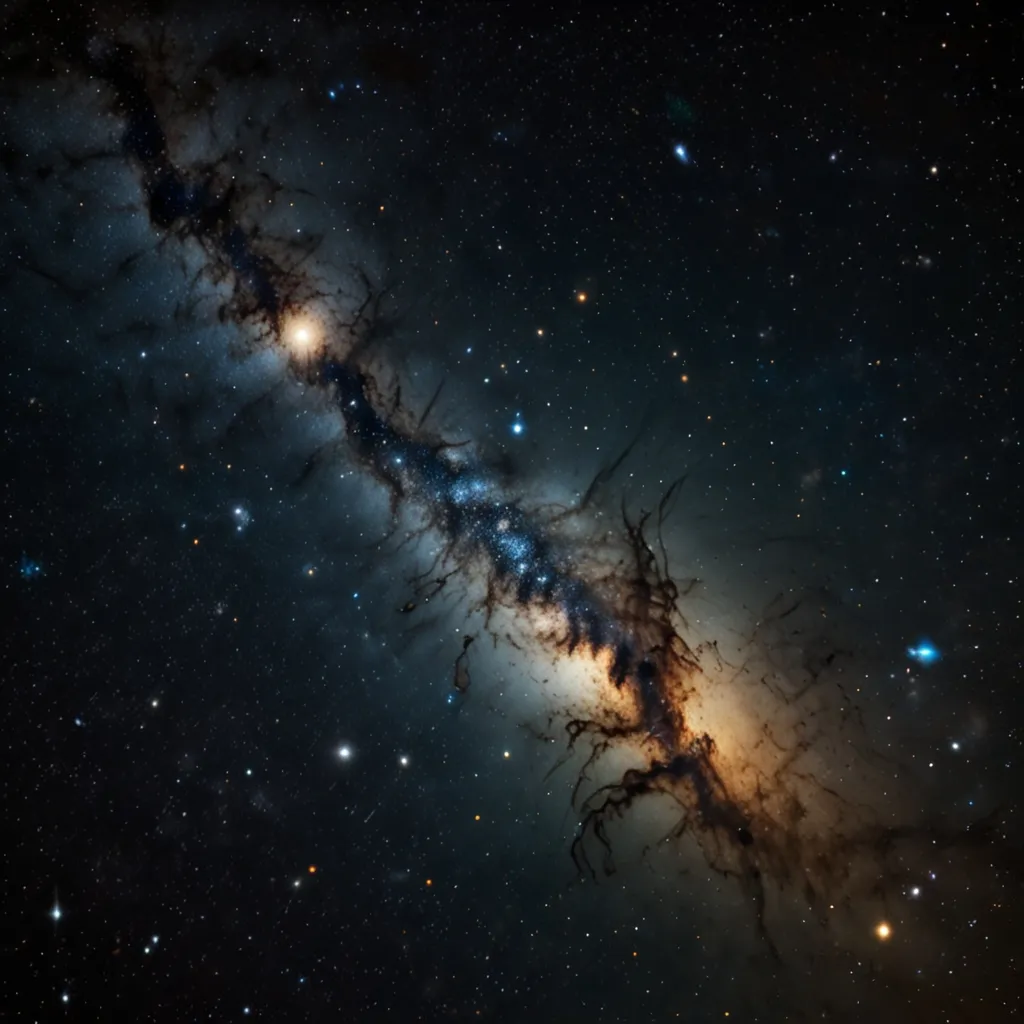
When you gaze at the stars splattered across the night sky, do you ever wonder what else is out there? Maybe somewhere, on a distant planet in another galaxy, there’s a being looking right back at you. It’s fascinating to think that there are more stars in the universe than grains of sand on all of Earth’s beaches—about ten times more, in fact. That’s an astonishing figure when you consider it’s a 7 followed by 22 zeros.
Recent discoveries from the Kepler space telescope reveal that planets exist around nearly every star. In just our Milky Way galaxy, which is only one of a trillion other galaxies, there may be around 10 billion Earth-sized planets orbiting their stars in habitable zones. This naturally leads to a burning question posed by physicist Enrico Fermi in the 1950s: If there are potentially so many planets with the right conditions for life, why haven’t we heard from any aliens?
Fermi theorized that any civilization with basic rocket technology and a strong desire to explore could send out self-replicating robot probes to colonize the galaxy. These probes could make the long journey over millions or billions of years. Given the universe’s age, he argued that intelligent life forms could have evolved millions of years before us and should have colonized entire galaxies by now. If that were the case, we should be able to detect them.
Our search for intelligent life involves scanning the universe for signals like radio or television waves—signals that would indicate a super-intelligent, space-faring civilization. Despite the near-ubiquity of the basic chemical ingredients for life, our instruments have found no such evidence across our galaxy or beyond. This lack of findings makes us question how rare super-intelligence might be.
Several intelligent species have evolved here on Earth, such as dolphins, parrots, and even the ancient Troodon dinosaurs. However, humans are the only super-intelligent species capable of potentially colonizing space, and we only appeared about 250,000 years ago—a blink of an eye in Earth’s 4-billion-year history. The evolution from simple single-celled organisms to complex beings like us might have involved a series of improbable coincidences.
The Drake Equation, formulated by Frank Drake in 1961, attempts to predict the number of active extraterrestrial civilizations in our galaxy. With current data, we can estimate some variables, but the fraction of planets with super-intelligent life remains a guess. This suggests that the emergence of such intelligence may be extraordinarily rare.
One theory suggests that there could be a “great filter” preventing civilizations from achieving the ability to colonize the galaxy. This filter could be in our past, making the development of super-intelligence extremely rare, or it could be in our future, posing a potential threat to our civilization’s survival.
There are theories suggesting aliens might have already visited or observed us without making contact. However, the simplest explanation remains that intelligent life is incredibly difficult to evolve. Given the vastness of the universe, even if life is rare, it can still be plentiful. Yet, the distances involved mean that even if there are other intelligent beings out there, we may be forever separated from them by the vast expanse of space.
So next time you look up at the night sky, remember that while the universe is teeming with stars and possibly planets, the conditions for super-intelligent life might be far rarer—and more precious—than we ever imagined.