Could Black Holes Secretly Glow with Hidden Light?
The Paradoxical Glow of the Universe's Darkest Mysteries
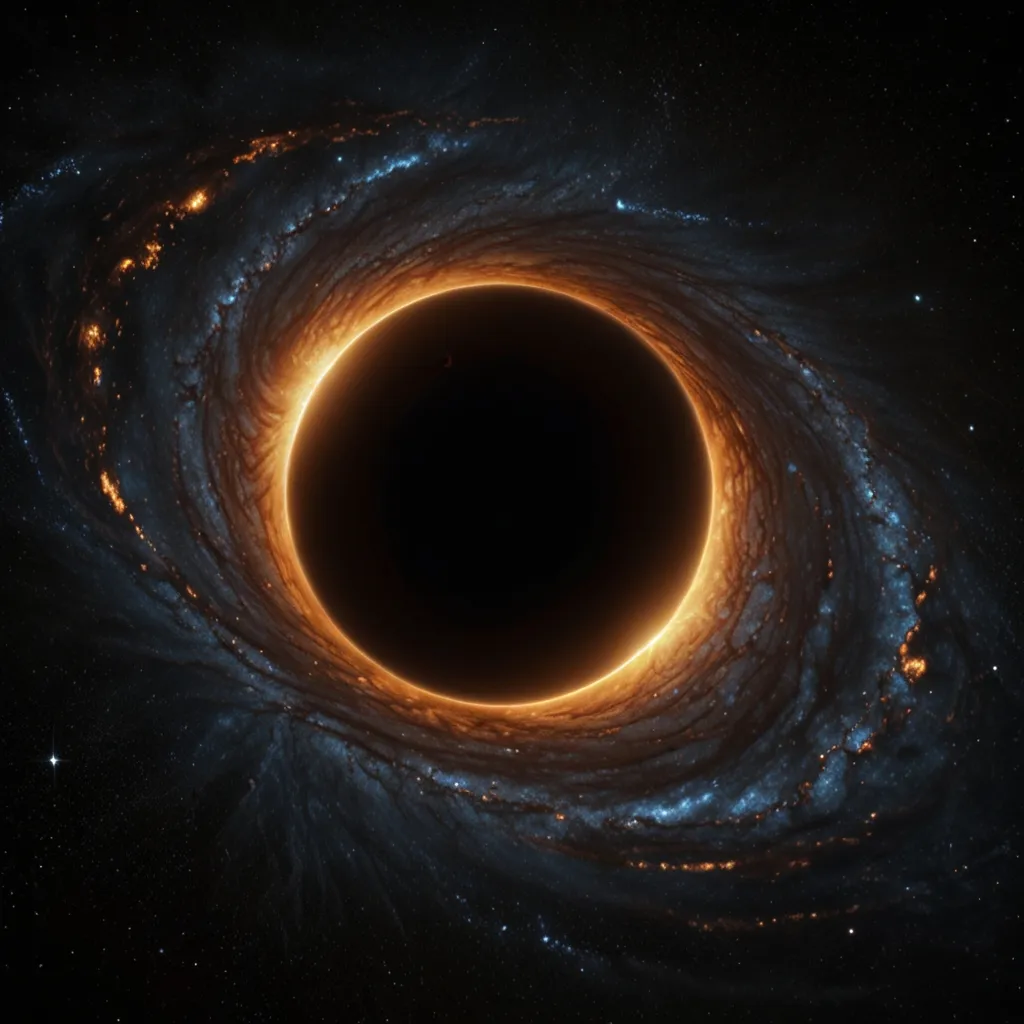
Black holes have captivated our imagination for decades, standing as some of the most enigmatic objects in the universe. The term “black hole” aptly describes these cosmic entities; they absorb all incoming light and seem to create an inescapable gravitational vacuum in space-time.
Despite their reputation for consuming everything, Stephen Hawking proposed a revolutionary idea in 1974. He suggested that black holes could, in fact, emit radiation, a theory now known as Hawking radiation. This idea stemmed from applying quantum mechanics to classical physics, showing that black holes are not entirely black but shine by emitting photons.
The intense gravity of black holes suggests that nothing, including light, should escape their grasp. Classically speaking, black holes can only grow by absorbing additional mass, and their surface area, described as the event horizon, adheres to specific physical laws similar to classical thermodynamics.
Hawking’s analogy likened black holes to black bodies in thermodynamics. A black body absorbs all radiation, and if black holes were similar, they should also have a temperature and emit radiation. Classical physics, however, rejects the idea of black holes releasing anything. Hawking dove into this paradox, initially intent on disproving the radiation theory. To his surprise, quantum mechanics revealed that particles could indeed escape the event horizon.
Virtual particles flit in and out of existence throughout space due to the Heisenberg Uncertainty Principle. Near a black hole, this quantum foam becomes particularly dynamic. Occasionally, particle-antiparticle pairs come close to the event horizon. One particle might be pulled into the black hole, preventing their mutual annihilation. The remaining particle, now free, appears as Hawking radiation, while its partner reduces the black hole’s mass.
Hawking’s findings imply that black holes lose mass over time, evaporating through radiation. The temperature of a black hole, inversely proportional to its mass, rises as it shrinks, eventually leading to an explosive end marked by high-energy bursts or gamma rays. Though we observe gamma-ray bursts in the universe, their patterns don’t fully align with predicted black hole evaporation signals, suggesting different phenomena like neutron star collisions or supernovae might be responsible.
Despite the lack of direct evidence of Hawking radiation, it conforms to quantum mechanics, and its acceptance is widespread among physicists. This idea underscores a fascinating property of black holes: their immense entropy, a measure of disorder. The entropy of a black hole, tied to its surface area, far exceeds that of all other matter and energy in the universe combined. This hints that black holes hold most of the universe’s information—a subject still shrouded in mystery and ripe for exploration.
Although we may never uncover all the secrets of black holes, contemplating their properties and implications offers an enthralling glimpse into the vast complexity of our universe.