Could the Secrets of Gravity Be Hidden in the Fabric of Space-Time?
Revolutionizing Gravity: The Journey from Newton to Quantum Mysteries
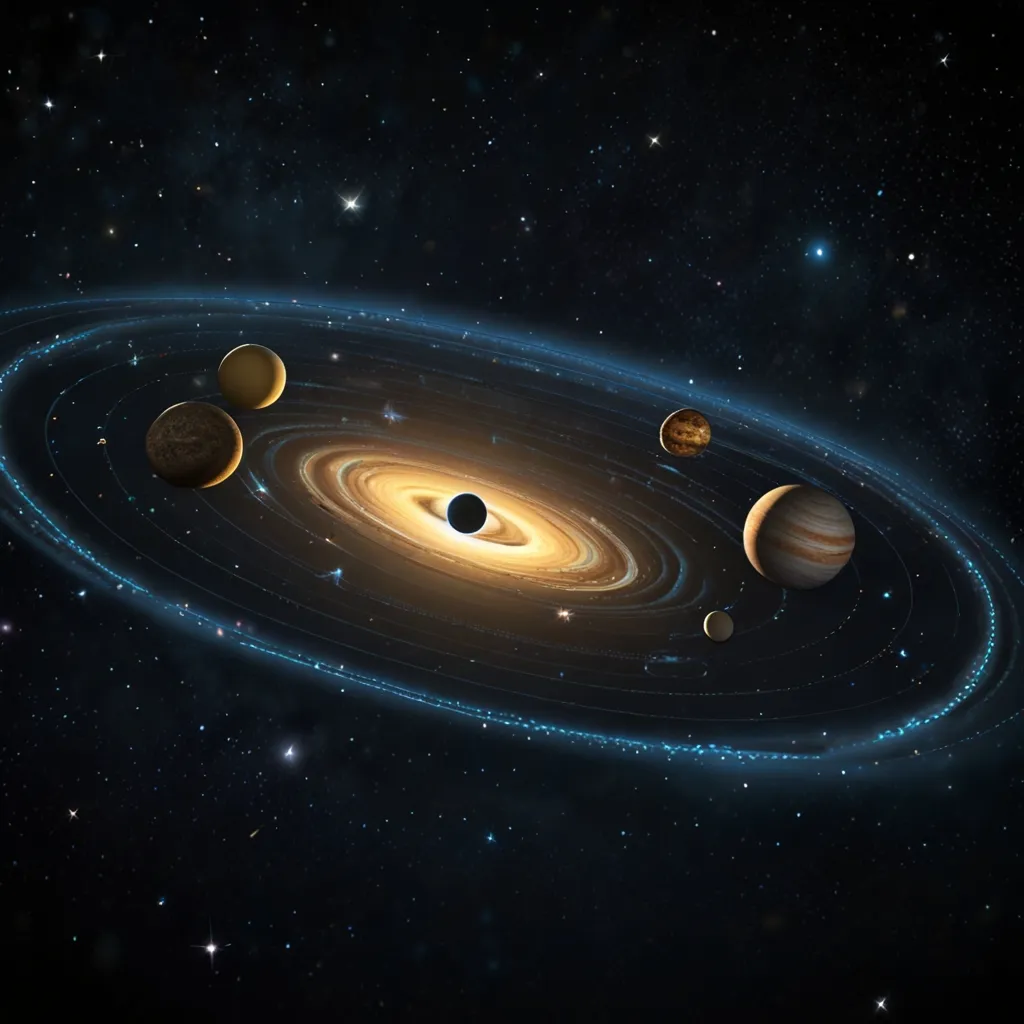
In 1687, Isaac Newton revolutionized our understanding of the cosmos. He connected the force we experience on Earth with the force that governs the movement of celestial bodies. This force, gravity, was expressed analytically in Newton’s law of universal gravitation. His equation explained planetary movements accurately, yet the idea of “action at a distance” — that a massive object could exert a force on another object without touching it — troubled even Newton.
By 1859, Newton’s laws couldn’t explain Mercury’s peculiar orbit, specifically its precession. While Newton saw gravity as an innate, instant force acting over distances, it couldn’t solve this riddle. Fast forward 250 years, and Albert Einstein changed everything in 1916 with his general theory of relativity. Einstein’s theory solved the puzzle of Mercury’s precession by describing gravity not as a force but as the curvature of space-time itself.
Einstein’s equations transformed our understanding of gravity, portraying it as a result of space-time bending around massive objects. Despite a century of corroborative evidence, Einstein’s theory has its own limitations, particularly in explaining singularities within black holes and the Big Bang. The pursuit of a quantum theory of gravity is now one of physics’ greatest quests. But even understanding general relativity is no small feat, as its math is notoriously difficult.
Newton’s and Einstein’s equations of gravity show remarkable parallels. Newton’s gravitational constant appears in both, but while Newton’s formula sees gravity as a force, Einstein’s sees it as the curvature of space-time. Essentially, matter and energy tell space-time how to curve, and this curvature directs how matter and energy move. Though Einstein’s elegant equation looks simple, it encompasses ten interrelated equations.
These equations describe the universe’s structure by treating space-time as flat over infinitesimally small distances. The idea is that general relativity behaves like special relativity at these micro scales, with overall curvature factored in. Curvature tensors and scalar curvatures present in these equations tell us how space-time deviates from flatness and how to calculate distances.
Yet, even Einstein’s work isn’t the final word. General relativity predicts the bending of light and time dilation, both experimentally confirmed. But it doesn’t mix well with quantum mechanics, which governs particles on extremely small scales. The theory fails to describe how gravity works at the quantum level. For instance, take a hydrogen atom: quantum mechanics places its electron in multiple locations simultaneously, complicating our understanding of where space-time curvature occurs.
Another issue arises with black holes. General relativity predicts infinite density at a singularity, where space-time supposedly curves infinitely. However, mathematical infinities usually signal a problem in our understanding.
The quest for a unified theory of quantum gravity remains. Two promising candidates are loop quantum gravity and string theory, which could better describe gravity at very small scales. These theories, still under exploration, might bridge the gap between general relativity and quantum mechanics.
In summary, while Newton and Einstein have laid the groundwork for our understanding of gravity, the journey to uncover the true nature of this fundamental force continues. Science is ever-evolving, with each discovery bringing us closer to a more complete picture of the universe.