Did Einstein's Window Washer Reveal the Secrets of the Universe?
From Patent Clerk to Cosmic Pioneer: How Einstein Revolutionized Our Understanding of Space and Time
In 1905, Albert Einstein introduced the Special Theory of Relativity to the world. At that time, his groundbreaking ideas were either harshly criticized or entirely overlooked. Many found Einstein’s theory too radical to take seriously, given that he was just a patent clerk, not a recognized scientist like Isaac Newton, whose theories had stood the test of time for centuries. To make matters worse, some people denigrated Einstein’s work by labeling it as “Jewish science,” attempting to undermine it based on his heritage.
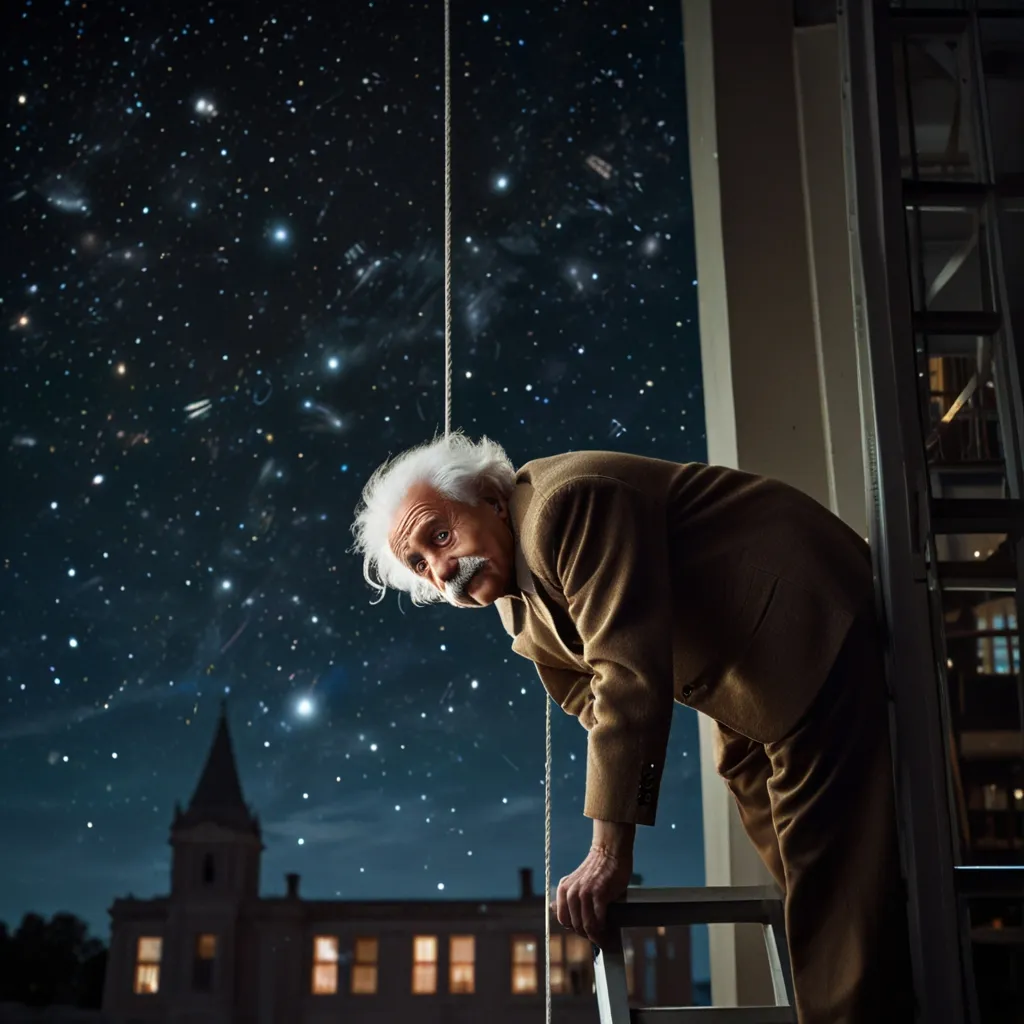
For Einstein, his theory was incomplete since it only applied to observers moving in a straight line at a constant speed and didn’t account for gravity or acceleration. Ever the imaginative thinker, Einstein frequently engaged in thought experiments. One day, while watching a window washer on a ladder, he pondered what would happen if the worker were to fall. Rather than focusing on the grim outcome, Einstein imagined the experience of falling.
In this thought experiment, Einstein realized that if the window washer were falling, gravity would be the only acting force, leading to a sensation of weightlessness. This revelation sparked a crucial insight: gravity and acceleration are equivalent. To illustrate this, imagine being in a room with no windows. Whether on Earth or in a spaceship accelerating upwards at 9.8 m/s² (the same as Earth’s gravitational acceleration), stepping on a scale would yield the same weight.
Einstein then theorized that light must bend in the presence of a gravitational field because the room’s upward acceleration would make the beam of light appear to curve. This led him to hypothesize that gravity causes space to curve. With the complex mathematical help of his college friend, mathematician Marcel Grossman, Einstein formulated the General Theory of Relativity, asserting that gravity emerges from the interaction between space and massive objects.
This theory was revolutionary, flipping Newtonian physics on its head, as it conceptualized gravity not as a force but as a curvature of space-time. John Wheeler later encapsulated this theory with the phrase, “Space-time tells matter how to move; matter tells space-time how to curve.”
Einstein’s predictions about General Relativity were confirmed when Arthur Eddington and his team observed a solar eclipse in 1919. The stars’ light bending around the sun validated Einstein’s theory, catapulting him to worldwide fame.
Special Relativity, Einstein’s first theory, plays a key role in this. It posits that light always travels at a constant speed, regardless of the reference frame. This permanence means that in a gravitational field, time dilates to keep the speed of light constant. Thus, time slows down in a gravitational field, a phenomenon confirmed by the fact that clocks on Earth run slightly slower than those on the International Space Station.
General Relativity, though groundbreaking, doesn’t answer all questions about gravity. It struggles with concepts like black holes and singularities, where space-time curvature becomes infinite. To understand gravity fully, especially at tiny scales, we need a new theory known as quantum gravity.
Einstein’s monumental work has fundamentally changed our understanding of the universe, yet it leaves some questions unanswered, sparking ongoing scientific exploration.