How 5 Revolutionary Materials Changed the Course of Human Civilization Forever
Discover how 5 transformative materials—flint, bronze, concrete, steel, and silicon—shaped human civilization. From ancient tools to modern technology, explore materials that changed history.
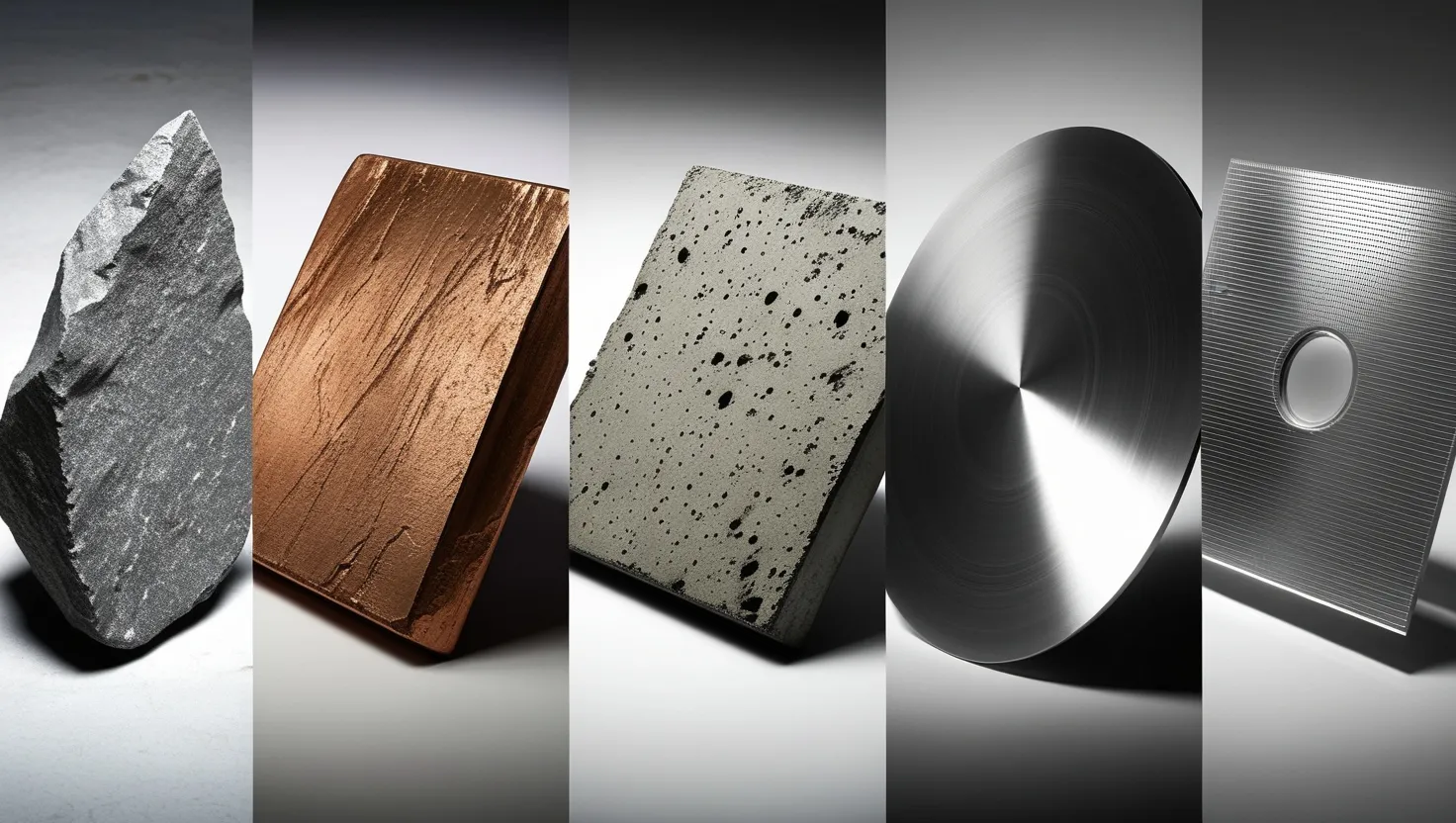
If you’ve ever held a rock, a coin, a chunk of concrete, a sliver of steel, or the sleek shell of a smartphone, you’ve met some of the most powerful forces in human history. Materials are often overlooked—they sit quietly behind the scenes while people, ideas, and events get the limelight. But look closer, and you see that the course of civilization has been bent, again and again, by the discovery, mastery, and manipulation of a handful of substances. The story of progress is, in so many ways, a story of what we have learned to shape and what those materials have then shaped in us.
What if, instead of listing kingdoms and inventions, we looked at our past through the lens of five transformative materials? Each had its moment, not by accident but because people figured out not just what these materials were, but what they could do. And each left an imprint far beyond the obvious, affecting everything from art and culture to the very way we think and organize ourselves.
Let’s start with flint. Picture early humans, tens of thousands of years before writing, standing over a raw lump of rock. If you’ve ever visited a museum, you’ve probably seen chipped flints and thought of them as primitive—simple tools for simple needs. But that sells short the almost artistic precision required for flint knapping. Early toolmakers learned to judge the angle, strength, and direction of each blow, producing razor-sharp edges that could slice meat, scrape hides, or carve wood. It was less a matter of brute force and more about finesse, planning, and patience. This was the first great leap in cognitive skill—a moment when humans started not just to use what nature gave them, but to impose their own vision on the world. How different might history look if this skill hadn’t emerged?
“The stone age didn’t end for lack of stones, but because something better came along.” That oft-quoted line, sometimes attributed to Sheikh Yamani, captures the essence of progress. Flint was not just practical; it taught us that materials could be transformed with knowledge. It set our ancestors on the path to innovation, and it’s a reminder that the urge to shape our environment is as old as humanity itself.
Jump forward a few millennia, and you find bronze. If flint was the signature of survival, bronze was the passport to power. Somewhere in the Near East, people discovered that mixing copper and tin—two soft, relatively useless metals—produced a material far tougher than either alone. Bronze didn’t just stay in tool sheds or blacksmiths’ shops; it became the stuff of weapons, armor, chariots, and—crucially—agricultural tools. Suddenly, empires could rise, armies could dominate, and societies could grow denser and more complex.
But here’s something less obvious: bronze also incited trade and collaboration. Tin is rare, and copper isn’t always close at hand, so communities had to interact, exchange, bargain, and sometimes fight to get the raw materials. The Bronze Age set up vast networks stretching from the British Isles to the Middle East. Was it the material that changed society, or society that changed the material? The answer, of course, is both.
Looking at the wonders built in bronze’s heyday, one might ask: would they have been possible without this combination of hardness and malleability? Could the epic poems and dusty legends of those civilizations exist without the infrastructure, weaponry, and artistry that bronze-supported societies built? The material itself outlived the societies that thrived on it, a silent testament to its durability and its power to connect.
Take a moment to imagine the ancient world without Roman concrete. For most people, concrete is a bland material, the backbone of drab highways and city sidewalks. The Romans, though, saw possibility. By perfecting the mix of volcanic ash, lime, and aggregate, they created a building material that didn’t just set hard like a rock—it did so underwater, shaping harbors, bridges, and the distinctive domes that still awe visitors today.
“Architecture is the learned game, correct and magnificent, of forms assembled in light.” Le Corbusier’s words come to mind as I marvel at the Pantheon’s enormous dome, which has stood for nearly two millennia without reinforcement. This wasn’t about replicating nature; it was about defying it, creating spaces and structures that previous materials couldn’t support. Roman concrete allowed cities to expand, armies to supply themselves, and cultures to flourish. Ask yourself: how did this unassuming substance help knit together an empire stretching from Britain to Syria?
Curiously, the precise recipe for Roman concrete was lost for centuries, and even today, engineers study ancient ruins for insights. It’s a reminder that progress is not always a straight line—sometimes, knowledge is fragile, and losing the secret behind a material can set back technological development for generations.
Now, shift to the 19th century, where the air is thick with smoke and change. If you’ve ever looked at a city skyline or crossed a steel bridge, you’ve seen the effects of the Bessemer process. Before this innovation, steel was precious—hard to make, expensive, and reserved for specialist uses. Henry Bessemer changed that by figuring out how to blast air through molten iron, removing impurities efficiently and on a massive scale. Suddenly, steel was everywhere.
But it’s the ripple effects that matter most. With steel, railways crisscrossed continents, goods and people moved like never before, and cities grew up—not out. Skyscrapers reached for the clouds, ships crossed oceans, and machines transformed labor. Steel wasn’t just about strength; it was about flexibility, scale, and speed. And it spurred a new kind of organization—businesses and governments had to manage supply chains, labor forces, and technical expertise on a massive scale.
What would our world look like without this cheap, plentiful steel? Would we still gather in dense cities, or would our societies have evolved along a completely different path? These questions highlight how materials don’t just serve needs—they create new possibilities and new problems.
“A new gadget that does not work is interesting. A material that does not exist is revolutionary.” This anonymous quote captures the shift that came in the mid-20th century, as science entered the atomic age. Here, the most important material might just be the most ordinary-looking: silicon. Found in sand and stone, it was only when purified to a near-perfect form that silicon became the foundation for the digital world.
Growing flawless silicon crystals—a task that sounds simple but is fiendishly complex—allowed for the reliable production of transistors and microchips. These components, packed by the billions onto tiny wafers, power our phones, computers, satellites, and virtually every tool of modern life. Silicon is, in a sense, the new bronze or steel, transforming not just what we can make but how we think, communicate, and organize our lives.
It’s easy to think of technology as the realm of software and ideas, but step back and you’ll see that every tweet, every streamed song, every global market—these all rest on atoms arranged, layer by layer, on slices of ultra-pure silicon. How much of our day-to-day dependence on digital technology is actually a dependence on the genius of materials science?
If I ask myself which of these materials mattered most, I find it hard to choose. Each shaped its era—and each left surprising legacies. Flint taught us to think ahead, Bronze to organize and interact, Concrete to build and endure, Steel to scale, and Silicon to imagine. These materials formed the bones of civilization and the sinews of connection.
Sometimes I wonder: which material will be next? Will it be graphene, with its strength and flexibility? Bioplastics that decompose and return to the earth? Or something entirely new, still waiting in the laboratory or the mind of a curious inventor?
There’s something reassuring in this ongoing dialogue with the material world. Every generation faces its own challenges and discovers its own answers in the stuff of the earth. The lesson, I think, is that our future is forged as much by imagination as by discovery, as much by what we create as by how we choose to use it.
“I am a part of all that I have met,” wrote Tennyson, and perhaps nowhere is that truer than in the materials that run through our history and beneath our feet. If you look at your own life, which materials define your daily world—and how might your choices shape what comes next?