How Did Earth's First Drop of Water Travel Across the Cosmos?
From Cosmic Explosions to Your Glass: The Epic Journey of Earth's Water
Water: The Universe’s Most Precious Resource
Imagine a world without water. It’s impossible because life as we know it hinges on this simple molecule. Water, or H2O, is essential for our survival. It’s all over our planet in forms of gas, liquid, and solid, making Earth stand out in our solar system. But how did we end up with such an abundance of water?
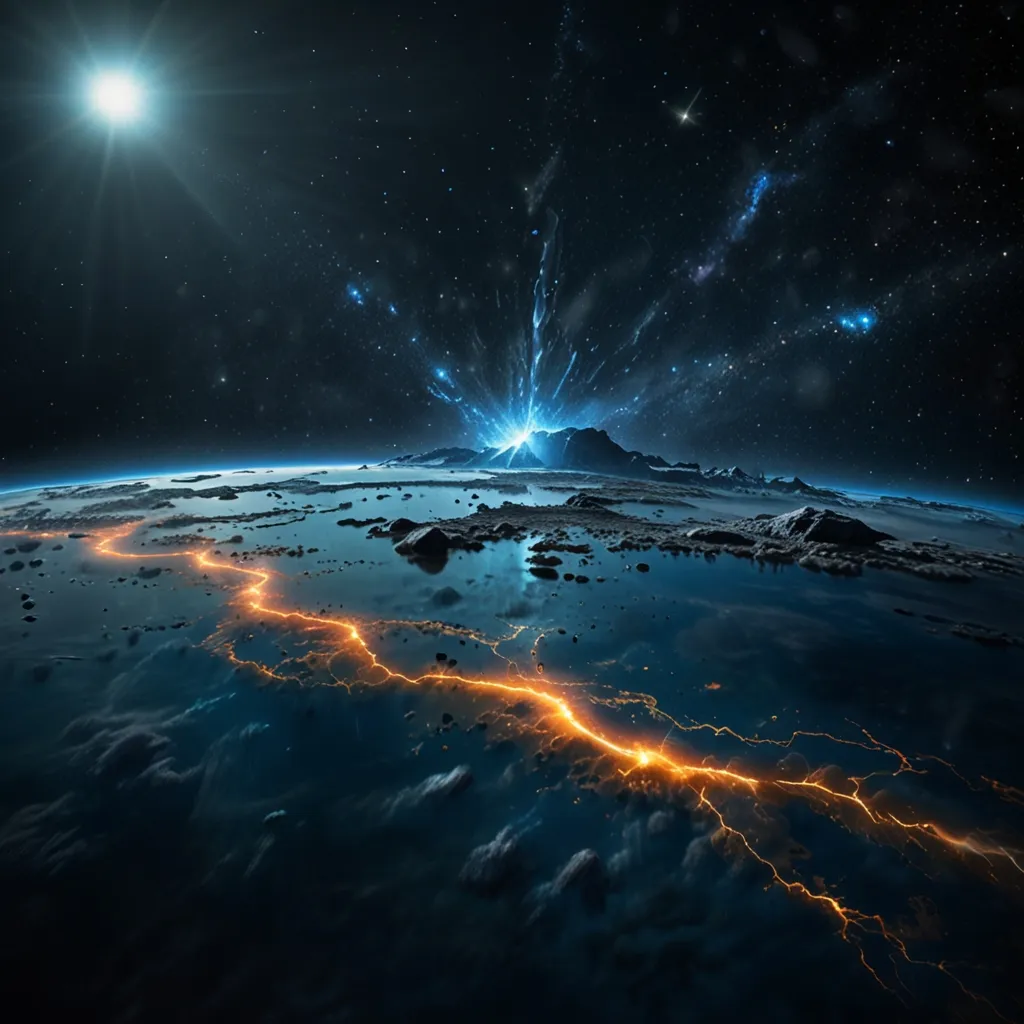
The Earth didn’t start out wet. Our planet began as a fiery, lifeless rock. So, where did the water come from? Let’s take a trip back in time to unlock this mystery.
A water molecule is a simple structure—just two hydrogen atoms and one oxygen atom. Hydrogen, the most abundant element in the universe, formed soon after the Big Bang around 13.8 billion years ago. But oxygen took a bit longer to come into existence. It required nuclear fusion in the hearts of early, massive stars.
These stars didn’t live long. They exploded in supernovae, scattering oxygen and other heavy elements into space. When conditions were right, hydrogen and oxygen combined, in the presence of some energy source, to form water. This water, now frozen in the cold of space, joined cosmic dust.
Over eons, this dust coalesced into new stars, planets, and other celestial bodies. One might think our planet was inherently wet from the start. But collisions like the one with the Mars-sized body called Theia would have vaporized much of Earth’s primordial water.
So, how did we get our vast oceans if our early water evaporated? For a long time, scientists thought comets, loaded with dirty ice, brought water to Earth. However, recent studies of the hydrogen isotope composition—specifically the ratio of deuterium to protium—in these comets revealed a mismatch with Earth’s ocean water.
The real carriers of Earth’s water were likely closer than we thought: asteroids. Unlike distant comets, near-Earth asteroids had isotope ratios that closely matched Earth’s water. This discovery shifts the focus to a period known as the Late Heavy Bombardment, about 3.8 billion years ago. During this era, numerous water-rich asteroids bombarded Earth, gradually filling its basins.
Next time you sip water, remember its incredible journey. From exploding stars to icy space debris, to fiery impacts and then life-giving rain, each water molecule has a story that spans billions of years and the vast expanse of the universe. Imagine the tales it could tell if it could speak.