How Did the Universe Cook Up Atoms From Nothing?
Particles and Universes: From the Big Bang's Inferno to the Birth of Atoms
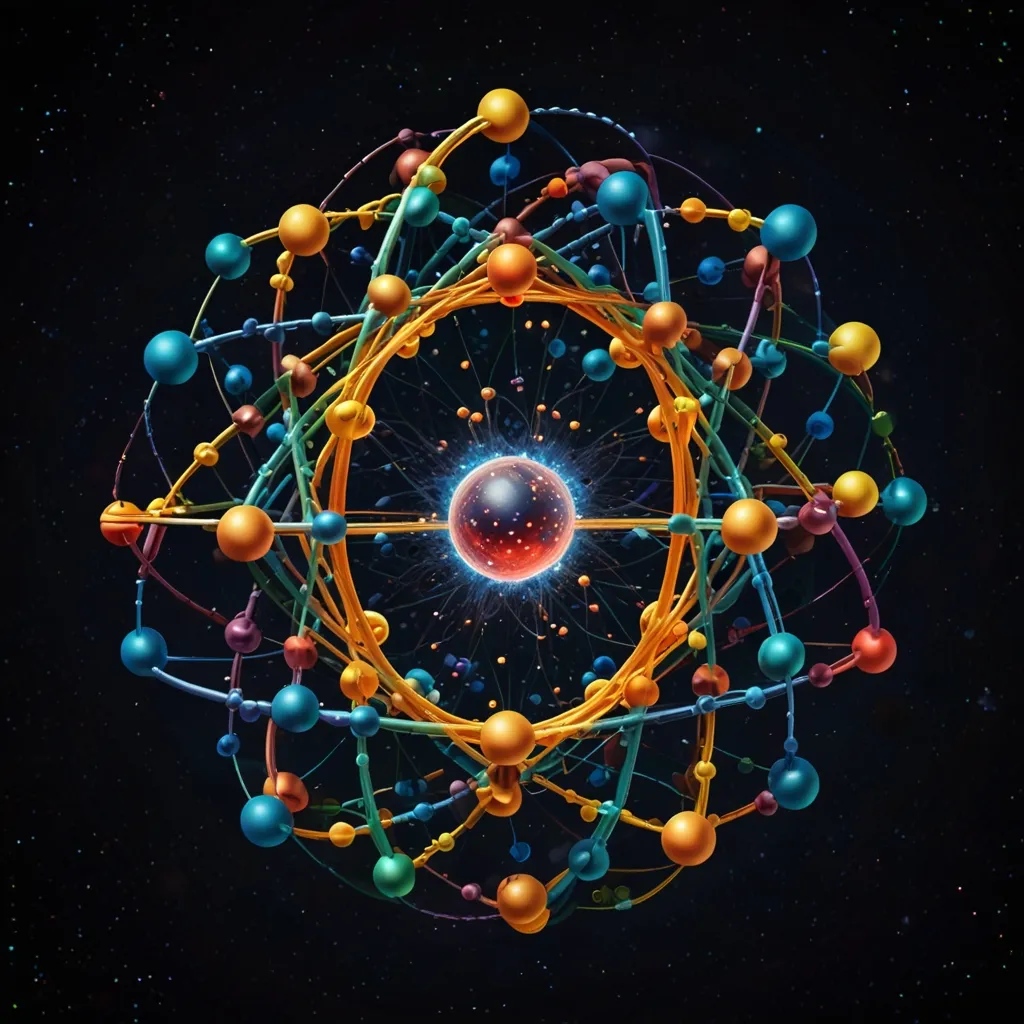
Atoms, the tiny particles that make up you and everything around you, are truly a marvel. They consist of electrons, protons, and neutrons, which in turn, are made up of even smaller particles called quarks. The creation of atoms ties back to an event known as the Big Bang.
The Big Bang wasn’t exactly the ‘beginning’ of the universe per se, but rather a period when the universe was incredibly hot, dense, and expanding rapidly. While we don’t have a precise understanding of what happened at the very onset of the universe, our best theories take us as close as 10^-43 seconds after the Big Bang, a moment known as the Planck epoch. At this juncture, we encounter the limits of our current understanding because gravity and quantum mechanics operate on incompatible scales.
Fast forward slightly, and we hit the inflationary epoch, roughly 10^-36 to 10^-33 seconds after the Big Bang. During this brief window, the universe expanded exponentially, faster than the speed of light—a process allowed because it wasn’t about moving through space but rather space itself expanding.
Post-inflation, the universe continued to cool and expand. Around 10^-11 seconds, the forces of nature began to separate. Initially, they were unified, but as the universe cooled, the electromagnetic and weak forces became distinct. This separation introduced the Higgs field, which is responsible for particles gaining mass.
Fast forward further, to about 10^-5 seconds, the universe cooled down from quark-gluon plasma to hadrons, including protons and neutrons. These particles then began to annihilate their antimatter counterparts, leaving behind a small but significant surplus of particles, setting the stage for the formation of the first atoms.
During the Big Bang nucleosynthesis, which lasted until the universe was around 20 minutes old, protons and neutrons combined to form nuclei, primarily hydrogen and helium, with traces of lithium. However, these nuclei were still too hot to capture electrons and form neutral atoms.
Finally, around 380,000 years after the Big Bang, the universe cooled enough for electrons to combine with nuclei, forming the first stable, neutral atoms. This process, known as recombination, also released photons, which we see today as the Cosmic Microwave Background—a kind of ‘baby picture’ of the universe.
This brief journey from the inception of the universe to the formation of the first atoms is merely the beginning. It only explains the creation of the lightest elements. The formation of heavier elements necessary for life such as carbon, oxygen, and nitrogen, is a fascinating story of its own, intricately tied to the lives and deaths of stars. Stay tuned to uncover more about this cosmic journey in future explorations.