How Do Unintended Consequences Shape Human Progress and Innovation?
A Journey Through Time: The Hidden Catalysts Driving Human Progress
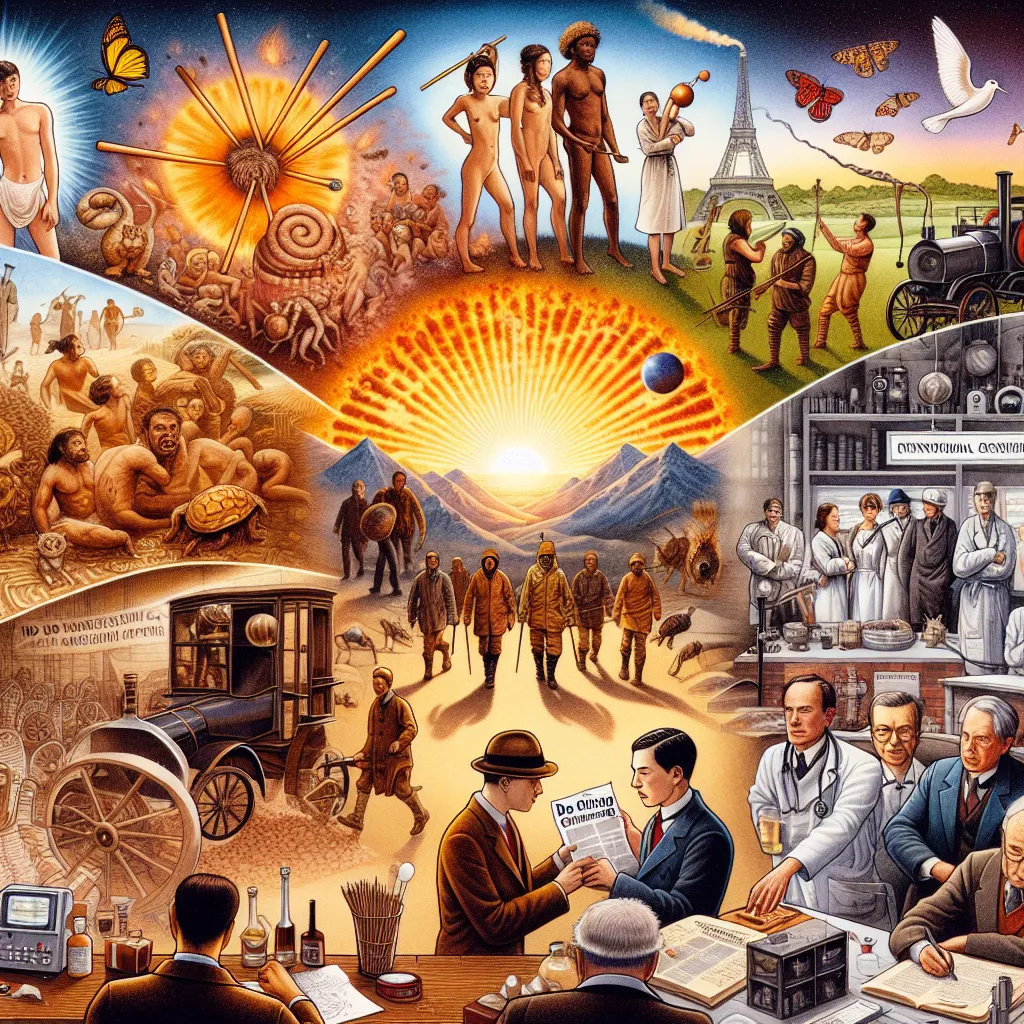
I’ve come to appreciate unintended consequences, although it wasn’t always the case. They are at the heart of progress, shaping our present in ways our ancestors couldn’t have predicted. Let me take you on a journey to illustrate how unintended consequences have driven innovation and growth over millennia.
Let’s go back 40,000 years to the cultural explosion. This period gave birth to music, art, and technology. Anthropologist Randall White points out that our ancestors, responding to immediate needs, inadvertently set the stage for us to enjoy these advancements today. They couldn’t fathom the long-term impact of their actions, yet those seemingly small steps propelled us forward.
Fast forward to 10,000 years ago, the dawn of agriculture. If our ancestors had a method to analyze the impact of technology, they might have opted out of farming due to its drawbacks—worse nutrition, shorter lifespans, and increased inequality. Women, in particular, suffered, grinding grain all day. Yet, despite these hardships, agriculture’s unintended consequences reshaped human society.
History is filled with examples of unintended consequences altering the course of human development. Take chopsticks—a simple tool that, as noted by a Japanese anthropologist, gradually changed the dental structure of Japanese people. Even today, our teeth and jaws are evolving due to changes in our diet and eating habits.
Ancient civilizations revered unintended consequences, evidenced by myths like Pandora’s Box and Prometheus. They understood the precarious balance of innovation and caution. Egyptian and Greek physicians recognized their limitations, often opting not to treat ailments beyond their scope, embodying Hippocrates’ principle of “do no harm.”
Harvey Cushing, a pioneer in neurosurgery, transformed a high-risk field into one with a hopeful outlook by meticulously recording and learning from his mistakes. His persistent effort underscores the crucial role of unintended consequences in advancing medicine.
In the 19th century, technology grew from simple tools to complex systems. The first hackers—telegraph operators—identified “bugs” in these systems, a term still used today to describe software glitches. Even brilliant minds like Mark Twain fell prey to the complexities of new tech, losing fortunes to machines they couldn’t fully grasp.
The 20th century brought safety technology that sometimes caused further hazards. The Titanic taught the need for enough lifeboats, but the Eastland disaster showed that adding too many lifeboats could make ships unstable, proving how complex systems can magnify unintended consequences.
Yet, emergencies often spur incredible advancements. During WWII, penicillin was scaled up from lab experiments to mass production, revolutionizing medicine. This rapid development arose from a collective effort under immense pressure.
Post-WWII, Legionnaires’ disease showcased how HVAC systems unintentionally harbored bacteria. The solution, a bactericide, led to a new problem—tin particles leading to tape drive failures. This incident highlighted the interconnectedness of technology and health.
Despite the growing complexity of our technology, our ability to foresee long-term impacts remains limited. Brent Goldfarb and David Kirsch from the University of Maryland found that major innovations often arise during crises, like the Great Depression, which spurred innovations like the Xerox copier.
This pattern of learning from disasters extends to figures like Warren Buffett’s mentor, Benjamin Graham, whose value investing principles emerged after the 1929 crash. Similar lessons could help us tackle modern plagues like bedbugs, killer bees, and spam, much like Louis Pasteur’s work on silkworm diseases paved the way for the germ theory of disease.
We need to embrace unintended consequences as opportunities for growth. Like Dr. Cushing, who advanced neurosurgery by learning from his mistakes, and pharmaceutical companies during WWII, who pooled knowledge for a greater good, we can turn chaos into progress.
In essence, unintended consequences are inevitable. But if we learn from them, they can drive extraordinary advancements. Let’s harness this potential to shape a better future.