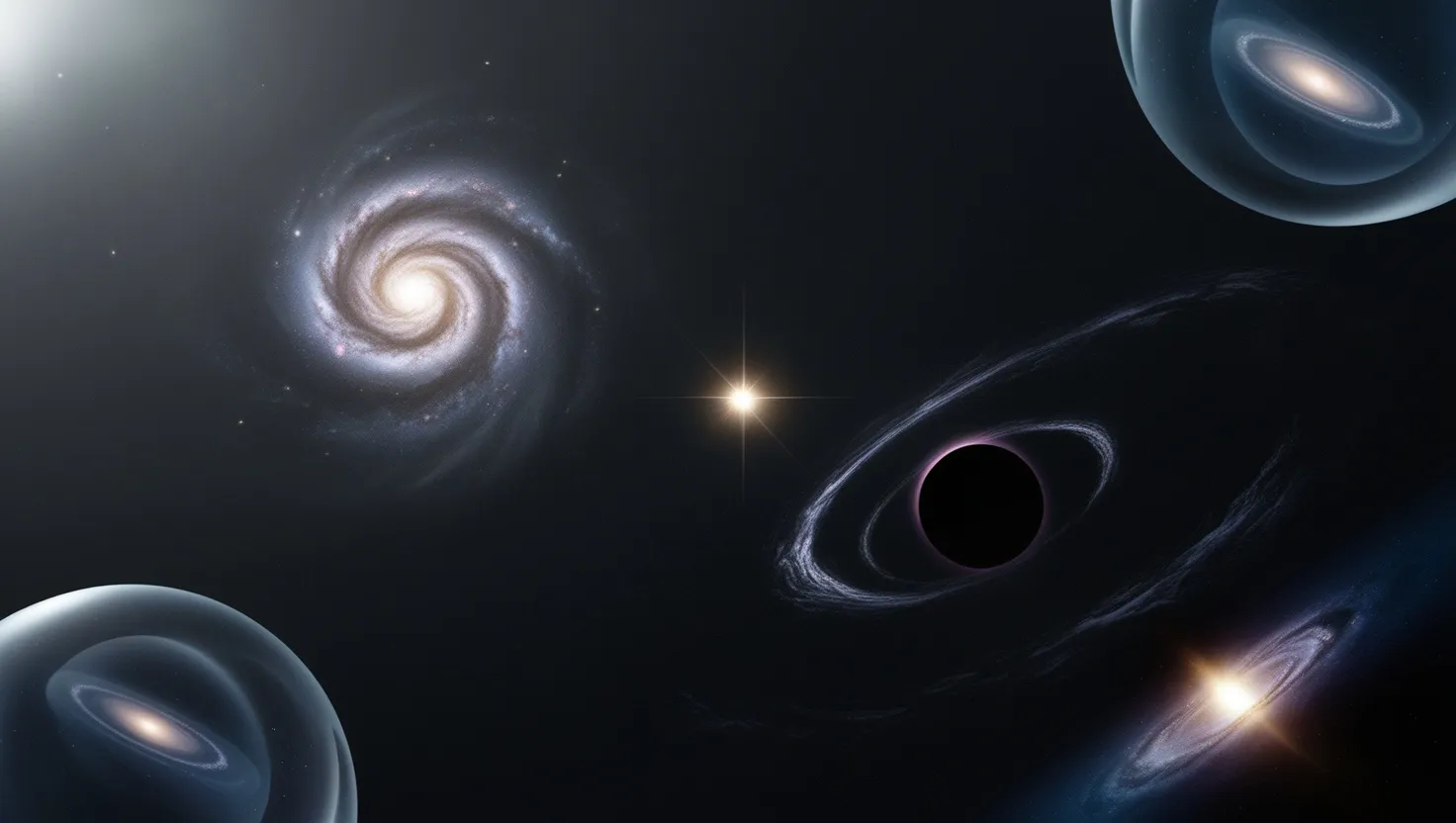
What Cosmic Secrets Did A WWII Soldier Discover That Became Black Holes?
Warping Spacetime: The Unseen Giants Sculpting the Universe
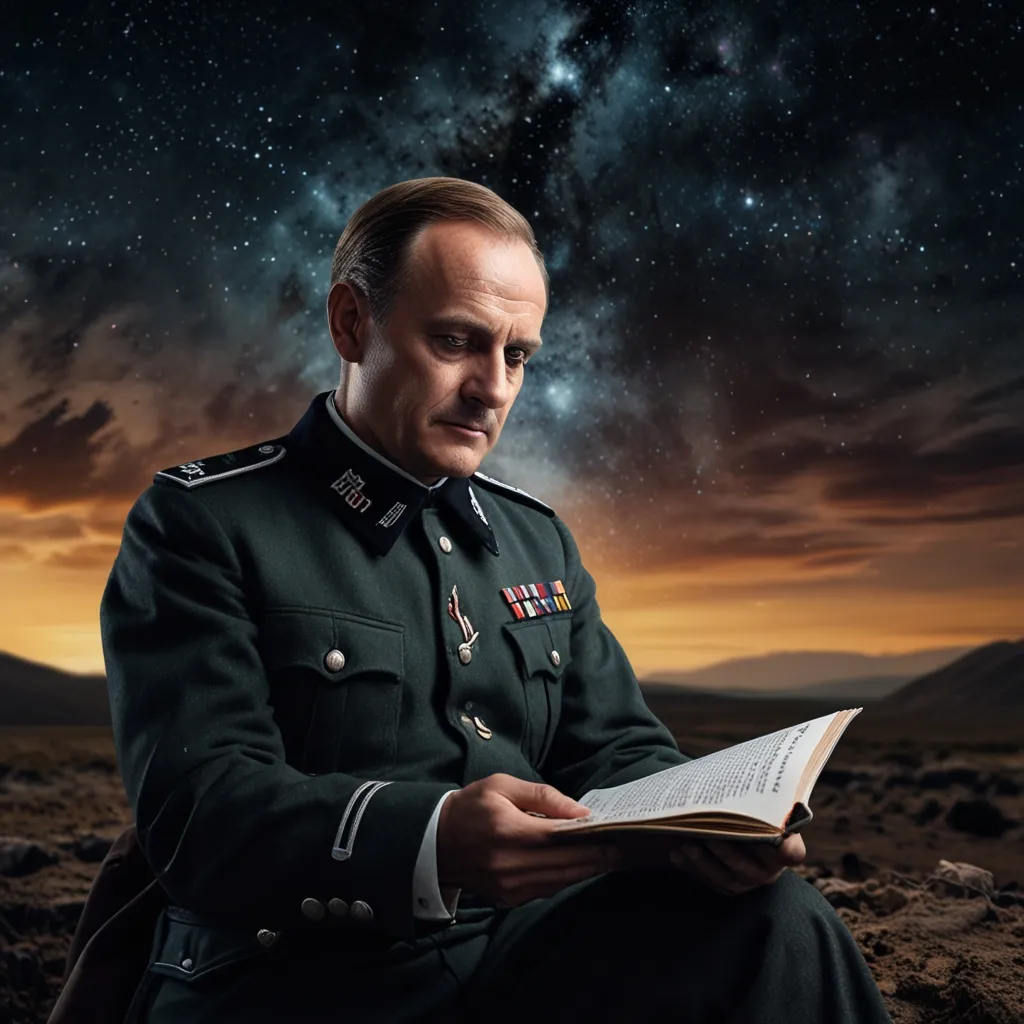
The tale of black holes starts over a century ago, back in 1915, during the chaos of the First World War. Picture Russian shells bombarding German trenches. A German lieutenant, in the dim light of a dugout, is absorbed in reading papers from the Prussian Academy of Sciences. Amidst thunderous gunfire, he dives deep into the wonders of General Relativity, a theory crafted by his acquaintance, Albert Einstein.
This lieutenant, Karl Schwarzschild, used just pen and paper to unravel one of the universe’s biggest mysteries. He worked on solving how spacetime bends around massive objects. To Einstein’s surprise, Schwarzschild found an exact solution to these equations. His findings ushered in the concept of what we now know as black holes—places in space so densely packed that even light can’t escape their gravitational pull.
These cosmic wonders have fascinated everyone from scientists to the general public. The term “black hole” was coined in the 1960s by American physicist John Wheeler, and it has stuck ever since. Schwarzschild’s equations led to the understanding that as gravity grows stronger, it eventually reaches a point of no return. Initially called “frozen stars,” these were later known as “dark stars,” and today’s “black holes.”
What’s utterly captivating about black holes is their extreme nature. When stars, especially massive ones, exhaust their fuel, they undergo a spectacular end. They can implode and, if massive enough, create black holes. This collapse results from gravity overwhelming the star once the internal fusion stops producing outward pressure.
A black hole is essentially where gravity wins. It warps spacetime to such a degree that nothing, not even light, can escape. At its heart lies the singularity—a point where matter is infinitely dense and our understanding of physics breaks down. Singularities might not be real physical things but indicate the limits of our current mathematical theories.
The event horizon, the boundary around a black hole, marks the point of no return. Anything crossing it, including light, gets pulled in irreversibly. Hence, black holes remain cloaked in darkness, unseen except through their gravitational influence on nearby objects.
Inside a black hole, conventional physics takes a backseat. Spacetime itself gets twisted beyond recognition. Einstein’s theory predicts that time and space switch roles, and everything is drawn inevitably towards the singularity, where time seemingly ends. This mysterious point is often described as the “reverse of creation,” juxtaposed against the Big Bang.
From a distance, we can only study black holes indirectly. Their immense gravity affects nearby stars and gas clouds, bending light and causing matter to radiate wildly as it spirals in. For instance, quasars, some of the brightest objects in the universe, are powered by supermassive black holes with hot, glowing accretion disks.
Interestingly, black holes aren’t scarce. Our galaxy alone could have around 100 million of them. Despite their name, they don’t just suck everything in—they often eject matter at high speeds, creating stunning phenomena like jets of gas stretching thousands of light-years into space.
You might wonder if planets could orbit black holes. Theoretically, yes. The steep gravitational gradient around a black hole could support millions of stable orbits, although most such planets would be remnants or captured wanderers. These exotic worlds might even host life, powered by the accretion disks or nearby stars.
Black holes outlast everything else in the universe. While our sun has about 10 billion years left, black holes can persist for a length of time so vast it’s almost incomprehensible. Even after the stars die out and the universe goes dark, black holes will continue to exist for septenvigintillion years—a time span with 84 zeros.
In essence, black holes are a testament to the extremes of the universe. They encapsulate mysteries that push the boundaries of our understanding, holding secrets that may one day lead to the long-sought quantum theory of gravity. As they roam the cosmos, they remind us of the awe-inspiring, unfathomable scale of time and space.