What Mind-Blowing Science Myths Are You Still Believing?
Unveiling the Deceptions Behind Popular 'Science Facts'
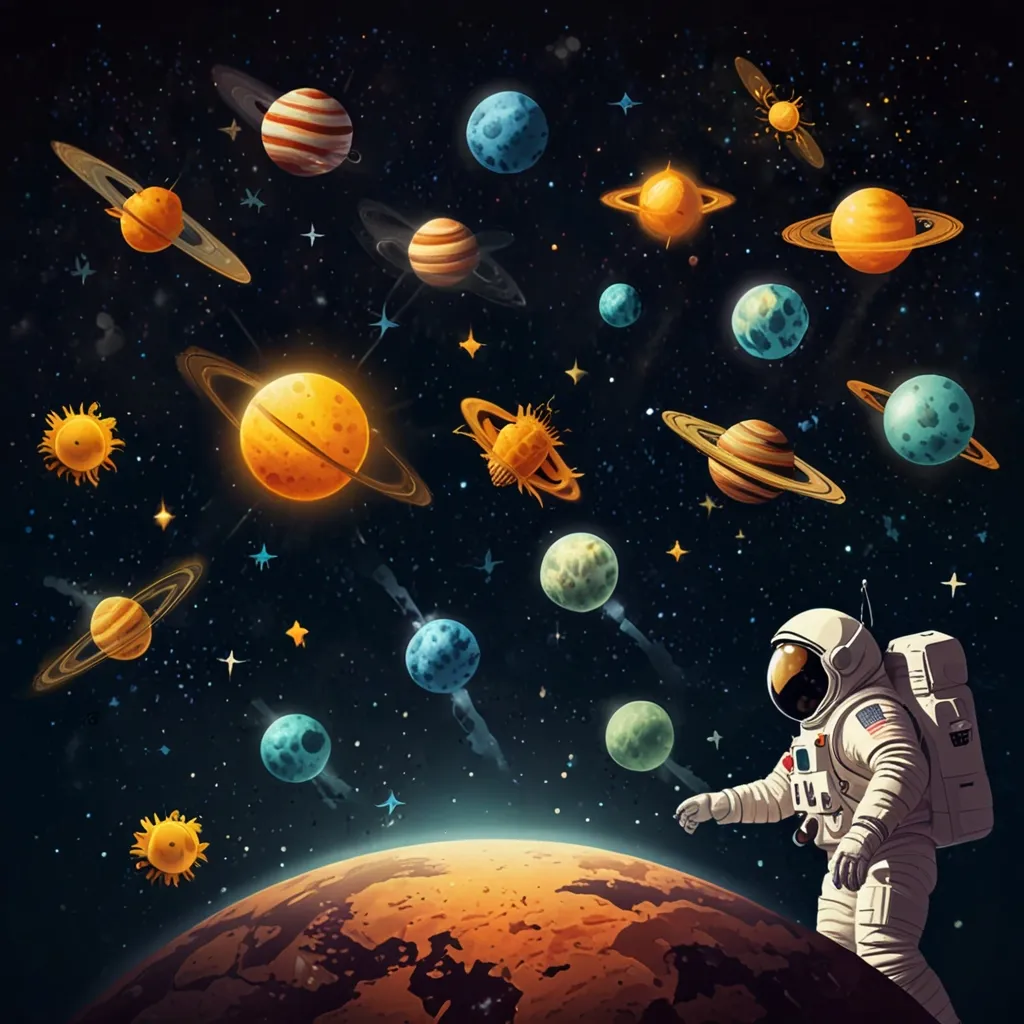
There are countless so-called science facts we accept without question, but some of these widely held truths are more myth than reality. Here are five commonly believed “facts” that aren’t actually true, and they might surprise you to learn why.
First up, the idea that there’s no gravity in space is flat out wrong. Gravity exists everywhere in the universe, though its strength diminishes with distance. Gravity keeps planets in orbit and objects within galaxies. Even on the International Space Station, astronauts experience gravity at about 90% of what we feel on Earth. The reason they float is because the station and the astronauts are in constant free fall, orbiting Earth in a state of perpetual falling.
Next, there’s the misconception that nothing can exceed the speed of light. Einstein’s theory of relativity does set the speed of light as a universal speed limit for particles with mass. However, certain aspects of spacetime itself, like the expansion that occurred right after the Big Bang, can surpass this speed, while information can’t travel faster without leading to bizarre causality issues.
The belief that bees shouldn’t be able to fly according to physics has been debunked too. Early calculations were based on assumptions that insect wings work like those of birds. However, bees generate lift by flapping their wings in a unique way, creating lift on both the forward and backward strokes.
Another false fact is that humans evolved from chimps. While it’s true that humans and chimps share a common ancestor, they each evolved along separate paths. Human evolution contains many branches, with modern humans (Homo sapiens) being just one of several species that once existed.
Finally, there’s the claim that The Big Bang Theory explains the creation of the universe. In actuality, the theory describes the evolution of the universe from a hot, dense state to its current form. It doesn’t address the moment of creation or what preceded it. The theory is supported by substantial evidence like the cosmic microwave background radiation and the abundance of light elements.
These corrections illustrate how scientific understanding evolves, challenging even our most ingrained beliefs. Keeping an open mind and a critical approach helps us all stay better informed.