What If You Found Out Your Weight Depends on Cosmic Gravy?
How the Higgs Field Shapes the Universe and Our Existence
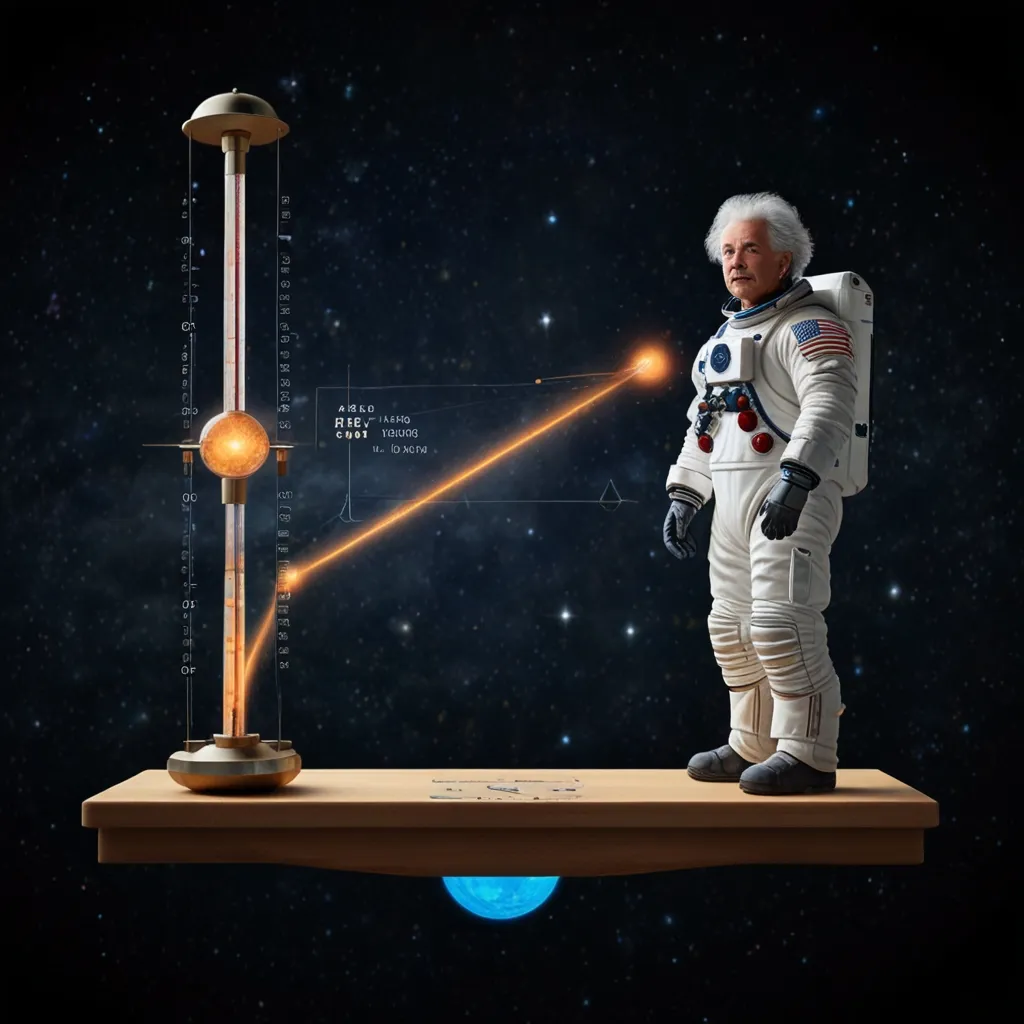
When you step on a scale and see that number, it’s telling you how much force your body exerts on the ground. It’s basic Newtonian mechanics: force equals mass times acceleration. Gravity gives the acceleration, and your body’s mass creates the force, which is your weight. While weight is a straightforward concept, mass is more elusive. If you were floating far away from Earth, you’d have no weight, but your mass would remain unchanged.
Your mass comes from the atoms in your body. The mass of atoms is essentially energy, demonstrated by Einstein’s famous equation, E=mc². Mass and energy are interchangeable, with the speed of light squared acting as the conversion factor. Most of an atom’s mass lies in the binding energy within its nucleus, a result of the strong force, one of the fundamental forces of nature. This energy is what binds protons and neutrons together.
Interestingly, about one percent of your mass is in the particles that make up atoms, like electrons and quarks. These particles also have intrinsic mass, which brings us to the Higgs field. This field, present everywhere in space-time, gives mass to these fundamental particles. Although explanations often involve complex concepts like symmetry breaking, the core idea is that the Higgs field imparts mass by interacting with particles.
The Standard Model of particle physics tells us that all matter consists of excitations in quantum fields. For example, an electron is an excitation of the electron field, and a photon is an excitation of the electromagnetic field. These fields permeate space-time, and even when no particles are present, they have some vibration due to the Heisenberg Uncertainty Principle. Virtual particles appear and annihilate rapidly, creating a flurry of activity without contributing to real particles’ mass.
Only when enough energy interacts with a field does it create a real particle. For electrons, their interaction with the Higgs field gives them mass—0.511 MeV. Without this interaction, electrons would be massless and travel at the speed of light, similar to photons. The Higgs field’s vacuum energy (VEV) is non-zero, meaning it has mass even in empty space. When particles interact with the Higgs field, they acquire mass due to this vacuum energy.
In other words, the Higgs field slows particles like electrons by resisting their acceleration, giving them mass. The stronger the interaction, the more mass a particle has. The Higgs field is like thick gravy, making it harder for charged particles to move, thus giving them inertial mass. Despite the complexity, this one-percent mass contribution from the Higgs field is crucial. It ensures atoms form correctly and allows particles to decay, contributing to the universe’s structure.
In a universe without the Higgs field, electrons would be massless, and atoms wouldn’t form, leading to a radically different cosmos. While the standard model predicts massless neutrinos, measurements suggest they have tiny mass. Their origin remains uncertain, possibly involving the Higgs field.
In essence, that tiny contribution from the Higgs field is fundamental to the universe’s existence as we know it. The intricate dance between energy and mass, facilitated by the Higgs field, shapes our reality, ensuring atoms form and particles decay as they should. Without it, our universe would be unrecognizable.