What Keeps the Universe Glued Together? Explore the Invisible Forces of Nature
Invisible Forces and the Hidden Strengths Shaping Our Universe
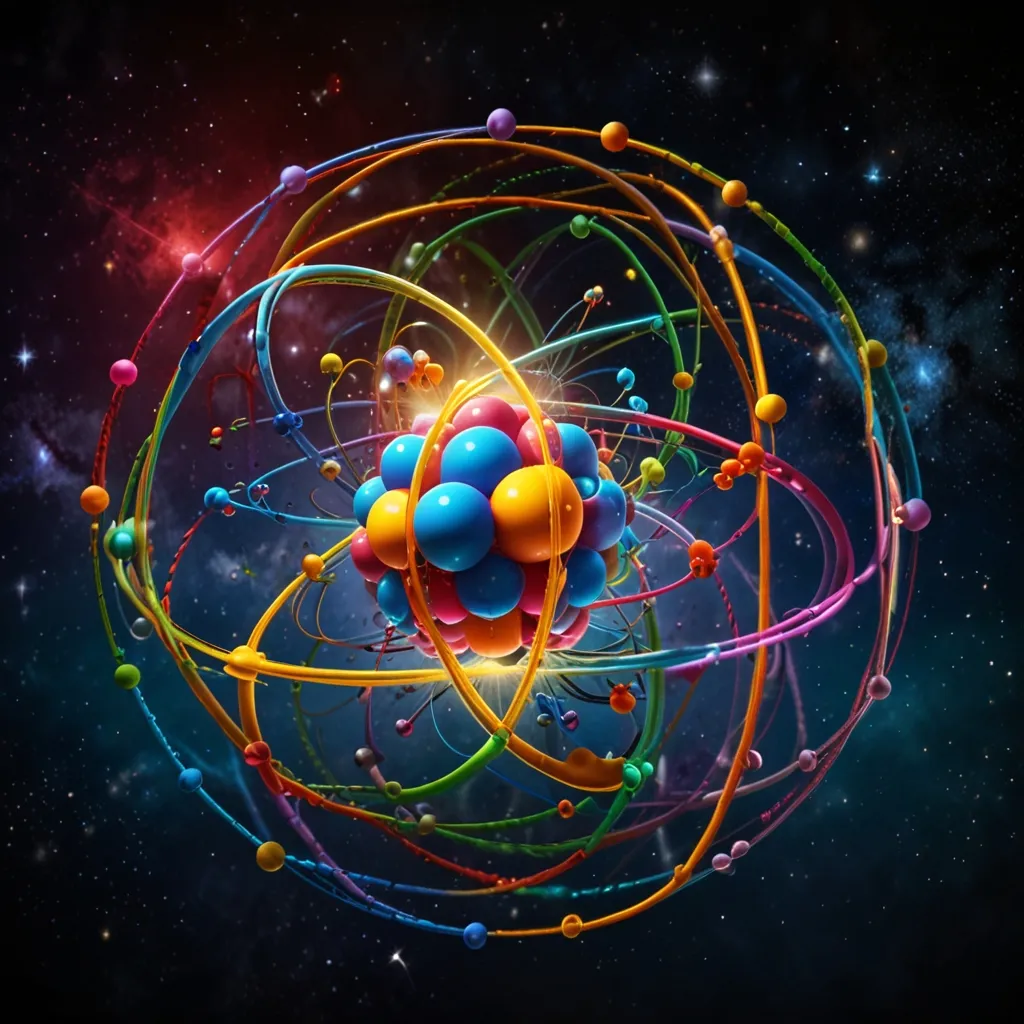
In our quest to understand the universe, we identify four fundamental forces. Two act at the quantum level, invisible to our daily lives, while the other two, gravity and electromagnetism, are very much part of our everyday experience. Gravity pulls you back to Earth when you jump, and electromagnetism makes your electronic devices work.
Electromagnetism is crucial in chemistry, maintaining electrons in orbit around atomic nuclei. In a helium atom, for instance, two protons repel each other with considerable force, despite the atom’s tiny size. The strength of this repulsion raises a fascinating question: What force keeps protons so tightly bound together in the nucleus?
Enter the strong nuclear force—the strongest force in the universe, believed to be about a hundred times stronger than electromagnetism. It operates only over very short distances and is studied through quantum chromodynamics, a theory rooted in the concept of color, though not in the visible sense.
When the atomic structure was deciphered in the 1920s, the question arose: How can the positively charged protons in a nucleus overcome their mutual repulsion? Japanese physicist Hideki Yukawa proposed an answer. He suggested a short-range force counterbalancing electromagnetic repulsion, mediated by a massive particle he termed the meson.
In the 1960s, Murray Gell-Mann and George Zweig introduced quarks as the fundamental particles comprising protons, neutrons, and mesons. Quarks come in types (up, down, and strange) and charges (fractions of the electron’s charge). The quark model explained particles’ behavior but contradicted the Pauli Exclusion Principle, which forbids particles from sharing identical quantum properties.
The solution? Color charge. This concept, proposed by American physicist Wally Greenberg, allows quarks to possess a type of charge called color, existing in three forms: red, green, and blue. Combining these neutralizes color charge, preventing violations of quantum principles.
Quarks never exist freely due to quark confinement. They are bound by gluons, particles that transmit the strong force. Unlike photons (neutral carriers of electromagnetism), gluons have color charges, causing them to interact strongly, even with each other.
This interaction makes pulling quarks apart akin to stretching a rubber band—energy-intensive and ultimately creating new quark pairs instead of isolating quarks. This process underpins the confinement concept, explaining why free quarks aren’t observed.
Additionally, while the Higgs field gives quarks their rest mass, most of a proton’s mass derives from the kinetic and binding energy within, attributed to the strong force. This reveals that a staggering 98% of an atom’s mass stems from the energy dynamics of quarks and gluons.
Understanding the strong nuclear force gives us insight into atomic nuclei’s stability and the universe’s mass. Though not directly observable, this force profoundly impacts matter’s structure and existence, anchoring our comprehension of the cosmos.