What Makes the Universe Tick at Its Most Basic Level?
The Infinite Journey Through Quantum Seas: Exploring the Nature of Fundamental Particles
More than 2,000 years ago, the Greek philosopher Democritus first introduced the idea of the “atom,” meaning something uncuttable. He believed that if you kept cutting a piece of metal in half repeatedly, you’d eventually end up with a smallest piece that couldn’t be divided further. This smallest piece, he assumed, was the fundamental particle of the material—the atom. Fast forward to today, our understanding of the fundamental nature of matter has advanced beyond what Democritus could have ever imagined.
In modern physics, we have the Standard Model, which is like the periodic table for fundamental particles. These particles are the building blocks of the universe. But defining what exactly these particles are isn’t straightforward. Quantum mechanics, governed by the Schrödinger equation, reveals that objects we think of as particles are more accurately described as waves spread out in space. These waves, called wave functions, describe the probability of finding a particle in a given location.
The classic double-slit experiment illustrates this concept beautifully. When light, in the form of photons, is shined through two slits, it creates an interference pattern characteristic of waves. However, if detectors are placed to see which slit a photon goes through, the wave pattern disappears, and the photon behaves like a particle. This phenomenon, known as wave function collapse, is one of the many mysteries of quantum mechanics, and why or how this collapse happens remains an open question in physics.
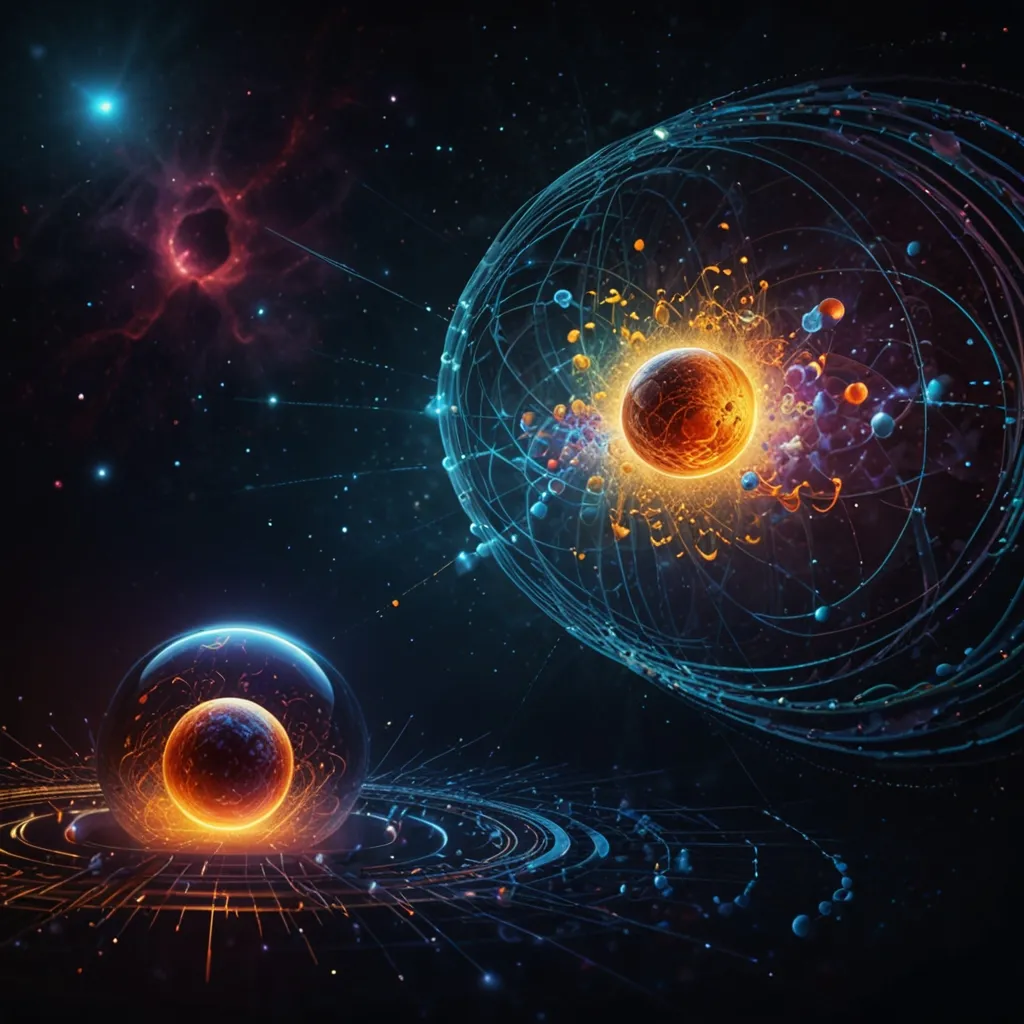
The next step in our understanding came with the formulation of quantum field theory in the 1930s. Classical fields like the electromagnetic field were quantized, leading to a theory that could account for the effects of special relativity. In this framework, particles are seen as quantized excitations in a field that permeates space-time. Imagine a sea with waves; each wave represents a particle, with the sea being the quantum field itself.
Quantum fields are never completely at rest; they always possess some minimum energy, known as vacuum energy. Real particles are created when there is enough energy to form these waves. Interesting phenomena, like the Casimir effect, provide evidence for these fields, showing how virtual particles exert forces even though they can’t be directly observed.
Our understanding of particles and fields led to the development of the Standard Model. Each fundamental particle has its own field, from electrons to photons to quarks. These fields, and the interactions between them, explain the structure of our universe. Yet, what we call fundamental particles today—those in the Standard Model—may not be the ultimate building blocks. In the past, atoms were considered fundamental until we discovered smaller particles like protons, electrons, and quarks.
In summary, a fundamental particle is an excitation in a quantum field, constantly in motion. There are as many fields as there are particles in the Standard Model. The detection and interaction of these fields constitute our current understanding of particle physics. Speaking metaphorically, uncovering the nature of these particles is akin to solving a complex mystery, with physicists piecing together clues to construct a coherent story.
This is what makes the pursuit of understanding fundamental particles so exhilarating—a never-ending journey into the very fabric of reality.