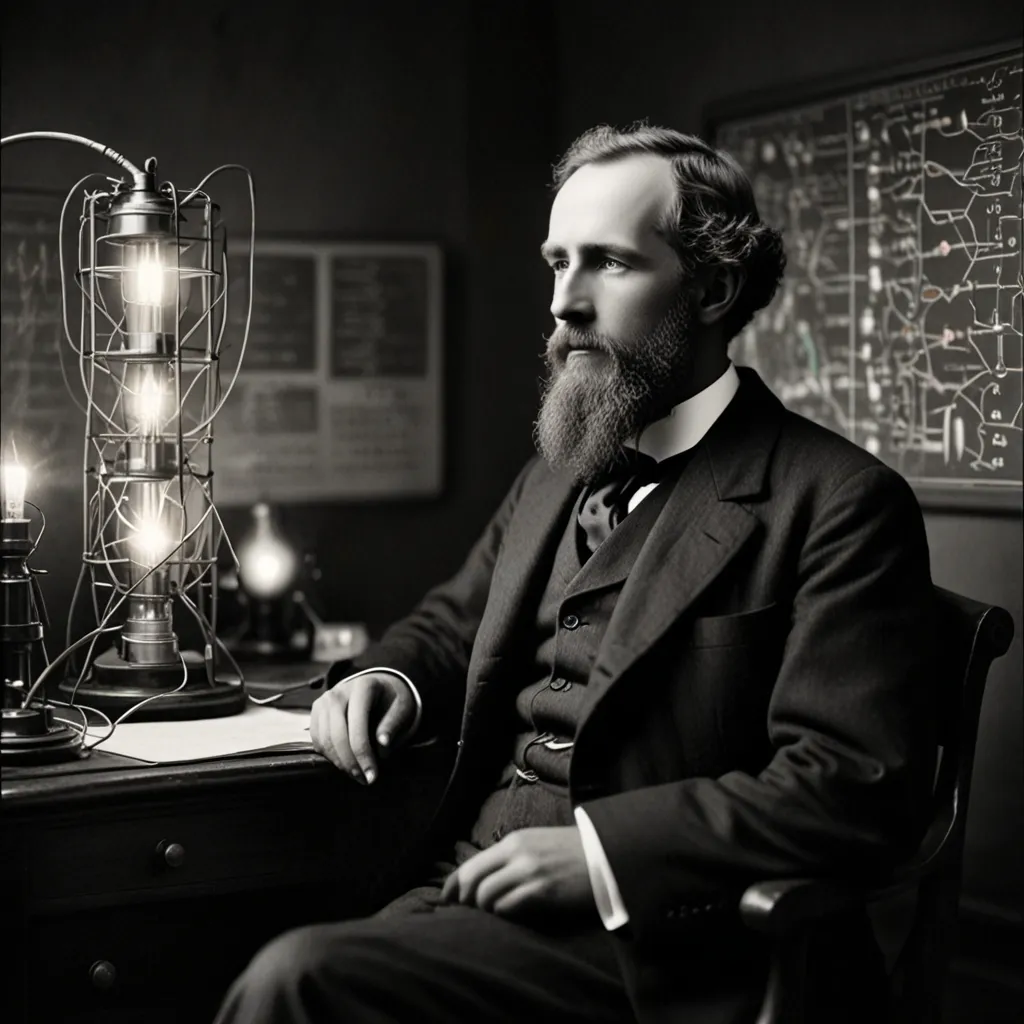
Maxwell’s equations are the unsung heroes of modern technology. From your smartphone to your refrigerator, the workings of almost all high-tech devices owe their existence to these pivotal equations formulated by Scottish physicist James Clerk Maxwell in 1865. Although not as famous as Newton or Einstein, Maxwell’s contributions are monumental, particularly his synthesis of electricity, magnetism, and light into a single theory. He demonstrated that these phenomena are different aspects of the same underlying principle.
Maxwell’s equations are daunting to look at, but don’t worry; we’re focusing on their practical implications rather than diving into the complex math. The essence of these equations tells us that static objects with a charge affect other charges, static magnets affect other magnets, and moving charges affect magnets and vice versa. At their core, Maxwell’s equations describe the relationship between electric fields, magnetic fields, and how they interact with each other.
The first equation, Gauss’s law for electricity, describes how electrical charges create electric fields. The second equation, Gauss’s law for magnetism, asserts that magnets always have two poles and magnetic field lines loop from one pole to the other. Faraday’s law, the third equation, explains how moving magnets generate electric fields, which is the principle behind electrical generators. The final equation, Ampere’s law, illustrates how electric currents create magnetic fields.
These foundational ideas paved the way for one of Maxwell’s most astonishing insights. By analyzing these equations, Maxwell posited that changing electric fields generate magnetic fields and vice versa, creating a self-sustaining wave. This wave, as it turned out, travels at the speed of light. Maxwell concluded that light itself is an electromagnetic wave—a revolutionary idea at the time.
Maxwell couldn’t experimentally prove this, but years later, Heinrich Hertz confirmed his theory, demonstrating that light is indeed an electromagnetic wave. Maxwell’s revelations set the stage for Einstein’s theory of relativity, which relied on the constancy of the speed of light, a concept rooted in Maxwell’s equations. Einstein himself acknowledged standing on Maxwell’s shoulders, underscoring the profound impact of Maxwell’s work on our understanding of the universe and the development of modern technology.
So, whether you’re watching TV, chatting on your phone, or surfing the web, remember that it’s all made possible by the incredible equations of James Clerk Maxwell—a piece of history truly worth remembering.