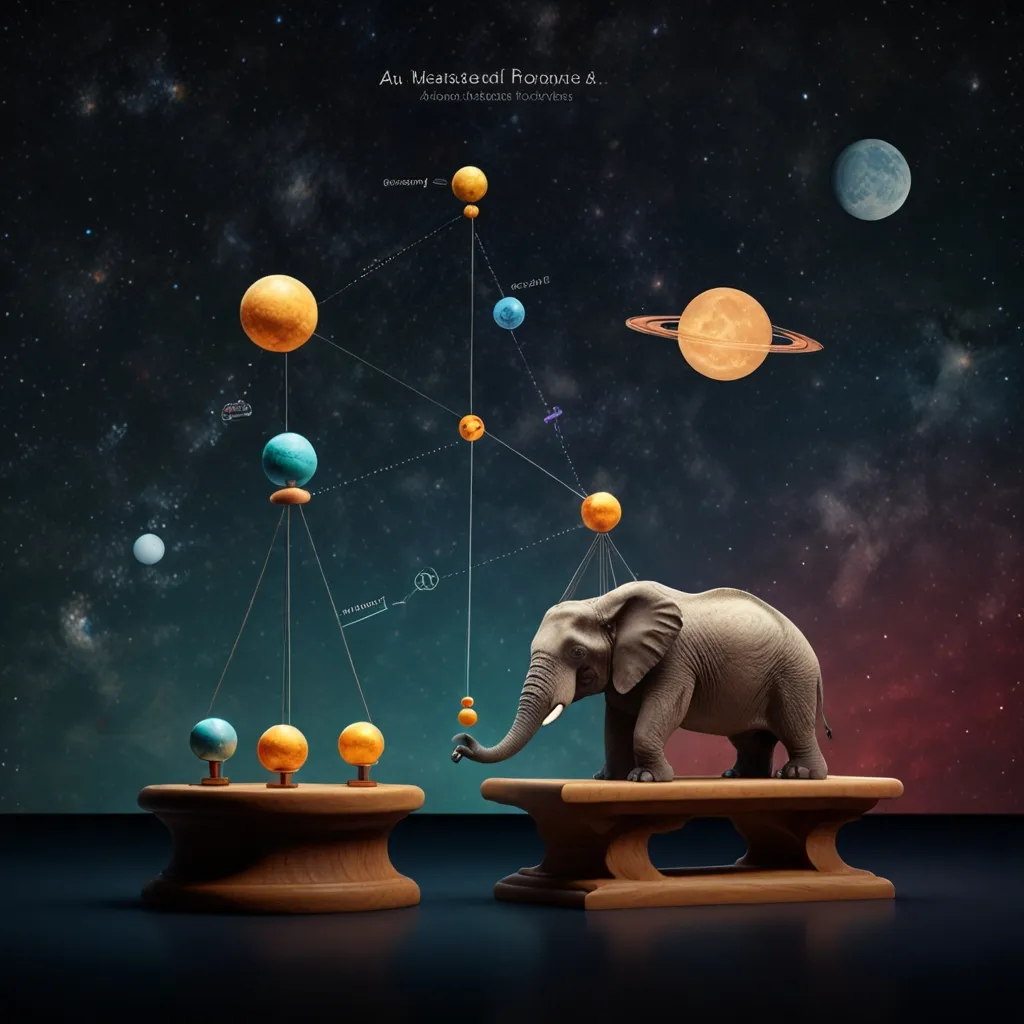
We often confuse “mass” with “weight.” For instance, you might weigh 150 pounds on Earth, whereas an elephant could weigh 12,000 pounds. But if you were on the moon, you’d weigh only about 25 pounds, and the elephant around 2,000 pounds. However, your mass wouldn’t change; it’s not your weight. Weight is the force of gravity acting on your mass.
Mass is essentially the amount of matter you’re made of. It’s a measure of your body’s resistance to motion, indicating how many atoms you’re composed of. If you broke down your body into atoms and measured them, you’d get your mass. So, where does an atom’s mass come from?
You might think the Higgs boson, or the so-called “God particle,” is responsible for this. While it contributes, the Higgs field only accounts for about 2% of the universe’s mass. The other 98%? Let’s dig deeper into the atom.
Atoms consist of a nucleus made up of protons and neutrons, with electrons zooming around it. Electrons, however, are relatively tiny, making up just 0.05% of the atom’s mass. Most of an atom’s mass, 99.95%, comes from the nucleus.
Protons and neutrons carry almost equal mass, but what’s intriguing is that if you examine a proton closely, you’ll find it comprises three smaller particles called quarks. Amazingly, the combined mass of these quarks is only about 2% of the proton’s total mass. So, where does the rest of the mass come from?
Quarks within protons and neutrons move at nearly the speed of light, around 186,000 miles per second, in incredibly tight spaces. These particles possess a lot of kinetic energy due to their rapid movement. Also, a strong force binds them together, similar to how gravity keeps planets in orbit around the Sun. This binding represents potential energy.
Einstein’s famous equation ( E = mc^2 ) (or rearranged, ( m = \frac{E}{c^2} )) tells us that mass results from energy. Thus, the mass of fundamental particles mainly comes from the kinetic and potential energy of quarks’ rapid movements and interactions. This energy manifests as mass, which gravity then acts upon to produce weight.
So, everything you see in the universe—stars, planets, comets, and even your weight—is fundamentally the energy contained within protons and neutrons. The intriguing thought is whether, in the future, we might create diets to reduce weight by cutting down on this quark energy—who knows?