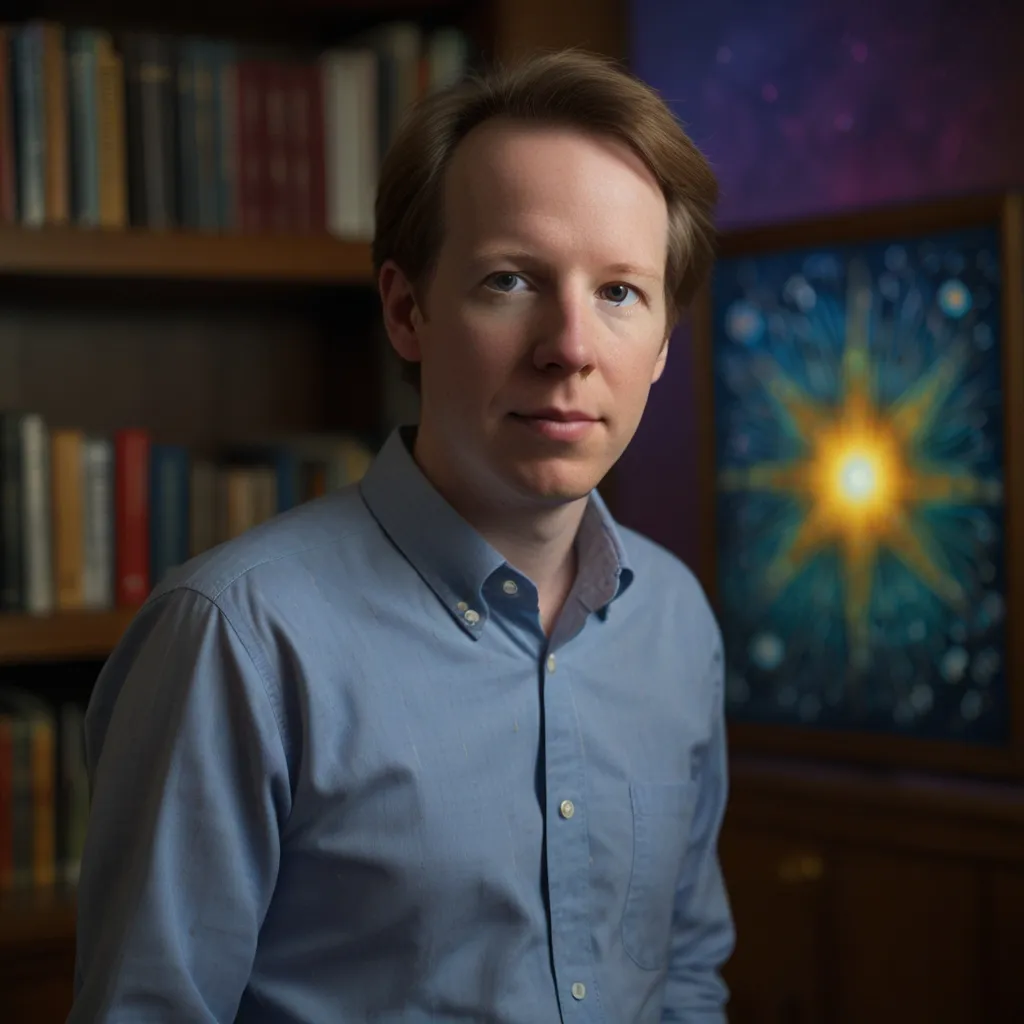
In a recent interview with Sean Carroll, one of the leading experts on the Many Worlds Interpretation (MWI) of quantum mechanics, I aimed to explore some of the most puzzling aspects of this theory. I’ve decided to make this interview available to everyone, not just my Patreon supporters, in celebration of reaching 200,000 subscribers on my channel. This milestone is humbling, and sharing this knowledge feels like the right way to acknowledge the occasion.
The interview is uncut and runs for 26 minutes. I’ve included a chart in the video description, pinpointing where Carroll addresses specific questions, so you can jump to the parts that interest you the most. Like many others, I approached this topic as a skeptic, grappling with the complexities and uncertainties surrounding MWI.
To kick things off, I confessed my admiration for Carroll, whose work I’ve followed for years. We began by delving into the foundational questions of the Many Worlds Interpretation, comparing it to the Copenhagen Interpretation. Carroll contends that Copenhagen lacks completeness, offering no clear explanation for the wave function collapse that it postulates. In contrast, he argues, MWI sticks rigorously to the Schrödinger equation, providing a more comprehensive framework that describes the behavior of physical systems and their interactions.
In MWI, wave function branching occurs when a quantum system interacts with its environment, leading to multiple parallel outcomes each existing in its own branch. Carroll clarified that this branching is an inherent outcome of the Schrödinger equation applied to quantum systems under specific conditions.
One intriguing aspect of our discussion involved the concept of probability within MWI. Carroll explained that probability, in this context, stems from our ignorance of which branch we’re in after the universe splits, rather than any fundamental randomness. This outlook aligns with Bayesian probability, where probabilities reflect our knowledge and beliefs about the system rather than true randomness.
Energy conservation in MWI also surfaced as a critical point. Carroll highlighted that while each branch maintains its own internal energy, the total energy when considering all branches of the wave function remains conserved. To our perspective within a branch, energy appears almost conserved, with minor quantum fluctuations.
We also touched upon the implications of MWI on the broader framework of string theory and the concept of a multiverse. According to Carroll, each MWI branch could potentially contain multiple pocket universes, aligning the interpretation neatly with string theory’s multiverse concept.
Our conversation pivoted to Carroll’s current research, which focuses on the emergence of space-time from quantum mechanics and the role of entanglement. Although this research is still in developmental stages, Carroll hinted at the promise it holds for advancing our understanding of gravity and the fabric of the cosmos.
Finally, Carroll shared his plans to write an undergraduate textbook on quantum mechanics, aiming to integrate foundational quantum principles with modern interpretations, encouraging a deeper grasp of the subject among future students.
This interview sheds light on the profound and often mind-bending implications of the Many Worlds Interpretation, reinforced by insights from one of the foremost physicists of our time.