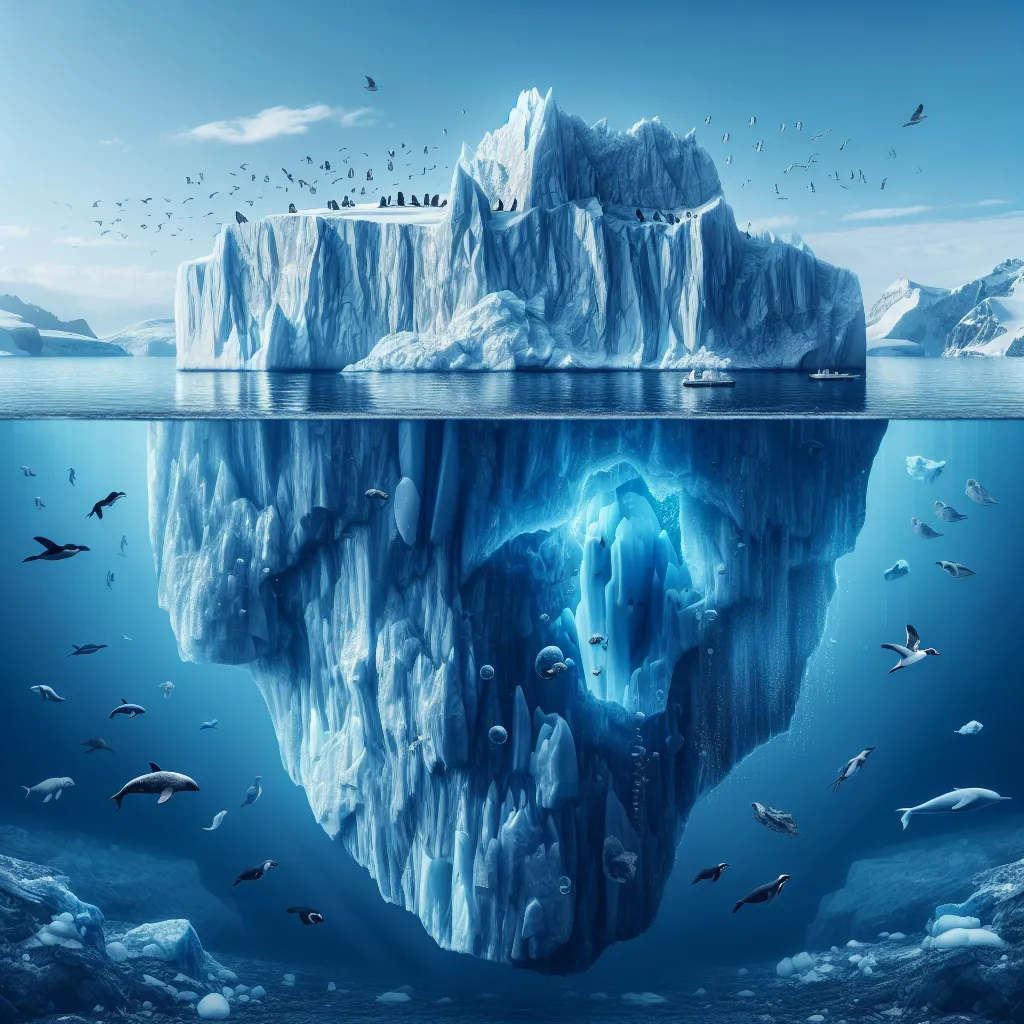
Ever heard the phrase “tip of the iceberg”? It’s one of those sayings we toss around to hint at something much bigger hiding beneath the surface. It’s not just a nifty metaphor, though—it’s grounded in cold, hard reality. Icebergs are mostly submerged underwater because pure ice is less dense than seawater. Fascinating, right? Only about 1/9 of an iceberg’s mass peeks above the water.
Icebergs have an intriguing journey that begins thousands of years before they touch the ocean. Unlike sea ice, which forms when the ocean freezes, glaciers are born from fresh water. These glaciers gradually build up, layer by layer, as they move ever so slowly, driven by gravity towards the sea. At some point, part of the glacier breaks away, becoming an iceberg or continues spreading as an ice shelf or ice tongue.
Once freed from the glacier’s grip, an iceberg lives for around three to six years. During this time, it floats, melts, bashes into land, and sometimes even crashes into other icebergs. Some icebergs meet dramatic ends, toppling over or even exploding. As they break apart, icebergs can produce all sorts of strange sounds. A unique fizzing sound, known as Bergie Seltzer, occurs when compressed air bubbles in the ice pop while melting.
Icebergs come in various shapes and sizes, classified into six categories. The smallest ones, known as growlers, are about the size of a car and can be quite hazardous for ships because they are hard to spot at the waterline. Next are the bergy bits, which can be as large as a home. The other categories include small, medium, large, and very large. To be classified as very large, an iceberg must loom at least 270 feet above sea level and stretch about 670 feet long—imagine a 27-story building made of blue ice.
Speaking of colors, did you know that an iceberg’s hue reveals its history? Blue icebergs are formed from highly compressed snow, which forces out most of the air bubbles, leaving pure ice. In contrast, white icebergs contain more air and reflect light differently.
Though they start in polar regions, icebergs can travel thousands of miles. Some Arctic icebergs have drifted as far as Bermuda. However, most Antarctic icebergs get trapped in the Circumpolar Current, preventing them from straying too far north. They do, however, sometimes disrupt shipping routes between Australia, South America, and South Africa.
Despite their icy appearance, icebergs aren’t lifeless. They actually host complex ecosystems. As icebergs melt, they create pools of fresh water that can influence the surrounding sea for miles. This colder freshwater pool generates thermal currents, affecting marine life in the area. Icefish, invertebrates like jellyfish, and tiny shrimp-like organisms called krill thrive around icebergs. Birds such as snow petrels nest on them, while whales, seals, and penguins frequently visit these floating islands.
And even with all this knowledge, remember—we’re still only scratching the surface of what there is to know about these icy giants. Perhaps someday, you’ll be the one to uncover even more of their mysteries.