What's Propelling Us Through the Cosmos at Breakneck Speeds?
Cosmic Highways and the Universal Road Trip Beyond Our Imagination
When you’re cruising down the highway at 80 km/h, you might think that’s how fast you’re moving. But let’s dive deeper. Every statement about movement requires reference points. Sitting on a train going 120 km/h? That’s your speed relative to the outside world. Inside, you feel static. This logic applies universally. You might feel still next to your device, but in reality, Earth is zipping through space at a staggering 30 km/s, faster than our rockets.
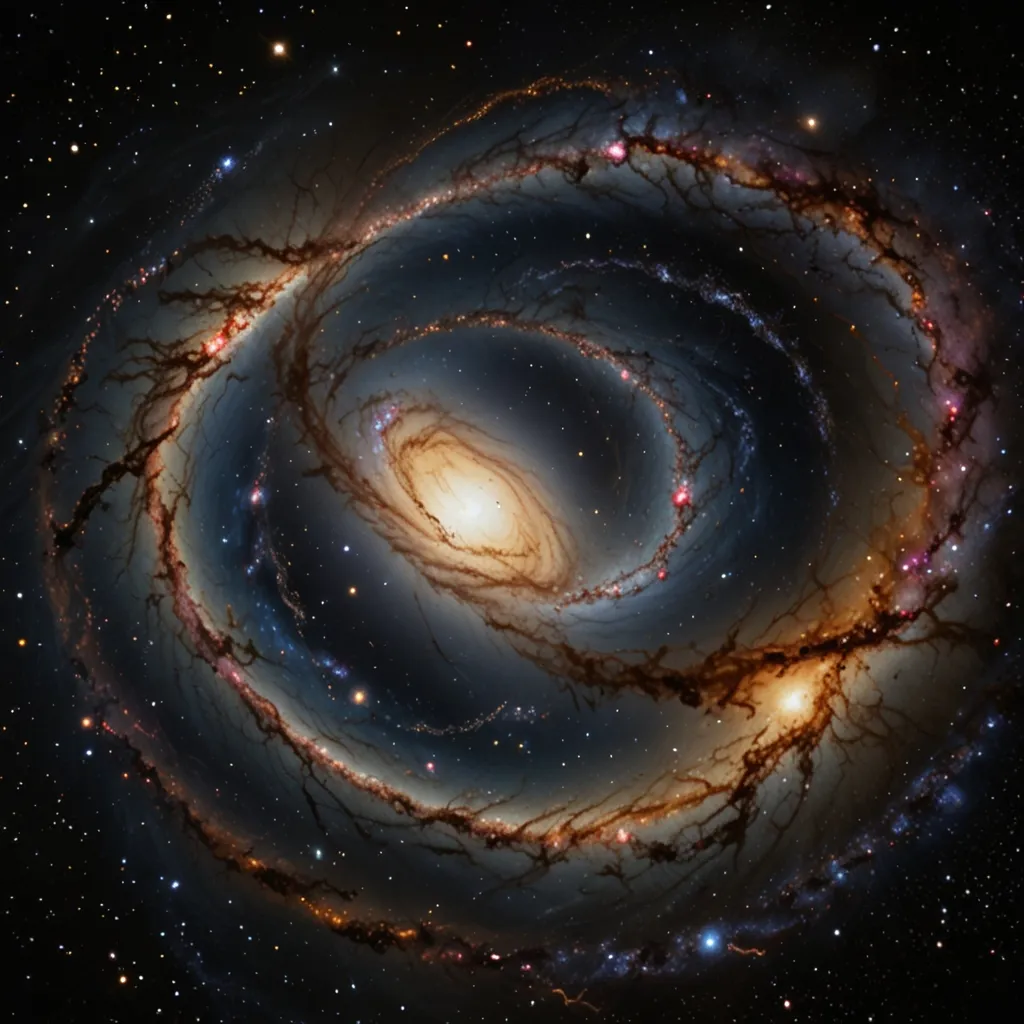
Now, Earth orbits the Sun, which is just a tiny part of the Milky Way galaxy. At the heart of our galaxy lies a supermassive black hole, around which everything, including you and I, orbits at approximately 230 km/s. But the journey doesn’t stop here. Our entire Milky Way is hurtling toward an enigmatic point known as the Great Attractor at an astonishing 600 km/s.
What exactly is the Great Attractor? It’s a colossal mass pulling entire galaxies, including ours, towards it. The gravitational pull hints at a mass over 10 million billion suns. This figure, derived using Newton’s law of universal gravitation, explains why galaxies move towards it with such intensity. The mystery deepened with the discovery that more than 400 galaxies were moving toward this same point.
The more recent revelation involves the cosmic microwave background (CMB), the universe’s leftover radiation from the Big Bang. Our movement through space affects the CMB, causing a Doppler effect similar to how an ambulance changes pitch as it passes by. This movement creates a dipole effect in the CMB, indicating our direction and speed.
Despite knowing our direction, our view towards the Great Attractor is obscured by the Milky Way’s stars and interstellar dust, a problem only solvable with technologies like X-ray detection. These emissions reveal the presence of the Norma cluster at the center of the Great Attractor. However, while the Norma cluster is significant, it doesn’t fully account for our velocity.
The search for more gravitational influences led to the discovery of the Shapley Supercluster, an enormous mass 650 million light years away. This supercluster has about ten times the mass of the Great Attractor and is a focal point of our journey. Another piece of the cosmic puzzle is the Vela Supercluster, contributing to our velocity as well.
Despite this vast gravitational dance, the universe’s expansion, fueled by mysterious dark energy, ensures we’ll never reach these destinations. Dark energy, making up 69% of the universe, accelerates the rate of cosmic expansion, meaning spacetime itself stretches faster than our movement towards these gravitational giants.
Locally, galaxies like ours might still collide and merge, such as the anticipated collision with the Andromeda galaxy in about 5 billion years. On grander scales, however, dark energy keeps galaxies moving apart. This massive, uniform expansion faces a curiosity known as “Dark Flow,” a term describing certain galaxies’ unexpected directional movement.
Although it’s intriguing, this doesn’t pose any real threat to Earth or humanity. These cosmic movements are too slow and far-removed to affect us directly. So, while the universe’s mysteries are vast and complex, they won’t disrupt our daily lives anytime soon. Feel free to ponder the universe’s wonders, but rest assured, nothing’s tearing apart in the near future.