5 Famous Treaties That Backfired and Still Shape Our World Today
Discover 5 historic treaties that backfired catastrophically — from Versailles to Munich. Learn what went wrong and why the consequences still shape our world today.
There is something almost poetic about the way history rhymes. Wars end, exhausted men sit around tables, and they write agreements meant to last forever. But some of those agreements were ticking clocks from the moment the ink dried. Let me walk you through five treaties that did not just fail — they made things actively worse, and in ways we still feel today.
Start with the most famous one. The Treaty of Versailles, signed in 1919, was supposed to close the books on World War I. The winners — Britain, France, and the United States — sat down and decided what Germany owed the world. The answer was: everything. Germany had to accept full blame for the war, pay enormous reparations, surrender territory, and shrink its military to almost nothing.
Now here is what the history books sometimes gloss over. The reparations figure was not set immediately in the treaty itself. The final bill came later, in 1921, at 132 billion gold marks. To put that in perspective, Germany only finished paying off that debt in 2010. Not a typo. 2010.
“The Council of Four paid no attention to these issues, being preoccupied with others — Clemenceau to crush the economic life of his enemy, Lloyd George to do a deal and bring home something that would pass muster for a week, the President to do nothing that was not just and right.” — John Maynard Keynes, The Economic Consequences of the Peace
What did that humiliation produce? An economy in ruins, a middle class wiped out by hyperinflation, and a population desperate enough to listen to anyone who promised to restore national pride. Adolf Hitler was not created by Versailles alone, but Versailles handed him a script and an audience.
The negotiators were not stupid people. They simply chose punishment over the harder work of building something stable. Think about that the next time you see a peace negotiation covered on the news. The question worth asking is not just “did they agree?” but “did the terms leave the losing side any reason to cooperate?”
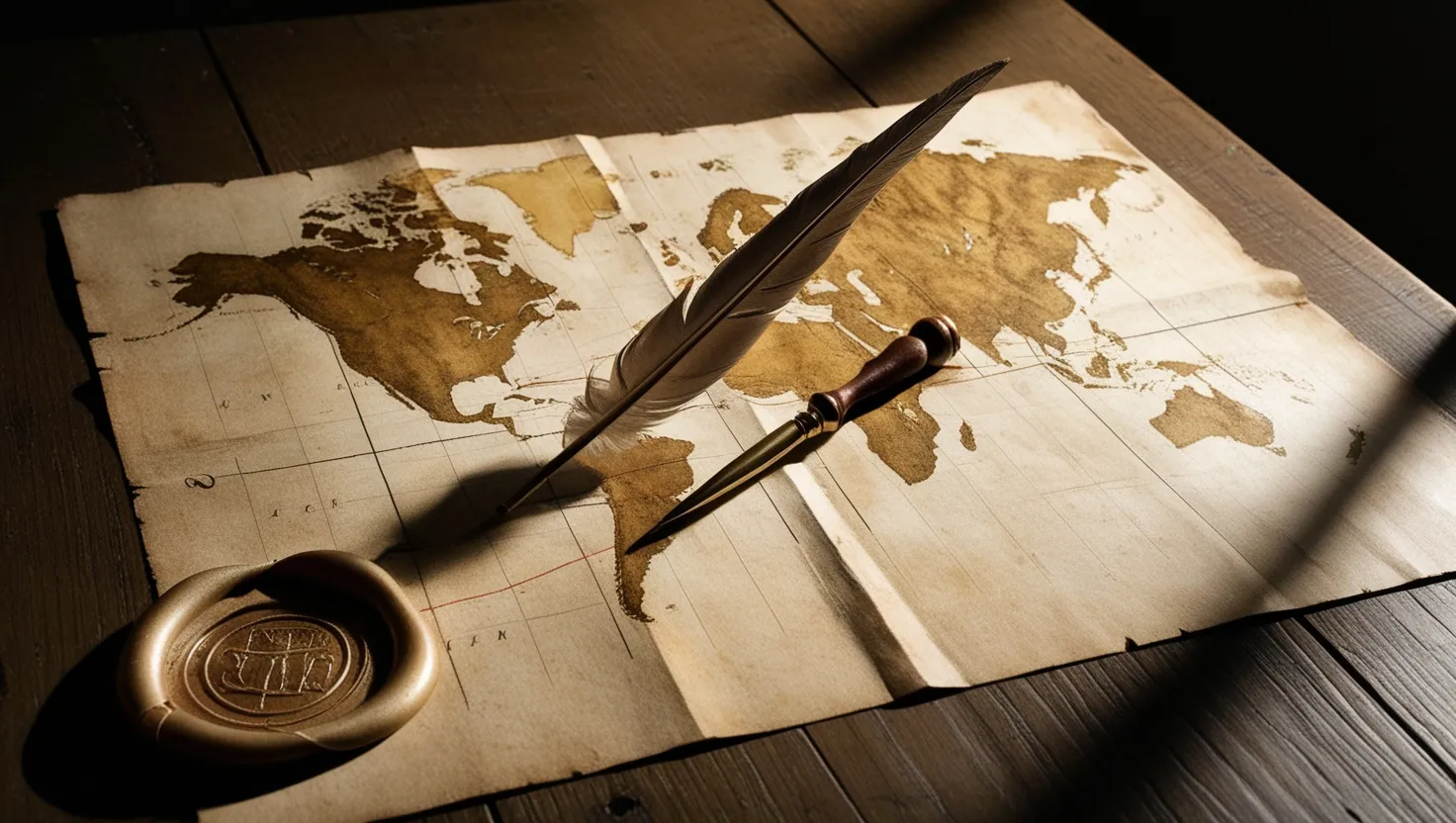
Here is one most people have not heard of: the Sykes-Picot Agreement. It was not even a peace treaty. It was a secret deal made in 1916, in the middle of World War I, between a British diplomat named Mark Sykes and a French one named François Georges-Picot. They sat with a map of the Middle East and drew lines — lines that divided up land they did not own, full of people they had never met.
Those lines created Iraq. They created Syria. They created the general shape of the modern Middle East. And they did it by cutting straight through tribal territories, splitting religious communities, and bundling groups together who had little reason to share a country. The Kurds, for instance, were promised a homeland in the 1920 Treaty of Sèvres — and then that promise was quietly abandoned three years later when the Treaty of Lausanne redrew everything again.
Do you ever wonder why the Middle East seems so perpetually fractured? This is a big part of the answer. The borders are not natural. They are lines drawn by men in suits, thousands of miles away, who treated human geography like a geometry problem.
“The settlement of 1919–22 was built on sand — on promises that could not be kept and on the wreckage of empires that nobody knew how to replace.” — David Fromkin, A Peace to End All Peace
Moving across the Atlantic, the Treaty of Guadalupe Hidalgo in 1848 ended the Mexican-American War. Mexico, having lost, handed over roughly half its territory — what is now California, Arizona, New Mexico, Nevada, Utah, and parts of Colorado and Wyoming. In exchange, the United States paid fifteen million dollars and made a set of very specific promises to the Mexican citizens living in those lands.
The promises included protection of property rights, religious freedom, and cultural autonomy. On paper, those terms were reasonable. In practice, they were almost entirely ignored. Mexican landowners found themselves fighting expensive legal battles they could not win, conducted in a language many of them did not speak, before judges with obvious interests in the outcome. Entire communities were dispossessed within a generation.
The reason this matters today is that the American Southwest’s complicated feelings about immigration, language policy, and cultural identity are not random. They have a paper trail that leads back to 1848 and a treaty that was honored in signing and abandoned in execution.
Now for a treaty that failed so completely it ceased to exist. The Treaty of Sèvres, signed in 1920, was the plan for what would remain of the Ottoman Empire after World War I. The plan was brutal. Greece would get large chunks of Anatolia. Armenia would get a substantial state. Kurdish territory would be set aside. Turkey would be left as a small, landlocked remnant.
The problem was that nobody asked whether the people being carved up would accept it. They did not. Mustafa Kemal organized a nationalist army and fought a new war — the Turkish War of Independence — and simply reversed the treaty by force. By 1923, Sèvres was replaced by Lausanne, and modern Turkey’s borders were set. The Armenian and Kurdish questions, which Sèvres had at least acknowledged, were quietly dropped.
The lesson here is not complicated. A treaty that exists only on paper, with no connection to the actual balance of power on the ground, is not a treaty. It is a wish. And wishes made by exhausted diplomats in Paris do not tend to survive contact with reality.
“Treaties are like roses and young girls — they last while they last.” — Charles de Gaulle
And then there is Munich. The Munich Agreement of 1938 is perhaps the clearest example of a treaty made to buy time that instead accelerated disaster. Britain and France agreed to allow Nazi Germany to annex the Sudetenland, a German-speaking region of Czechoslovakia. Czechoslovakia was not invited to the meeting that decided its fate.
British Prime Minister Neville Chamberlain came home waving a piece of paper and declared “peace for our time.” Six months later, Hitler took the rest of Czechoslovakia. A year after that, Germany invaded Poland and World War II began.
What makes Munich different from the others on this list is that the flaw was not ambiguous language or ignored promises. The flaw was the decision itself. The negotiators knew who Hitler was. They chose to believe that one more concession would satisfy him. It did not. It convinced him that the democracies were too afraid to fight.
Munich gave the English language a new political term — appeasement — which now carries an almost universally negative meaning. Every time a government debates whether to impose sanctions, supply weapons to an ally, or draw a red line somewhere, someone invokes Munich. Sometimes that comparison is overused. But the core question it raises is permanent: does accommodating an aggressor buy peace or purchase more aggression?
What connects all five of these agreements? None of them treated the people most affected as real participants in the outcome. Versailles humiliated Germany without giving it a path back to dignity. Sykes-Picot drew borders without asking the people inside them. Guadalupe Hidalgo made promises to Mexican communities and then failed to enforce them. Sèvres imposed terms on a population that refused to accept them. Munich sacrificed a country that was not at the table.
Peace, it turns out, is not an event. It is not the moment when signatures appear on a document. It is what happens in the years and decades after, when the terms either take root or begin to rot. A treaty with no mechanism for adjustment, no genuine buy-in from all parties, and no honest accounting of who lives with the consequences — that is not peace. That is just a delay.
“You can no more win a war than you can win an earthquake.” — Jeanette Rankin
The next time you hear about a peace deal being signed somewhere, ask one simple question: who was not in the room? Because history has a reliable habit of giving those absent people the loudest voices later.