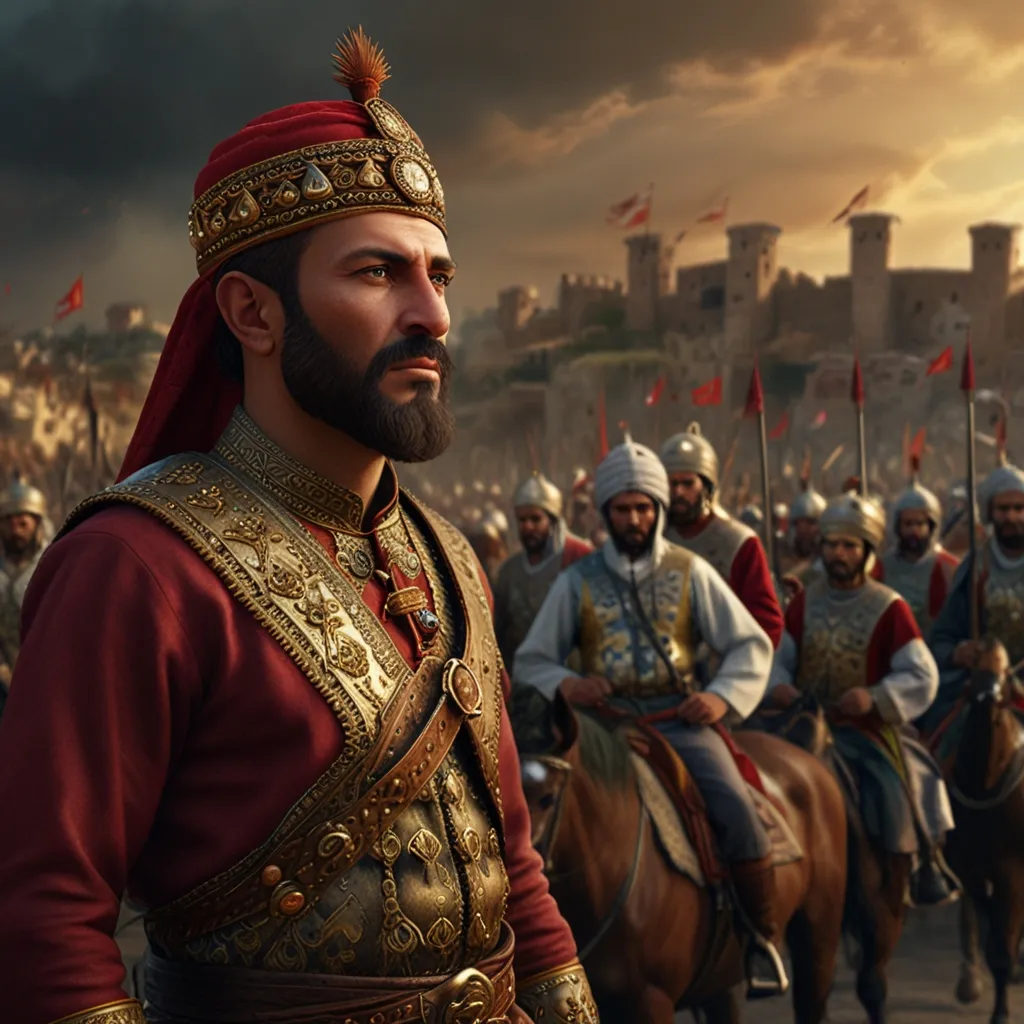
The Ottoman Empire, one of the most powerful and enduring empires in history, was founded by Osman I in the early fourteenth century. Osman I, also known as Osman Bey, was a Turkish tribal leader who emerged as the military head of the Turkoman tribes in Anatolia. He led successful campaigns against the Byzantine Empire and consolidated his power by 1299, marking the beginning of the Ottoman State.
Osman I’s origins trace back to the Kayı tribe, a group of Turkmen Oğuz nomads who migrated from Central Asia. These nomads had previously established the Seljuq dynasty in Iran and Mesopotamia and had occupied parts of Anatolia after the Battle of Manzikert in 1071. Osman I’s ancestors were part of this migration, and he continued their legacy by expanding Ottoman dominion.
The early stages of the Ottoman Empire were characterized by continuous territorial expansion. The Ottomans were known as ghazis, or raiders, who fought against the shrinking Christian Byzantine state. This period saw the amalgamation of political, economic, and social institutions from classical Islamic empires, Byzantium, and the great Turkish empires of Central Asia. These institutions were reestablished in new forms that would shape the region for centuries to come.
One of the most significant events in the early history of the Ottoman Empire was the conquest of Constantinople in 1453 by Mehmed II. This conquest marked the end of the Byzantine Empire and solidified the Ottoman Empire’s position as a major power. Mehmed II’s reign also saw the establishment of the Janissaries, an elite fighting force composed of young male Christian slaves taken from wars in the Balkans. These troops were raised in the Islamic faith and became key administrators and military personnel for the sultan.
The Ottoman Empire reached its zenith during the reign of Suleyman the Magnificent in the sixteenth century. Suleyman’s rule extended from Hungary in Europe to Iran in the East, through the Middle East to Egypt and Algeria. This period was marked by significant cultural and intellectual achievements, including the development of a refined literary and artistic culture. The Ottomans were known for their love of books and learning, with extensive studies revealing the widely read works of the time. The Quran was one of the most widely read books, and many Ottomans memorized it from beginning to end.
The empire’s military prowess was also a key factor in its expansion. The Ottomans were one of the first gunpowder empires, using new weapons like the harquebus to great effect. Their military campaigns extended across three continents, making the Ottoman Empire one of the largest and most long-lasting empires in world history.
Despite its grandeur, the Ottoman Empire faced significant challenges and internal problems. The Tanzimat reforms, initiated in the nineteenth century, aimed to modernize the empire and address its internal issues. However, these reforms were not enough to stem the decline of the empire. The Ottoman Empire officially came to an end in 1922, when the title of Ottoman Sultan was eliminated. The modern state of Turkey was declared a republic on October 29, 1923, marking the end of an era that had spanned over six centuries.
The legacy of the Ottoman Empire continues to influence the modern world. Its cultural achievements, military innovations, and political institutions have left a lasting impact on the regions it once ruled. The story of the Ottoman Empire is a testament to the power of vision, leadership, and the enduring spirit of a people who shaped history.