Imagine holding a tiny bone fragment from a saint in your hand. It feels ordinary, like any old rock, but for millions of believers, it’s a direct line to heaven. That’s the magic of sacred objects in religions. They take everyday stuff—wood, metal, cloth—and turn it into a bridge between our messy world and something bigger. Let’s walk through seven of them, one by one. I’ll share stories you probably haven’t heard, and ask you questions along the way to make you think. Ready? Let’s go.
Start with Christian relics. These aren’t just souvenirs. Picture a splinter said to be from the True Cross, the wood Jesus died on. Kept in gold boxes called reliquaries, they’re kissed, prayed to, and carried in parades. But here’s a lesser-known twist: in medieval Europe, some relics were fakes sold by con artists. Kings bought “saint’s blood” that was pig’s blood boiled to clot. Why did people fall for it? Because touching the relic made God’s power feel real, right there in your fingers. It healed the sick or promised miracles. Have you ever touched something that made you feel closer to a lost loved one? Relics do that for the divine.
“The relic is not worshipped for itself, but for the saint it contains.” — St. Jerome, early church father.
What if a bone could whisper prayers for you? In quiet cathedrals, pilgrims still line up for this. It’s not about magic; it’s about making heaven touch earth. Think of it as God’s phone booth.
Now, shift to the Jewish mezuzah. This little case goes on your doorpost. Inside? A scrap of parchment with verses from the Torah, handwritten by a scribe. Every time you walk through the door, you touch it and kiss your fingers. Simple, right? But dig deeper: during the Holocaust, Jews hid mezuzot in walls of camps. They became secret signs of survival, marking hidden holy spaces amid horror. Unconventional angle—it’s not just for homes. Soldiers carry mini ones into battle as shields. Does your front door remind you of anything bigger than mail? The mezuzah turns entering your house into a holy step.
Touch it daily. Feel the words seep into your skin. It’s faith you carry without thinking.
Ever wonder why beads calm your mind? Enter Islamic prayer beads, called Misbaha or Tasbih. Thirty-three beads, sometimes ninety-nine for Allah’s names. You roll them between fingers while saying “Subhanallah”—God is perfect. Lesser-known fact: in Sufi traditions, these beads trace back to desert nomads who used camel knotted ropes before beads existed. Spinning them isn’t rote; it’s body prayer. Your hands move, heart quiets, tongue praises. In crowded mosques, the click-clack sound blends into one rhythm. What everyday motion could you turn into worship? Like stirring tea mindfully?
“The misbaha is a rope that ties the servant to his Lord.” — Imam Al-Ghazali.
I urge you: grab some beads today. Count breaths instead of prayers. See how your body joins your soul.
In Hinduism, meet the murti. These are statues of gods like Krishna or Shiva, but not idols. Priests “awaken” them with oils, flowers, even food offerings. The god lives inside. Strange perspective: some temples treat murtis like babies—rocked to sleep, bathed at dawn. In South India, they’re paraded on elephant shoulders during festivals. Forgot to mention: blind devotees “see” the divine through touch alone, tracing the statue’s curves. It meets humans where we are—needing eyes, hands, smells to love what’s invisible. Can you love something without seeing it fully? Murtis say yes, pour your devotion into form.
Picture dressing God in silk each morning. Your hands make the eternal real.
Spin this way for the Buddhist prayer wheel. A cylinder stuffed with millions of mantras on paper scrolls. Turn it clockwise, and it’s like chanting each one aloud. High in Tibetan mountains, giant wheels powered by water streams pray 24/7. Hidden gem: nomads tie wheels to yaks’ tails—the animal’s walk sends blessings everywhere. Each spin spreads compassion, merit for all beings. Body moves, karma shifts. Ever tried walking prayers? What if your daily stroll released good vibes for strangers?
“One turn of the wheel equals reading the mantra seven times.” — Padmasambhava, founder of Tibetan Buddhism.
Go on, find a wheel or make one from a bottle. Spin it. Feel prayers fly free.
Strap on a Sikh Kirpan. One of five K’s every baptized Sikh wears: a small dagger, no longer than a hand. Not for violence—it’s for justice. Defend the weak, cut oppression. Uncommon view: women carry them too, under saris. During India’s Partition riots, Kirpans saved lives, slicing through mobs to rescue families. Steel reminds you: be a saint-soldier. Peace with a edge. Does carrying a tool change how you stand up for right? The Kirpan says carry your principles sharp.
“The Kirpan is the sword of spirituality, cutting ignorance.” — Guru Gobind Singh.
Wear something symbolic tomorrow. A bracelet, a pin. Let it nudge your courage.
Finally, Native American medicine bundles. Personal pouches of feathers, stones, sage—gathered in visions or ceremonies. Each item holds a story: eagle feather for vision, bear claw for strength. Lesser-known: some bundles are “alive,” fed tobacco offerings like pets. Passed down generations, they heal or guide hunts. In urban apartments today, they’re tucked in drawers but opened for big decisions. They tie you to ancestors, land spirits. Portable power. What’s in your pocket that connects you to your roots?
“The bundle is a living prayer, holding the breath of the people.” — Black Elk, Lakota holy man.
Open your hands. What small things could you bundle into your own sacred kit?
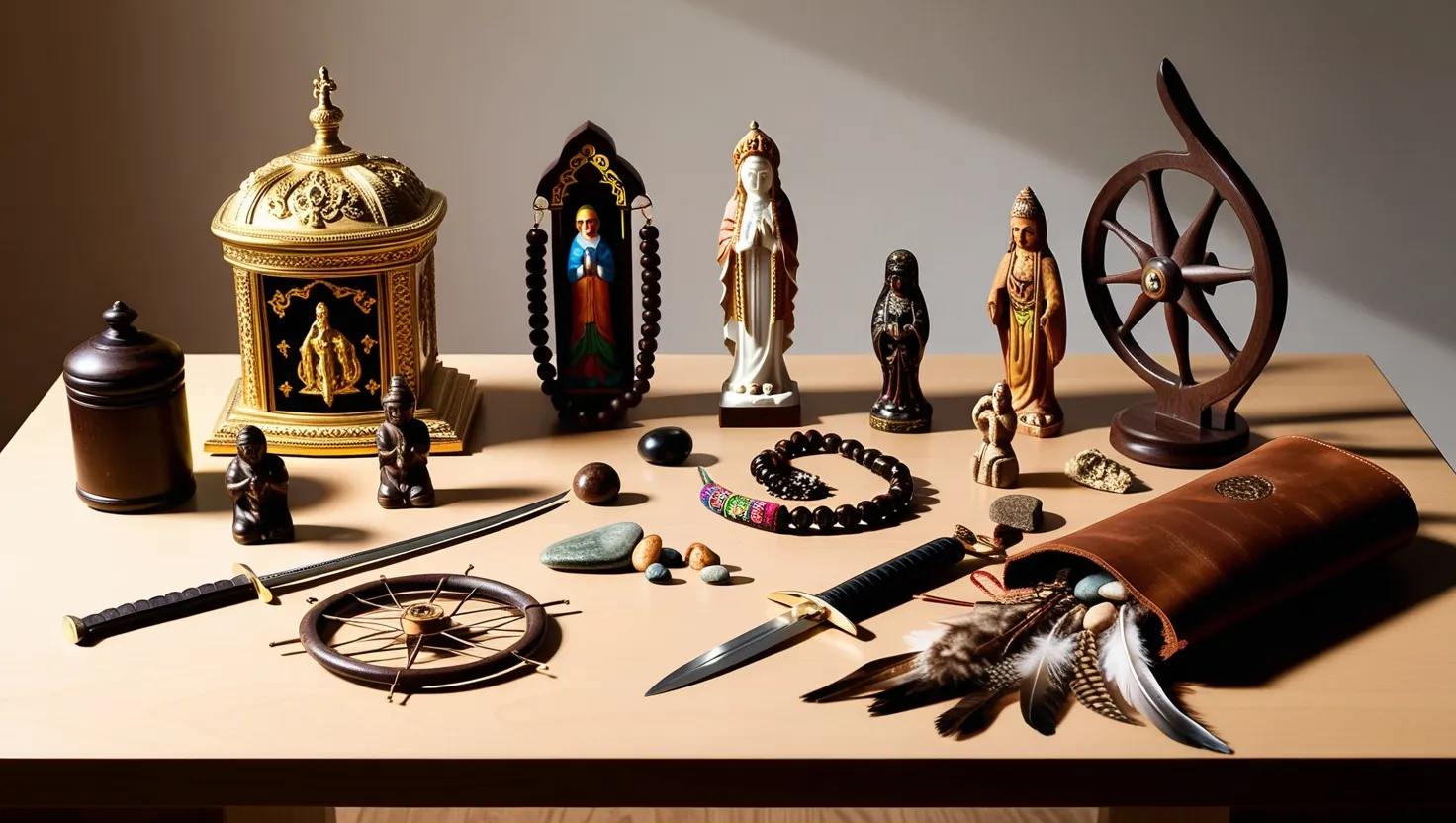
These seven objects—bones, scrolls, beads, statues, wheels, swords, pouches—show religions aren’t floating ideas. They’re things you hold. Why? Humans need touch. We forget spirits without skin. In Christianity, relics prove saints stick around. Mezuzot make homes holy thresholds. Beads train wandering minds. Murtis give gods faces to hug. Wheels let lazy arms pray endlessly. Kirpans arm ideals. Bundles pack worlds.
But let’s flip it: what if these objects choose us? Stories whisper of relics glowing, beads breaking at death, bundles humming in dreams. Ever had an object “speak” to you? A childhood toy or family ring? Religions amplify that.
Think ancient roots. Early humans carved stones to trap spirits. Today, it’s the same—material anchors the divine. Unconventional take: science nods too. Studies show touching prayer tools calms brain waves, like meditation apps but older.
Question for you: pick one object here. How would carrying it change your week? Touch a doorpost like a mezuzah. Spin a mental wheel. Feel the bridge form.
Religions bridge worlds this way. Spiritual isn’t “out there.” It’s in your palm. Matter gets holy when you pour meaning in. Grace through grit. Divinity in dirt.
I’ve shared lesser-known bits—like Holocaust mezuzot or yak-powered wheels—to show these aren’t museum pieces. They’re alive, adapting. In a digital age, we swipe screens for zen. But fingers on beads? That’s primal power.
“God is in the details.” — Ludwig Mies van der Rohe, architect who saw sacred in craft. (Though not religious, it fits.)
Urge yourself: find a sacred thing. Relic, bead, stone. Hold it. Let it hold you back. The gap between here and holy shrinks.
What happens next? Pilgrims still flock. Sikhs sharpen Kirpans yearly. Bundles get new feathers. These objects endure because they work. They make God, Dharma, Torah, Allah feel near. Not distant thunder—warm breath on skin.
Imagine a world without them. Prayers float away. Faith turns heady fog. But with objects? Solid. Yours.
So, touch more. Turn more. Carry more. Bridge your worlds. What’s stopping you?
(Word count: 1523)